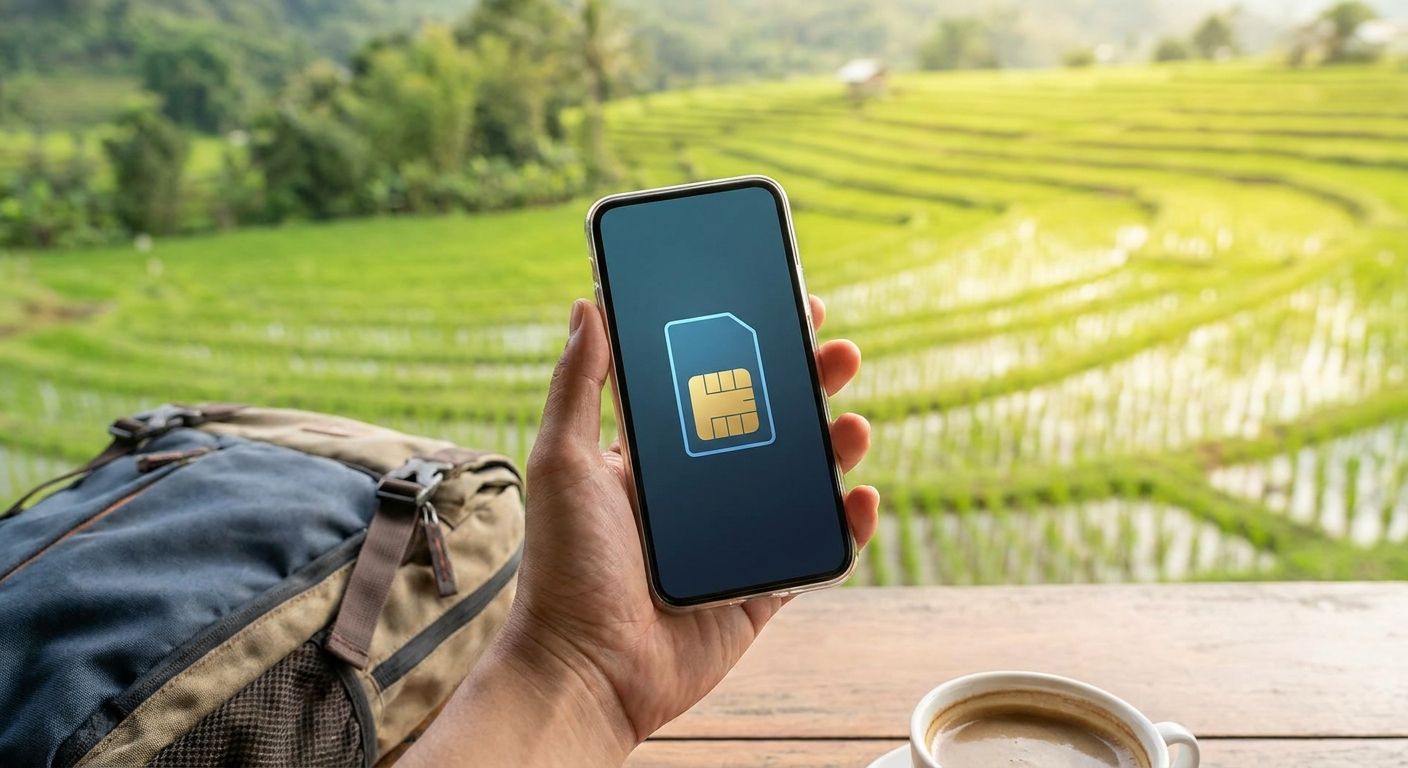
Southeast Asia in 2026 means crossing borders fast — Bangkok to Hanoi to Bali in a two-week trip — and swapping a physical SIM at every stop wastes time you don't have. This guide ranks the eSIM options that actually handle a multi-country Southeast Asia itinerary versus the ones built for a single destination.
- A-sim wins the best esim for southeast asia pick for one-tap regional install and in-app top-up across multiple countries.
- Airalo is the right call if your entire trip stays inside one country.
- Holafly suits travelers who want continuous data without checking a usage meter.
- Nomad and Saily fit people who like managing every eSIM decision from a companion app.
- GigSky is built for business itineraries spanning multiple regions, not a single Southeast Asia trip.
Why this matters
Southeast Asia is generally counted as 11 countries — Thailand, Vietnam, Indonesia, Malaysia, Singapore, the Philippines, Cambodia, Laos, Myanmar, Brunei and Timor-Leste. A traveler hitting three or four of them on one trip needs a plan that doesn't require reinstalling a new profile at every border in 2026.
That's the gap between a regional eSIM and a single-country one, and it's the difference this list is built around. If your trip stretches past Southeast Asia into other continents, the broader international eSIM roundup covers plans built for hopping regions rather than staying inside one.
Best overall for Southeast Asia: A-sim, for one-tap regional install and in-app usage control. Best for single-country flexibility: Airalo. Best for simple continuous data: Holafly. Best for app-based plan management: Nomad. Best for travelers already inside the Nord ecosystem: Saily. Best for multi-region business travel: GigSky.
What makes the best eSIM for Southeast Asia
- Regional coverage across multiple Southeast Asia countries without swapping profiles
- One-tap install from an app or website, no physical SIM store visit
- In-app usage tracking and top-up while you're already traveling
- Compatibility across eSIM-capable iPhone and Android models
- Flexibility to pick a regional plan or a single-country one depending on the itinerary
- A straightforward path to top up mid-trip if data runs low
Southeast Asia eSIMs at a glance
| Provider | Best for | Standout feature | Key limitation |
|---|---|---|---|
| A-sim | Multi-country Southeast Asia trips | One-tap regional install, in-app top-up | Trades some country-specific pricing granularity for regional convenience |
| Airalo | Single-country trips | Country-by-country plan catalog | Requires a new plan at every border |
| Holafly | Simple continuous data | Always-on plan structure, no usage meter | Less granular control for active data management |
| Nomad | App-based plan management | Browse and switch plans inside one app | Regional Southeast Asia bundle depth varies |
| Saily | Existing Nord ecosystem users | Shared account with other Nord Security apps | No Southeast Asia-specific advantage over competitors |
| GigSky | Multi-region business travel | Plans built around enterprise itineraries | Overkill for a single Southeast Asia holiday |
1. A-sim: best esim for southeast asia regional coverage
A-sim runs on a regional plan built to cover multiple Southeast Asia destinations under one profile, installed from the app or the website with a single tap and no physical SIM swap between countries.
A-sim pros:
- Regional plan spans multiple Southeast Asia countries under one install
- Activation through the app or the website, live on iPhone and Android
- Usage tracking and top-ups managed inside the app, no carrier counter visit
- Single-country plans are also available if you want to isolate one destination
A-sim cons:
- Regional convenience trades against per-country pricing structures some travelers prefer for a one-city trip
- Still requires an eSIM-capable, carrier-unlocked phone, same requirement as every option on this list
Best for: travelers crossing two or more Southeast Asia countries on one trip. Verdict: Buy.
Get your Southeast Asia eSIM
Install in one tap and manage usage or top-up from the app.
2. Airalo: best for single-country flexibility
Airalo sells country-specific eSIM plans market by market, so a Thailand-only trip gets a Thailand-only profile instead of a bundled region.
Airalo pros:
- Single-country plans exist for each major Southeast Asia destination
- Broad published device compatibility list
- App-based browsing before you commit to a plan
Airalo cons:
- Country-hopping means installing a new plan at every border
- No regional bundle for travelers covering three or four countries back to back
Best for: a trip confined to one Southeast Asia country. Verdict: Hold — fine for single-country trips, less efficient for multi-stop itineraries.
3. Holafly: best for simple continuous data
Holafly's positioning centers on straightforward, always-on data plans rather than tiered gigabyte buckets, aimed at travelers who don't want to track a usage meter mid-trip.
Holafly pros:
- Simple plan structure without checking remaining data
- Country and regional options across popular Southeast Asia destinations
Holafly cons:
- Less granular control for travelers who want to actively manage usage in-app
- Regional Southeast Asia bundles are narrower than some competitors' single-country lists
Best for: travelers who want to set the plan once and stop thinking about it. Verdict: Hold.
4. Nomad: best for app-based plan management
Nomad runs its eSIM business through a dedicated app where you browse, buy and monitor plans by country or region.
Nomad pros:
- App-first experience for browsing and switching plans
- Coverage across individual Southeast Asia countries
Nomad cons:
- Regional Southeast Asia bundle depth varies compared to its single-country depth
- No website-only install path
Best for: travelers who prefer doing everything inside one app screen. Verdict: Hold.
5. Saily: best for existing Nord ecosystem users
Saily comes from Nord Security, the company behind NordVPN, and pitches itself to travelers who already use its other apps.
Saily pros:
- Familiar account system for existing Nord Security users
- Country and regional eSIM options available
Saily cons:
- Newer entrant to the travel eSIM category compared to the rest of this list
- No particular Southeast Asia-specific advantage over competitors
Best for: current NordVPN subscribers who want one account across tools. Verdict: Wait — fine if you're already in the ecosystem, not a reason to switch on its own.
6. GigSky: best for multi-region business travel
GigSky targets business travelers and enterprises with plans built around multi-region work itineraries rather than single leisure trips.
GigSky pros:
- Multi-region plan structures aimed at business travel patterns
- Longstanding presence in enterprise travel connectivity
GigSky cons:
- Consumer-facing app experience is less streamlined than app-first competitors
- Overkill for a single two-week Southeast Asia holiday
Best for: business travelers whose itineraries span multiple regions, not just Southeast Asia. Verdict: Wait — worth it only if your itinerary genuinely goes beyond Southeast Asia.
How we ranked
Each provider was measured against the same six criteria: regional coverage, install simplicity, in-app usage control, device compatibility, single-country flexibility, and how easy top-up is once you're already traveling. A-sim leads on the combination of regional coverage and in-app control; the rest trade one criterion for another depending on trip shape.
Which eSIM should you choose for Southeast Asia in 2026?
If your itinerary crosses two or more of Southeast Asia's 11 countries, A-sim's regional plan removes the reinstall step at every border. Staying in one country the whole trip makes Airalo's single-country catalog the more efficient pick. Want to stop thinking about usage entirely — Holafly. Already inside the Nord ecosystem or running a multi-region business trip — Saily and GigSky respectively fit those narrower cases.
FAQ
What's the best eSIM for Southeast Asia in 2026?
A-sim is the best esim for southeast asia in 2026 for travelers visiting more than one country on a single regional plan with in-app top-up. Airalo suits a trip staying inside one country the whole time.
Is a regional eSIM better than buying a separate eSIM per country?
A regional plan avoids reinstalling a new profile at every border, which matters if your Southeast Asia trip covers Thailand, Vietnam and Indonesia in one itinerary. A single-country plan can be simpler if you're only visiting one destination.
Does an eSIM work on any iPhone or Android phone?
No — the phone must be eSIM-capable and carrier-unlocked, a requirement across every provider on this list in 2026. Older or carrier-locked devices can't activate any of these plans.
Can I top up an eSIM while traveling in Southeast Asia?
Yes, providers like A-sim manage top-ups directly inside the app, so you don't need a local SIM shop. Confirm the option inside each provider's app before you depart.
How many countries make up Southeast Asia?
Southeast Asia is generally counted as 11 countries, including Thailand, Vietnam, Indonesia, Malaysia, Singapore and the Philippines. A regional eSIM plan built for the area typically targets this group of destinations.
Is Holafly or A-sim better for Southeast Asia?
Holafly focuses on simple, continuous data plans, while A-sim pairs regional Southeast Asia coverage with in-app usage tracking and top-up. The better pick depends on whether you want to actively manage data or not think about it at all.
Do I need a physical SIM card as backup?
Not for most trips in 2026, since eSIM-only travel is standard practice across Southeast Asia's major airports and cities. Some travelers still carry a physical SIM as a backup in case of device issues.
Can I install an eSIM before I land?
Yes, every provider on this list lets you install the eSIM profile before departure so data is ready the moment you land. Activation only needs to happen once you arrive to avoid using data early.
One last thing
Southeast Asia's 11-country count surprises most first-time regional travelers who assume it's just Thailand and Vietnam. Before you compare any plan on this list, confirm your phone is carrier-unlocked — some carriers won't unlock a device once you've already landed, and that single detail decides whether any eSIM here works at all in 2026.