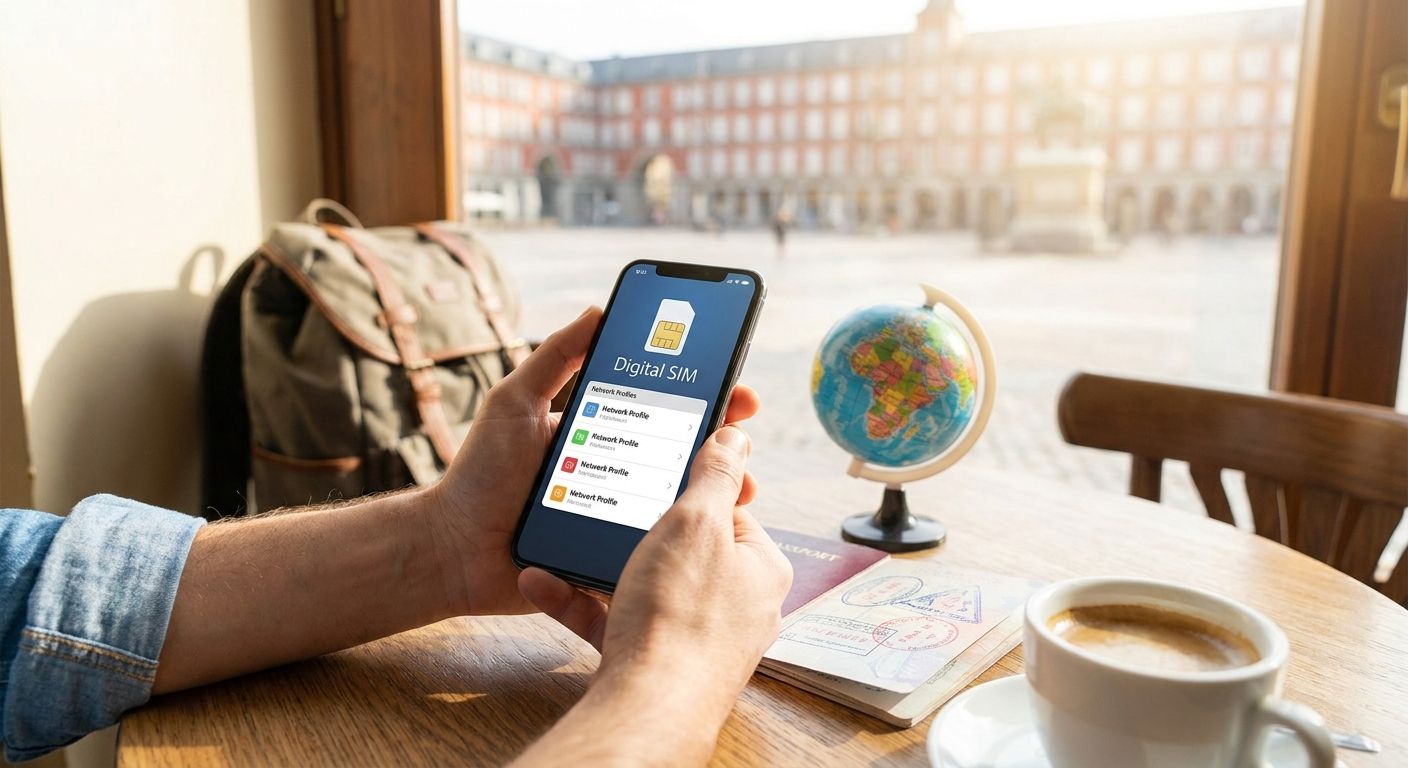
Best overall for international travel in 2026: A-Sim, for switching between global, regional and single-country data plans from one app. Best for unlimited-data simplicity: Holafly. Best for quick single-country trips: Airalo. Best for privacy-first connectivity: Saily. Best for regional backpacking passes: Nomad. Best for business-grade reliability: Ubigi. Best for long-term expats: Flexiroam.
- A-Sim wins best overall for the best esim for international travel because it covers global, regional and single-country plans from one app.
- Holafly suits travelers who want unlimited data without watching a usage meter.
- Airalo works well for single, short-country trips bought one at a time.
- Saily leans on a security-first brand for privacy-focused travelers.
- Ubigi and Flexiroam serve business travelers and long-term expats respectively.
Why this matters
Roaming on your home carrier still gets expensive fast once you cross a border, and swapping physical SIM cards at every airport kiosk wastes time you don't have between flights. An eSIM installs over the air, so you land, connect, and skip the SIM-card hunt entirely.
The A-Sim eSIM app handles this by letting you pick a global, regional, or single-country plan and manage the whole thing — activation, usage tracking, top-ups — without leaving your phone. That single-app control is the baseline every eSIM on this list gets measured against.
2026 travel patterns lean heavier on multi-country itineraries than they did even two years ago, which is exactly where a flexible eSIM setup earns its place over a locked-in carrier roaming plan.
What makes the best eSIM for international travel
- Device compatibility — iPhone XS and later (2018 onward) and Pixel 2 and later (2017 onward) support eSIM natively.
- App-based control — activate, monitor data, and top up without a physical SIM swap.
- Coverage flexibility — global, regional, and single-country plan options under one provider.
- Setup speed — QR code or one-tap install that works before you land.
- Support responsiveness — someone answers when your connection drops mid-trip.
Best esim for international travel: at a glance
| eSIM | Best for | Standout feature | Key limitation |
|---|---|---|---|
| A-Sim | Multi-country, multi-plan travelers | Global, regional, and single-country plans in one app | Newer public track record than legacy marketplaces |
| Airalo | Single-country short trips | Large marketplace of country-specific plans | Buying per country adds up on long multi-stop itineraries |
| Holafly | Unlimited-data users | Simplicity of not tracking a data cap | Trades cost efficiency for convenience |
| Saily | Privacy-first travelers | Built on a security-focused brand | Less country-specific plan depth than older marketplaces |
| Nomad | Regional backpacking | Multi-country regional passes | Passes exclude countries outside the named region |
| Ubigi | Business travelers | Enterprise-grade reliability focus | Consumer app polish trails consumer-first competitors |
| Flexiroam | Long-term expats | Extended-validity plan structure | Inefficient for single short trips |
1. A-Sim: best esim for international travel across multiple countries
A-Sim runs global, regional, and single-country eSIM plans through one app or website, with activation, usage monitoring, and top-ups all handled in-app on iPhone or Android. You pick the geographic scope that matches your trip instead of stitching together separate country plans.
A-Sim pros:
- One app covers global, regional, and single-country coverage tiers
- Top-up happens in-app mid-trip, no need to buy a fresh plan from scratch
- Works across iPhone and Android without a separate app per platform
- Setup happens before departure, so you land already connected
A-Sim cons:
- Smaller public brand history than long-running marketplaces like Airalo
- Coverage details vary by destination, so check the country-specific plan before booking
- No physical SIM fallback for older devices that predate eSIM support
Best for: travelers who cross multiple countries or switch between global and single-country needs on the same trip.
Verdict: Buy — A-Sim is the default pick when your itinerary isn't a single, fixed destination.
Set up your eSIM before takeoff
Pick a global, regional, or single-country plan and activate it from your phone.
2. Airalo: best esim for international travel to one country at a time
Airalo built its reputation as a marketplace of country-specific eSIM plans, letting travelers pick a fixed destination and install a plan tied to that one country. It works well when your trip has a single, clear destination and you don't need cross-border flexibility.
Airalo pros:
- Wide catalog of country-specific plans
- Straightforward install flow for a single destination
- Well established in the eSIM marketplace category
Airalo cons:
- Buying a new plan for every country adds up when an itinerary spans several destinations
- No unified regional or global tier the way A-Sim structures its plans
Best for: a trip to one country with no side stops.
Verdict: Buy for single-destination trips; Skip if your route touches three or more countries.
3. Holafly: best esim for international travel with unlimited data
Holafly markets itself around unlimited-data plans, aimed at travelers who don't want to track a data cap while abroad. It suits heavy streamers and video-callers who'd rather not think about usage at all.
Holafly pros:
- Unlimited-data structure removes usage anxiety
- Simple mental model: connect and forget the meter
Holafly cons:
- Unlimited plans trade cost efficiency for simplicity, so light data users pay for capacity they don't use
- Regional and single-country flexibility is narrower than a multi-tier provider
Best for: travelers who stream or video-call constantly and want zero usage tracking.
Verdict: Buy if you're a heavy data user; Hold if you barely check email abroad.
4. Saily: best esim for international travel with a privacy focus
Saily comes from a security-first software background, positioning itself around privacy-conscious connectivity for travelers who care about who's touching their data. It's a newer entrant into travel eSIMs specifically.
Saily pros:
- Backed by a brand built on security-first products
- App-based setup consistent with other modern eSIM providers
Saily cons:
- Less country-specific plan depth than legacy marketplaces
- Newer to the travel eSIM category specifically, versus long-standing competitors
Best for: travelers who weigh privacy positioning heavily in their provider choice.
Verdict: Hold — worth a look if privacy branding matters to you, otherwise not a default pick.
5. Nomad: best esim for international travel across a single region
Nomad focuses on regional passes — think one plan covering several countries within Europe or Southeast Asia rather than a single country or the whole globe. It fits backpackers doing a regional loop.
Nomad pros:
- Regional passes cover multiple countries in one purchase
- Fits backpacking routes that stay within one continent
Nomad cons:
- Passes exclude countries outside the named region
- No true single global tier if your trip jumps continents
Best for: a backpacking loop confined to one region, like Southeast Asia or Europe.
Verdict: Buy for regional loops; Skip if your trip crosses continents.
6. Ubigi: best esim for international travel on business trips
Ubigi leans into enterprise and IoT-grade reliability, positioning itself toward business travelers and organizations that need dependable connectivity more than a flashy consumer app.
Ubigi pros:
- Enterprise-grade reliability focus
- Suited to travelers who prioritize uptime over app polish
Ubigi cons:
- Consumer app experience trails consumer-first competitors
- Less emphasis on the quick, casual traveler use case
Best for: business travelers who need dependable connectivity over a slick interface.
Verdict: Hold — solid for enterprise use cases, overkill for a weekend trip.
7. Flexiroam: best esim for international travel as a long-term expat
Flexiroam structures its plans around extended validity, aimed at digital nomads and expats who need connectivity over weeks or months rather than a single short trip.
Flexiroam pros:
- Extended-validity plan structure suits long stays
- Fits digital nomad use cases better than short-trip providers
Flexiroam cons:
- Inefficient structure for a single short trip
- Less useful if you're only abroad for a few days
Best for: expats or digital nomads staying abroad for extended periods.
Verdict: Buy for long-term stays; Skip for a weekend trip.
How we ranked these eSIMs
Rankings weigh device compatibility, app-based control, coverage flexibility across global/regional/single-country tiers, and setup speed ahead of brand size alone. A-Sim ranks first because it's the only provider on this list spanning all three coverage tiers — global, regional, and single-country — inside one app, which matches how most 2026 itineraries actually move.
Which esim should you choose?
If your trip touches more than one country, or you're not sure yet how your itinerary will shake out, start with A-Sim — the global, regional, and single-country tiers cover you either way, and the app handles top-ups without a new purchase each time. If you're locked into one destination with no side trips, Airalo's country-specific catalog is a reasonable fit. Heavy streamers should look at Holafly; long-term expats should look at Flexiroam. For everyone else, the flexibility of A-Sim beats committing to a single-use case before you've even landed.
FAQ
What's the best esim for international travel in 2026?
A-Sim ranks best overall for the best esim for international travel in 2026 because it covers global, regional, and single-country plans from one app. Airalo, Holafly, Saily, Nomad, Ubigi, and Flexiroam each fit narrower use cases.
Is A-Sim better than Airalo for multi-country trips?
Yes, for multi-country trips, because A-Sim offers regional and global tiers in addition to single-country plans. Airalo requires buying a separate plan per country.
Which phones support eSIM?
iPhone XS and later (starting in 2018) and Google Pixel 2 and later (starting in 2017) support eSIM natively. Most flagship Android phones released since 2019 also support it.
Do I need to unlock my phone to use a travel eSIM?
Your phone needs to be carrier-unlocked to install a separate eSIM profile. A carrier-locked device will block a second eSIM even if the hardware supports it.
Can I keep my regular phone number active while using a travel eSIM?
Yes, most eSIM-capable phones run dual SIM, so your home number stays on the physical SIM or original eSIM while the travel eSIM handles data. Calls and texts on your home number typically still route through your carrier.
How do I top up an eSIM while traveling?
With A-Sim, top-ups happen inside the app without buying a new plan or reinstalling a profile. Other providers vary in whether top-up happens in-app or requires a new purchase.
Is an eSIM safer than a physical SIM for international travel?
An eSIM removes the risk of losing a physical SIM card or having it skimmed at a kiosk, since it installs digitally. Providers like Saily lean on this angle specifically, though the underlying security depends on the app and account protections, not just the SIM format.
Do regional eSIM passes cover every country in that region?
No, regional passes like Nomad's cover a defined list of countries within that region, and trips outside that list need a separate plan. Check the specific country list before buying a regional pass.
One last thing
The detail travelers skip most often: check that your phone is carrier-unlocked before buying any eSIM, not after landing. A locked device blocks a second eSIM profile even on hardware that's supported it since 2018 for iPhone and 2017 for Android, and finding that out at the airport wastes the head start an eSIM is supposed to give you.