
Best overall for a France-only trip: a single-country eSIM that explicitly includes France. Best for a European itinerary: a regional eSIM covering every stop; best for travel across continents: a global eSIM matching your route.
- The best eSIM for France matches your itinerary: single-country for France, regional for Europe, global for multiple regions.
- A-sim suits travelers who want travel eSIM usage management and top-ups through an app.
- Check France coverage, phone compatibility, validity, and hotspot terms before choosing a travel data plan.
- Choose by included destinations and usable data, not the size of the country list.
Why this matters
For a 2026 trip to France, choose the plan’s geographic scope before choosing a provider. A Paris city break and a journey through several countries need different comparisons. The right choice follows your route, not a generic provider leaderboard.
A-sim offers single-country, regional, and global travel eSIMs, with purchases through its website or app and usage management and top-ups through its app. Check the selected plan’s destination list and terms against your itinerary before purchasing.
A-sim is best for travelers who want to manage travel eSIM usage and top-ups through an app. That convenience is useful, but it does not replace checking the actual plan.
What makes the best eSIM for France?
Use these criteria to assess a France travel eSIM in 2026:
- Destination coverage: France must appear in the plan’s included destinations. Check every additional stop separately.
- Phone compatibility: Your exact device must support eSIM and allow the selected provider’s service. A familiar phone name alone is not enough.
- Validity rules: Identify what starts the validity period and when the allowance expires. Installation and activation are not interchangeable terms.
- Data allowance: Match the allowance to your habits, including navigation, uploads, video, and laptop use.
- Connection terms: Check the listed network, supported service, speed restrictions, and hotspot rules. An eSIM label does not establish connection quality.
- Usage control: Look for a clear way to check remaining data and understand replenishment before you run low.
Treat coverage, compatibility, and validity as pass-or-fail checks. Compare convenience only after a plan clears those checks. A useful app cannot fix an unsupported phone or an excluded destination.
Best eSIM options for France at a glance
This ranking compares plan types rather than making unsupported claims about provider speeds or network performance. The order follows how closely each type fits a France-focused trip.
| Rank and option | Best for | Standout feature | Key limitation |
|---|---|---|---|
| 1. Single-country France eSIM | Trips staying within France | A destination scope focused on France | Does not establish coverage for another country |
| 2. Europe regional eSIM | Trips combining France with other European stops | Multiple included destinations under one plan | A regional label does not include every European destination automatically |
| 3. Global eSIM | Trips combining France with other regions | Coverage spanning multiple included regions | A broad destination list still needs route-by-route checking |
A wider geographic scope is not automatically better. If you remain in France throughout your trip, extra destinations do not improve the fit of the plan to that itinerary.
1. Single-country eSIM: best for France-only trips
A single-country France eSIM is the clearest starting point when your international travel stays within France. You compare the data allowance, validity, and connection terms against one destination rather than a wider country list.
Best for: Travelers staying in France without another international stop requiring mobile data.
Single-country eSIM pros
- Keeps the coverage decision focused on France.
- Makes it easier to compare plans against the same itinerary.
- Avoids treating unused destinations as a reason to choose a plan.
Single-country eSIM cons
- France coverage does not establish coverage in another country.
- A changed itinerary requires a fresh coverage check.
- A data plan does not necessarily include a local number, ordinary calls, or SMS.
For a hypothetical 7-day trip based entirely in France, start here. Check that validity covers arrival through departure, including the time you expect to need maps or transport information on your final day.
Do not choose an allowance by trip length alone. Someone uploading video throughout the day has different needs from someone using messaging and saved maps. Review your phone’s recent app-level data usage as a starting point, then account for activities you expect to add abroad.
For a France-only holiday in 2026, this is the default recommendation. Move to a regional plan because your route needs it, not because its destination list looks more impressive.
Verdict: Buy a single-country France eSIM for a France-only itinerary after checking compatibility, validity, and connection terms.
2. Europe regional eSIM: best for a multi-country European trip
A Europe regional eSIM covers a specified group of destinations under one plan. It fits an itinerary that includes France and other included European stops without requiring a separate destination plan for each one.
Best for: Travelers combining France with other European countries covered by the same plan.
Europe regional eSIM pros
- Keeps included European destinations within one plan’s scope.
- Reduces the need to choose separate plans for each covered stop.
- Lets you assess validity against the full European journey.
Europe regional eSIM cons
- “Europe” is a regional label, not a complete coverage guarantee.
- Territories and destinations outside the listed scope need separate checking.
- Shared data can be used before you reach the final stop.
For a hypothetical 14-day trip through France and neighboring countries, write down every destination first. Compare that list with the plan’s included countries. Do not infer coverage from proximity, regional membership, or a familiar map outline.
Check whether the allowance is shared across destinations and whether any connection terms differ by country. Border coverage and the phone’s network selection also deserve attention; a multi-country plan does not remove the need to follow its connection instructions.
For 2026 European travel, the deciding question is simple: does one regional plan cover the route you will actually take? If it excludes an important stop, compare a different regional scope or separate destination plans.
Verdict: Buy a Europe regional eSIM when its destination list covers France and your other European stops.
3. Global eSIM: best for a trip across regions
A global eSIM groups destinations across multiple regions. It belongs on your shortlist when France is one stop in a wider international journey, rather than the whole reason you need mobile data.
Best for: Travelers combining France with destinations outside Europe under one suitable plan.
Global eSIM pros
- Brings multiple included regions into one coverage scope.
- Lets you assess data and validity against a wider itinerary.
- Provides an alternative to selecting separate plans for every region.
Global eSIM cons
- The word “global” does not guarantee coverage everywhere.
- Data used early in the journey reduces what remains later.
- Different destinations can have different listed network arrangements.
For a hypothetical 30-day trip spanning Europe and another region, compare the entire route with the included destinations. Then check whether the validity period spans the journey. Geographic breadth is irrelevant if the plan expires before your final stop.
Keep each destination visible during the comparison. An airport connection, an overnight stop, and a longer stay create different connectivity needs, but each still requires an explicit decision about whether you need mobile service there.
A-sim offers global travel eSIMs alongside regional and single-country options. Choose the scope that fits the journey, and check the selected plan rather than assuming the category name settles coverage.
Verdict: Buy a global eSIM when your cross-region route fits its destination list and validity period.
How these eSIM options are ranked
The ranking prioritizes itinerary fit, then compatibility, validity, data needs, connection terms, and usage control. Single-country ranks first for the France-only traveler; regional and global options take their own distinct use cases.
No geographic category wins on signal quality by itself. Single-country, regional, and global describe where a plan applies, not how a connection performs at a particular location.
For your 2026 comparison, keep those decisions separate. First establish that the plan fits your journey. Then compare its stated service terms with the alternatives that also fit.
Set up your France eSIM without mixing up your lines
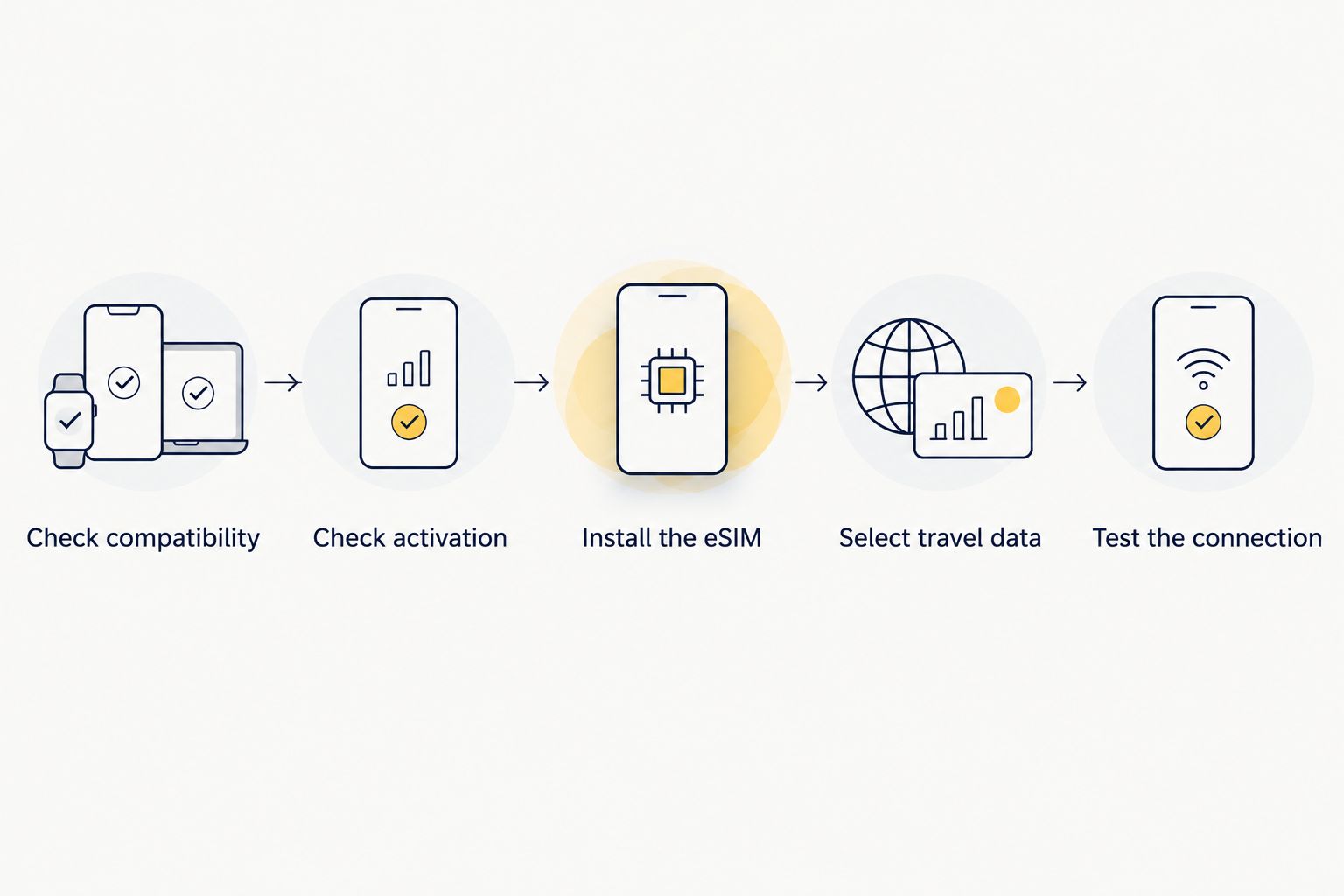
Prepare while you have a dependable internet connection. Follow the selected provider’s instructions, because installation steps and activation triggers differ between plans.
- Check compatibility. Confirm eSIM support for your exact device and whether carrier restrictions prevent using another provider.
- Check activation. Read what starts validity before installing or enabling the plan. Match that trigger to your departure schedule.
- Install the eSIM. Follow the supplied instructions and label the travel line clearly in your phone’s settings.
- Select travel data. Choose the travel line for cellular data, and follow its instructions about data roaming.
- Test the connection. Once the plan should be active, temporarily turn off Wi-Fi and open a simple webpage.
The important distinction is between adding the eSIM to your phone and starting its service period. Read the guide to installing an eSIM before travel before deciding when to complete those steps.
If you retain your home line, review its roaming settings separately. Selecting a travel line for data does not change the home carrier’s terms for calls or messages. Keep automatic data switching off if you do not want the phone switching data use back to that line.
Match your allowance to what you actually do
Use your phone’s data history as a planning reference, not a guaranteed forecast. Travel changes your habits: unfamiliar routes need navigation, sightseeing creates uploads, and accommodation Wi-Fi changes when you use cellular data.
- Navigation and messaging: Save useful maps and booking details before leaving dependable Wi-Fi.
- Photos and backups: Review automatic cloud uploads so they do not consume travel data unexpectedly.
- Video and calls: Check quality settings and decide which activities can wait for Wi-Fi.
- Laptop use: Confirm hotspot permission before relying on the phone for work.
A-sim supports usage management and top-ups through its app. Check your remaining allowance during the trip rather than waiting until a map or message fails to load.
Set a personal check-in point, such as reviewing usage after your first full travel day. This is a planning habit, not a consumption estimate: compare what you used with the days and activities still ahead.
Which eSIM for France should you choose?
Choose a single-country France eSIM if France is your only destination. Choose a Europe regional eSIM for an included multi-country European route, or a global eSIM for an included cross-region itinerary.
For an undecided traveler in 2026, the next move is not another provider ranking. Confirm your phone, write down your destinations, and check the plan’s activation and expiry rules. Those checks eliminate unsuitable options before convenience features enter the decision.
A-sim is a fit for travelers who want website or app purchasing with app-based usage management and top-ups. Compare the selected plan’s details with your route before committing.
FAQ
What's the best eSIM for France in 2026?
A single-country eSIM explicitly covering France is the best starting point for a France-only trip. Choose a Europe regional or global plan instead when its included destinations better match your wider itinerary.
Is a France eSIM better than a Europe eSIM?
A France eSIM is the more focused choice for a France-only itinerary; a Europe eSIM fits trips covering several included European countries. Compare validity, data, and connection terms after checking the destination list.
Will a travel eSIM work on my iPhone or Android phone?
A travel eSIM requires an eSIM-compatible device that permits the selected provider's service. Check the exact model, regional version, and carrier restrictions rather than assuming every iPhone or Android phone qualifies.
Can I keep my Canadian number while using an eSIM in France?
You can keep your Canadian line alongside a travel eSIM if your phone supports the required dual-SIM setup. Use the travel line for data and review your Canadian carrier's roaming terms for calls, messages, and any home-line data use.
Does a France travel eSIM include a French phone number?
A France travel eSIM does not automatically include a French phone number. Check whether the selected plan includes ordinary calls and SMS or provides data only.
Can I use my France eSIM as a hotspot?
Hotspot use depends on the selected plan's terms and your device. Confirm tethering permission and any restrictions before relying on the connection for a laptop or another traveler.
Should I install my France eSIM before leaving home?
Install before departure only after checking the provider's installation instructions and activation trigger. Some plans distinguish installation from the event that starts validity, so follow the selected plan's wording.
One last thing
Download your arrival essentials before you fly. Save your accommodation address, booking details, and the route from your arrival point somewhere you can open offline.
That preparation gives you breathing room to select the correct data line and test the connection. Your first task after landing should not depend on already having mobile data working.