
Yes, one eSIM plan can work across multiple countries on the same trip when its coverage list includes every destination and its validity covers your travel dates. Crossing a border does not extend the plan or reset its data allowance, and an excluded country needs separate coverage.
- One eSIM plan, multiple countries, same trip: choose regional or global coverage that explicitly includes every destination.
- A-sim travel eSIMs suit travellers who want app-based usage tracking and top-ups.
- Regional coverage does not automatically include every country in a region; global coverage does not mean everywhere.
- Check destinations, validity and remaining data before each border crossing.
Why this matters
Your itinerary matters more than the word on the package. A regional plan can cover a multi-country route, while a global plan can still exclude a stop you need. Buy against the destination list, not the plan name.
For a 2026 trip, compare your actual stops with the current coverage details. A-sim offers single-country, regional and global travel eSIMs, with usage management and top-ups through its app. Those categories give you different starting points; the individual plan's terms determine whether one purchase covers your route.
Keep the distinction clear: installing one eSIM profile and buying one data plan are not necessarily the same thing. A profile can remain on your phone after its package expires, but an installed profile alone does not provide an active connection.
Does one eSIM plan work across multiple countries on a trip?
Yes, provided every country is included and the package remains active with usable data. A compatible, unlocked phone also needs access to a supported local network. Inclusion in a coverage list does not guarantee reception in every building, rural area or transport corridor.
These are the main coverage categories to compare for a 2026 itinerary:
| Coverage option | Best for | Main advantage | Main limitation |
|---|---|---|---|
| Single-country eSIM | A trip focused on one country | Coverage is easy to match to that destination | Does not cover other countries unless explicitly included |
| Regional eSIM | Several included countries within a region | One package can cover multiple stops | Nearby countries and territories can be excluded |
| Global eSIM | Included destinations across different regions | Broader geographic scope within one package | Global does not mean every country or network |
Use this sequence before purchasing:
- List every destination. Include stopovers where you intend to use mobile data.
- Match each destination. Check the actual country list, including any separately listed territories.
- Match the dates. Read the activation trigger and expiry rules against your itinerary.
- Check the allowance. Confirm how data is allocated and what happens when it runs out.
A plan passes only when all of those checks work together. Country coverage cannot compensate for an expired package, and unused data cannot compensate for an excluded destination.
Single-country eSIM: best for one main destination
A single-country package is the straightforward choice when you need mobile data in one destination. It keeps the coverage decision narrow: check that country, the supported networks, the allowance and the validity period.
Its limitation appears when your itinerary expands. A stop across the border is not covered simply because the countries are neighbours or share a currency. Treat another country as a separate coverage check, even when you reach it by train rather than plane.
Choose single-country coverage when your mobile-data needs stay within its stated coverage. For a multi-country trip, separate country packages also mean keeping track of separate allowances, expiry rules and selected data lines. That extra management is the trade-off to assess, not just the destination labels.
Regional eSIM: best for several included countries in one region
A regional package fits a route through multiple countries on its coverage list. You keep the same selected travel data line as you move between supported destinations, rather than installing a different profile solely because you crossed a border.
The limitation is the boundary of the package itself. A geographic label is not a promise that every country, island or territory in that area is included. Check each named destination separately, particularly when your route includes a side trip.
Choose regional coverage when every stop appears in the same package and its validity spans the route. Review the current list for your 2026 departure rather than relying on a previous purchase or an old screenshot. Save the relevant details offline so you can check them without an active connection.
Global eSIM: best for included stops across different regions
A global package is relevant when your route crosses regional boundaries. It can keep several included destinations under one active package, reducing the need to manage separate country purchases during the trip.
The drawback is that broad coverage still has limits. Read the destination list and network details instead of interpreting global as universal. Also check whether the allowance is shared across covered destinations or subject to destination-specific terms.
Choose global coverage because it matches your route, not because the label sounds more complete. A wider package is unnecessary if a regional option already meets every requirement. Conversely, a regional package is not enough when your next stop falls outside its stated coverage, however short that stop is.
Why multi-country eSIM coverage varies
The same phone can connect successfully in one destination and fail to connect at the next. Check these factors before treating a border-crossing problem as a faulty eSIM:
- Included destinations: The package must name the country or territory where you need service.
- Supported networks: The eSIM needs access to a network permitted by the package in that destination.
- Validity rules: Service depends on the package remaining active under its activation and expiry terms.
- Remaining data: An exhausted allowance requires the next action specified by the plan, such as a top-up or replacement package.
- Phone compatibility: Your device must support the eSIM and permit use with the provider; model and carrier restrictions matter.
- Mobile settings: The travel line must be enabled and selected for data, with roaming configured according to the provider's instructions.
These checks separate a coverage problem from a settings problem. Buying more data does not add an excluded country unless the new package explicitly includes it.
How do I prepare one eSIM for a multi-country trip?
Use the following checks before your 2026 departure. The goal is to settle coverage and activation questions while you still have a reliable internet connection.
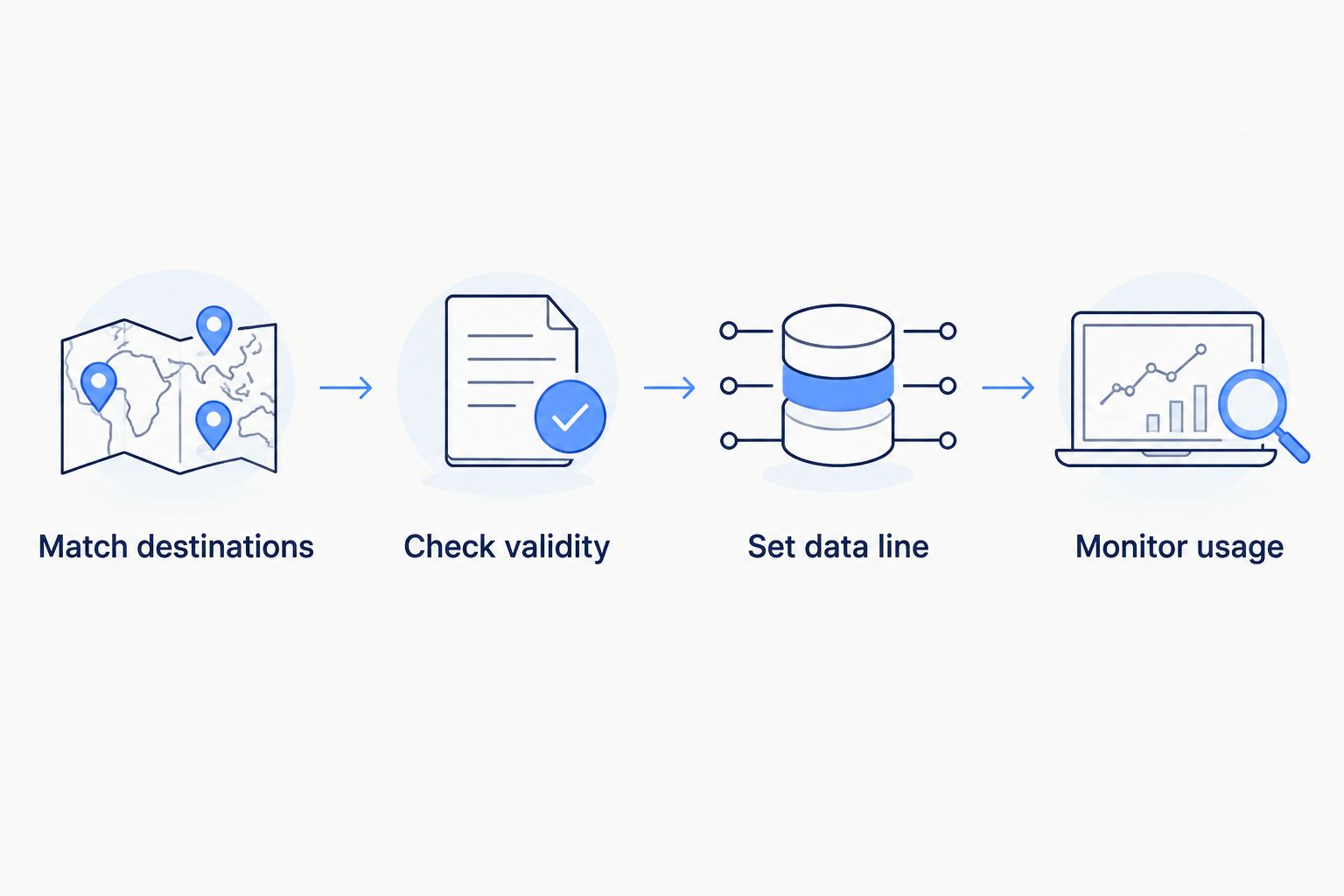
Match destinations
Write your route in travel order, including overnight stops and airport connections where you plan to go online. Compare each location with the package's destination list. Do not count onboard aircraft or ship connectivity as ordinary country coverage.
Check validity
Identify what starts the validity period: installation, activation or connection to a supported network, as specified by the provider. Then compare the expiry rule with your final day of use. Installing early and starting the package early are different questions; this guide to installing an eSIM before travel explains the distinction.
Set data line
Give the travel eSIM a recognisable label and select it for mobile data when you intend to use it. If you keep your home line enabled, review its roaming settings and any automatic data-switching option. Keeping a number active does not require selecting that line for travel data.
Monitor usage
Check the package balance before long travel days and border crossings. A-sim travel eSIMs support usage management and top-ups through the app. Before adding data, confirm that the selected package covers your next destination and read how the top-up affects validity.
The order matters: establish coverage first, then timing, then phone settings. Monitoring usage cannot fix a destination mismatch discovered after arrival.
What should I do when I cross a border?
Keep the covered travel eSIM selected for mobile data and let the phone search for a supported network. A border crossing can involve a network change, so do not treat the connection as uninterrupted service. Finish essential downloads before leaving reliable coverage.
If data does not return, troubleshoot in a deliberate order:
- Confirm the new destination is included in the active package.
- Check that the package has not expired and still has usable data.
- Confirm the travel eSIM is enabled and selected for mobile data.
- Follow the provider's instructions for data roaming and network selection.
- Consult the installation instructions before changing access-point settings or deleting anything.
Do not delete the eSIM as your first troubleshooting step. Reinstallation depends on the provider's rules and the installation method. Keep the profile in place while you check the account, settings and support instructions.
Near a border, also check which network the phone has selected. Your physical location and the network your phone reaches are not always the same coverage question. The relevant package must permit the connection being used.
Does my data allowance reset in each country?
No automatic reset follows a border crossing. For a shared-data package, usage in covered destinations draws from the same allowance unless the terms specify a different arrangement.
Check whether the package uses a shared pool, a daily allowance or another structure. Do not assume that arriving somewhere new restores data already used during the trip. The same caution applies to expiry: moving into another covered country does not start a fresh validity period unless the terms explicitly say so.
For your 2026 route, plan around the whole trip's usage rather than each arrival in isolation. Download offline maps and travel documents before departure so you are not dependent on a fresh connection at every stop.
Do I need to install another eSIM in every country?
No, not when the active package covers each destination. The existing travel profile can remain selected while the phone connects to supported networks along the route.
You need a separate coverage solution when the next country is excluded or the existing package no longer meets your needs. That solution might involve another package on the same profile or a different profile, depending on the provider's instructions. Check before purchasing; do not assume every new package requires installation or that every installed profile accepts every package.
Keep the terms separate when reading instructions: profile, package and selected data line describe different parts of the setup.
Can I use one plan for stopovers and connecting flights?
Yes, for ground-based mobile data in an included stopover destination while the package is active. Check the stopover country even when you never leave the airport, because your phone still needs an eligible local mobile network.
Country coverage does not establish onboard aircraft connectivity. Airport Wi-Fi is also a separate connection, not evidence that the eSIM works there.
For a brief connection, decide whether you need mobile data at all. If you do, include that stop in your coverage comparison before buying. A short visit does not create an exception to the destination list.
FAQ
Can one eSIM cover my entire multi-country trip?
Yes, one eSIM package can cover the trip when every destination is included, validity spans your travel dates and usable data remains. Check the package details rather than relying on regional or global labels.
Is a regional eSIM better than a global eSIM?
A regional eSIM is the better fit when it covers your whole route and meets your other requirements. Global coverage is relevant when your included destinations span different regions; the label alone does not establish a better fit.
Will my eSIM automatically connect after I cross a border?
Your phone can search for a supported network with the travel eSIM enabled, but an uninterrupted connection is not guaranteed. Confirm coverage, remaining data, validity and the provider's required settings if service does not return.
Can I manage a multi-country travel eSIM through an app?
A-sim supports travel eSIM usage management and top-ups through its app. Check the chosen package's destinations and validity before relying on it for the full route.
Does global eSIM coverage include every country?
No, a global eSIM covers the destinations listed for that specific package. Check every country and separately listed territory on your itinerary.
Can I keep my home number while using a travel eSIM?
Yes, a phone that supports the required dual-SIM setup can keep your home line enabled while using a travel eSIM for data. Home-line calls, texts and roaming remain subject to your home carrier's terms.
Should I remove my eSIM when I leave the first country?
No, leaving the first country is not a reason to remove an eSIM that covers your next destination. Keep the profile installed and check the package's coverage, validity and balance.
One last thing
A top-up and a coverage extension are not the same thing. Adding data does not establish that a previously excluded country is now covered. Read the new package details before paying, especially if your itinerary has changed.
Before your 2026 departure, save the destination list, expiry information and installation instructions offline. Those details answer different questions: where you can connect, how long service lasts and how to configure your phone. Having them available without mobile data makes a failed connection easier to diagnose.