
Best overall for a single-country trip: a country eSIM matched to your route. Best for neighbouring countries: a regional eSIM. Best for a multi-continent itinerary: a global eSIM. A-sim offers all three travel eSIM formats, with usage management and top-ups through its app; this 2026 guide ranks plan types by trip fit, not by an unsupported claim of stronger signal.
- The best esim network coverage depends on local networks and your route, not the number of countries advertised.
- A-sim suits travellers who want country, regional or global travel eSIMs with app-based usage management and top-ups.
- Choose a country eSIM for one destination and a regional eSIM for an itinerary within its included countries.
- Check named local networks and route coverage before choosing a global or multi-network plan.
- A backup helps only when it offers an alternative connection where your primary plan fails.
Why this matters
A country on a coverage list tells you where a plan is eligible to connect. It does not tell you whether your mountain lodge, rural road or hotel room has usable reception. That distinction matters more than the length of the destination list.
Travel eSIMs connect through mobile networks. The eSIM stores your subscription digitally; it does not create a separate radio network or improve the phone's antenna. Terrain, buildings, local network deployment and your device still affect reception.
For a 2026 trip, start with the places where you actually need data. An airport connection is useful, but it is not evidence that the same plan covers your entire journey. Rank coverage against your itinerary before comparing convenience.
What makes the best eSIM network coverage?
Use these six criteria before choosing a plan:
- Route coverage: Check cities, accommodation, transport corridors and remote stops, not just country names.
- Named networks: Identify which local operators the specific plan permits you to use.
- Country inclusion: Confirm every destination and any transit country where you need mobile data.
- Network access: Check supported network technologies and any restrictions stated for the plan.
- Device compatibility: Confirm your exact phone model supports eSIM and accepts another provider's subscription.
- Connection continuity: Check validity, activation conditions, data allowance and top-up arrangements so an expired plan does not look like a coverage failure.
Country count measures geographic scope, not signal quality. A narrower plan that matches your route is a better fit than a broader plan that leaves your essential stops uncovered.
Travel eSIM coverage options at a glance
The order below starts with straightforward destination matching, then moves to broader itineraries and specialist backup choices. It is a decision tree, not a measured network-performance leaderboard.
| Rank and option | Best for | Standout feature | Key limitation |
|---|---|---|---|
| 1. Country eSIM | A trip within one country | Destination-specific plan scope | Does not establish coverage at every local stop |
| 2. Regional eSIM | Several destinations within one region | Groups included countries under one plan | A geographic region's name does not guarantee every country is included |
| 3. Global eSIM | Travel across different regions | Broad geographic plan scope | Local network access still needs checking country by country |
| 4. Multi-network eSIM | Routes where alternative local networks matter | Access to more than one operator, when explicitly included | Switching behaviour and permitted networks depend on the plan |
| 5. Backup eSIM | Travellers who need a second connection option | Adds another subscription alongside the primary connection | Offers little coverage protection if both subscriptions use the same network |
1. Country eSIM: best coverage fit for one destination
A country eSIM is the clearest starting point when your trip stays within one country. A-sim offers single-country travel eSIMs alongside its regional and global formats, with purchase through its website or app.
For coverage, inspect the local network behind the destination plan. Then compare that network's published coverage information with your actual stops. A country-specific label does not establish better rural reception or priority network access.
Consider a 7-day trip spent entirely in one destination. Your useful comparison is coverage around the accommodation, sightseeing stops and intercity journeys—not how many other countries a different plan includes.
Country eSIM pros:
- Keeps the coverage check focused on one destination.
- Makes it easier to compare local operators against a defined route.
- Avoids choosing broader geographic scope that your itinerary does not need.
Country eSIM cons:
- Does not cover another country unless the plan explicitly includes it.
- Still depends on local network reception at each stop.
Best for: Travellers staying within one country who want a direct destination-to-plan match.
Verdict: Buy a country eSIM when its local network and plan conditions match your route.
2. Regional eSIM: best coverage fit for neighbouring countries
A regional eSIM groups a defined set of countries into one plan. It suits a journey that crosses borders within that set, without requiring you to choose a separate destination plan for every stop.
Read the included-country list rather than relying on a regional label. Also check local networks separately for each destination: access in one country says nothing about the operator used after you cross a border.
For example, a 10-day trip through 2 countries is a regional-plan use case only if both countries are explicitly included. A short transit stop belongs on your checklist too when you need data outside the airport's Wi-Fi.
Regional eSIM pros:
- Groups eligible destinations under one geographic plan.
- Reduces the number of separate destination plans you need to assess.
- Matches an itinerary that stays within a defined country group.
Regional eSIM cons:
- Regional names do not guarantee inclusion of every nearby country.
- Network access and reception differ between destinations.
Best for: Travellers crossing borders within one included region.
Verdict: Buy a regional eSIM after confirming every country where you need data.
3. Global eSIM: best coverage fit for multi-region trips
A global eSIM is designed around broader geographic inclusion. Choose this format when your itinerary spans different regions and the specific plan includes your destinations.
Global does not mean universal. Check the country list, local networks and validity conditions before treating a global plan as your single travel connection. Mainland coverage also does not establish offshore or in-flight service.
For a 2026 itinerary with 3 country stops across different regions, build a destination-by-destination checklist. Mark the countries included, the named networks and the places where you need reliable reception. The global label should simplify the purchase decision, not replace that check.
Global eSIM pros:
- Provides a broad geographic format for multi-region travel.
- Lets you assess one plan against an extended itinerary.
- Avoids treating each border crossing as an entirely separate buying decision.
Global eSIM cons:
- Does not guarantee inclusion of every country.
- Does not establish consistent network access or reception across destinations.
Best for: Travellers visiting included countries across several regions.
Verdict: Buy a global eSIM for geographic fit; skip it when an essential destination is excluded.
4. Multi-network eSIM: best for routes needing network alternatives
A multi-network eSIM permits access to more than one local operator where that access is explicitly included. It is a coverage option worth assessing when your route moves between areas served differently by local networks.
Do not confuse multiple partner networks across the world with multiple usable networks in your destination. Check the specific country and plan. Also establish whether network selection is automatic, manual or restricted before relying on switching.
An alternative network is useful only where it provides service your primary network does not. For a rural itinerary, compare the route against each permitted operator's coverage information. Two network names alone do not establish two usable connections at your lodge.
Multi-network eSIM pros:
- Provides alternative local network access when the plan explicitly permits it.
- Gives you more than one operator to evaluate against your route.
- Supports a coverage strategy based on network differences rather than destination count.
Multi-network eSIM cons:
- Requires more detailed checks than a country-inclusion list.
- Does not guarantee automatic switching or uninterrupted service.
Best for: Travellers whose essential stops justify checking alternative local operators.
Verdict: Hold until the permitted networks and switching conditions are confirmed.
5. Backup eSIM: best for connection-dependent travel
A backup eSIM is a second subscription you prepare alongside your primary connection. Its coverage value comes from the underlying network, not from having another eSIM profile on your phone.
Before choosing a backup, check device support for storing and using multiple subscriptions. Then compare the primary and backup network arrangements. Different provider names do not necessarily mean different local networks.
For work calls, navigation or arrival coordination, plan an offline fallback as well. Download essential directions and save accommodation details before entering a weak-signal area. A second subscription cannot create reception where neither permitted network reaches.
Backup eSIM pros:
- Adds another connection option when your device supports it.
- Lets you separate your primary plan from a contingency subscription.
- Provides coverage redundancy when the underlying networks genuinely differ.
Backup eSIM cons:
- Adds another plan and validity period to manage.
- Provides limited coverage protection when both plans depend on the same local network.
Best for: Travellers who need a contingency connection and can verify network diversity.
Verdict: Buy a backup for a distinct network option; skip duplicate-network coverage protection.
Check coverage before you choose
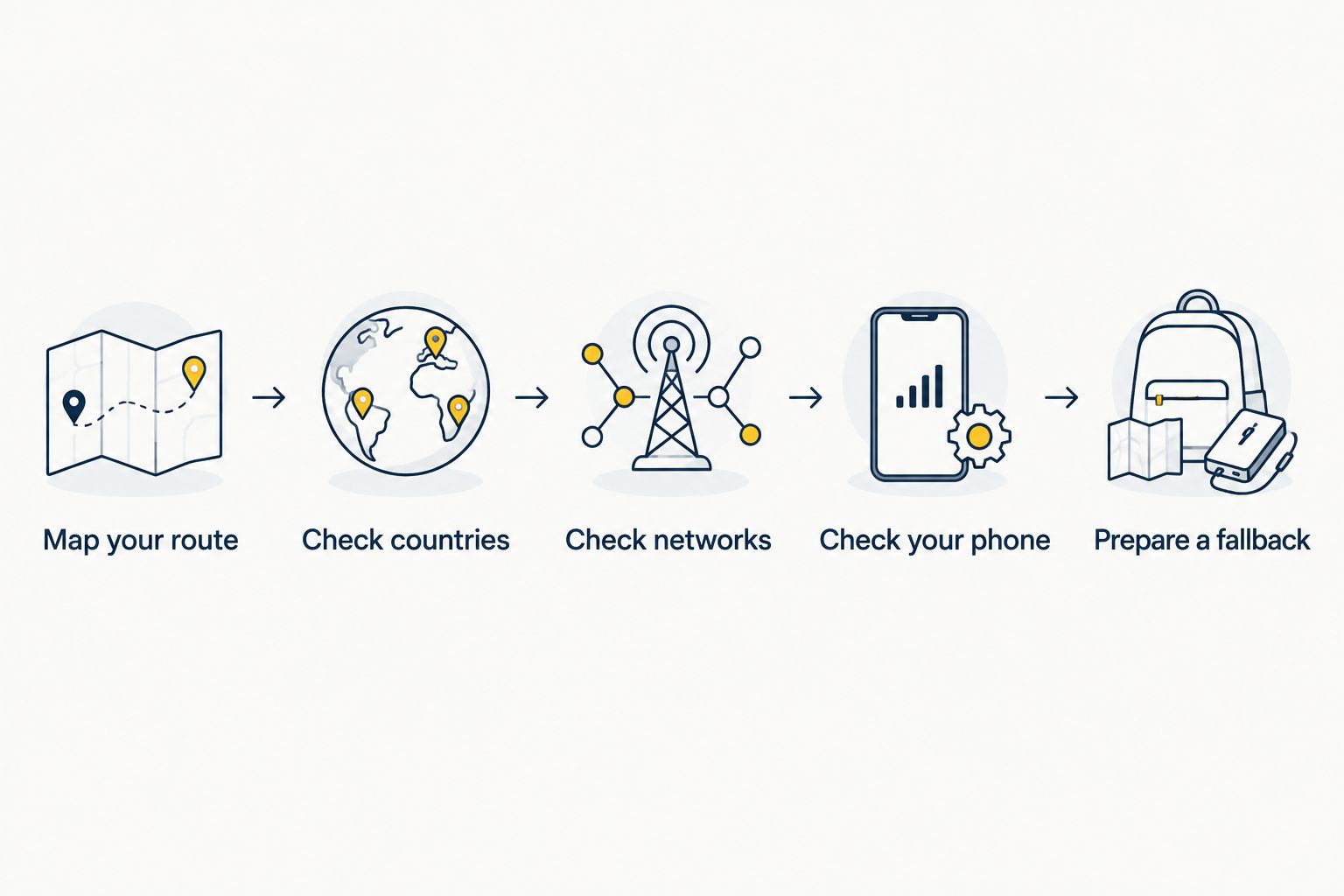
Use this sequence to select a travel eSIM in 2026. Keep geographic scope and local reception separate throughout the process.
- Map your route. List destinations, accommodation and transport stretches where mobile data matters. Include border crossings and overnight stops.
- Check countries. Match each destination against the specific plan's inclusion list. Do not infer inclusion from a regional or global label.
- Check networks. Identify permitted local operators, then consult their published coverage information for your stops. Coverage maps are guidance, not a guarantee of indoor reception.
- Check your phone. Confirm eSIM support, carrier-lock status and the device requirements stated for the subscription. Check dual-SIM support separately if you need a backup.
- Prepare a fallback. Save maps and travel details offline. Where connectivity is essential, assess another permitted network rather than relying on a second brand name.
These checks separate a plan-selection problem from a signal problem. They also prevent you from buying broader geographic inclusion as a substitute for local route coverage.
If your itinerary includes countryside, islands or long road journeys, read the guide to eSIM use in remote areas with weak coverage. Treat those stretches as separate coverage decisions rather than extensions of the nearest city's reception.
How these coverage options are ranked
This 2026 ranking prioritises itinerary fit: country plans for one destination, regional plans for included neighbouring countries, and global plans for multi-region travel. Multi-network and backup options address a different need—alternative connections.
The ranking does not assign providers a signal score. The strongest coverage choice is the plan whose permitted local networks serve the places you need to connect. App features help you manage the subscription; they do not establish radio coverage.
Which travel eSIM should you choose?
Choose the narrowest geographic format that includes your full route, then check its local networks. For one country, start with a country plan. For included neighbouring countries, assess a regional plan. For destinations across regions, assess a global plan.
A-sim travel eSIMs are best suited to travellers who want country, regional or global plans with app-based usage management and top-ups. Choose among those formats using your itinerary, not an assumption that broader inclusion means stronger reception.
For your 2026 departure, settle the network question before installing. Once the plan fits, confirm activation and validity conditions so you know when the subscription becomes usable and when its allowance ends.
FAQ
What's the best eSIM network coverage for international travel?
The best eSIM network coverage is the coverage of the plan's permitted local networks along your actual route. Choose country, regional or global scope to match your destinations, then check local operator coverage for your essential stops.
Does a global eSIM have better signal than a country eSIM?
A global eSIM does not have better signal simply because it includes more countries. Signal depends on the local network, your device and conditions at your location.
Is A-sim suitable for trips across several countries?
A-sim offers regional and global travel eSIM formats alongside single-country options. Check the specific plan's included destinations and network conditions against every country on your itinerary.
Will an eSIM work in rural areas?
An eSIM works in rural areas where its permitted local network provides compatible service. Check the operator's coverage information for your route and save essential travel information offline.
Can I switch networks if my travel eSIM has weak signal?
Network switching depends on the operators and selection rules permitted by your specific plan. Check those conditions before relying on another network as a fallback.
Does an eSIM get weaker signal than a physical SIM?
The digital SIM format does not itself make the phone's radio signal weaker. The relevant comparison is the device, permitted network access and reception at the same location.
Do I need a backup eSIM for a work trip?
A backup eSIM is useful when it provides a distinct connection option and your phone supports the required subscriptions. Check the underlying local networks; different provider names alone do not establish coverage redundancy.
How do I choose a regional eSIM for a border-crossing trip?
Choose a regional eSIM only after confirming every country where you need mobile data is included. Then check the local networks and plan validity for each part of the journey.
One last thing
Two eSIM providers can depend on the same local mobile network. If you are buying a backup specifically for coverage, compare operator names before provider names. Otherwise, a local network outage or coverage gap affects both subscriptions.