
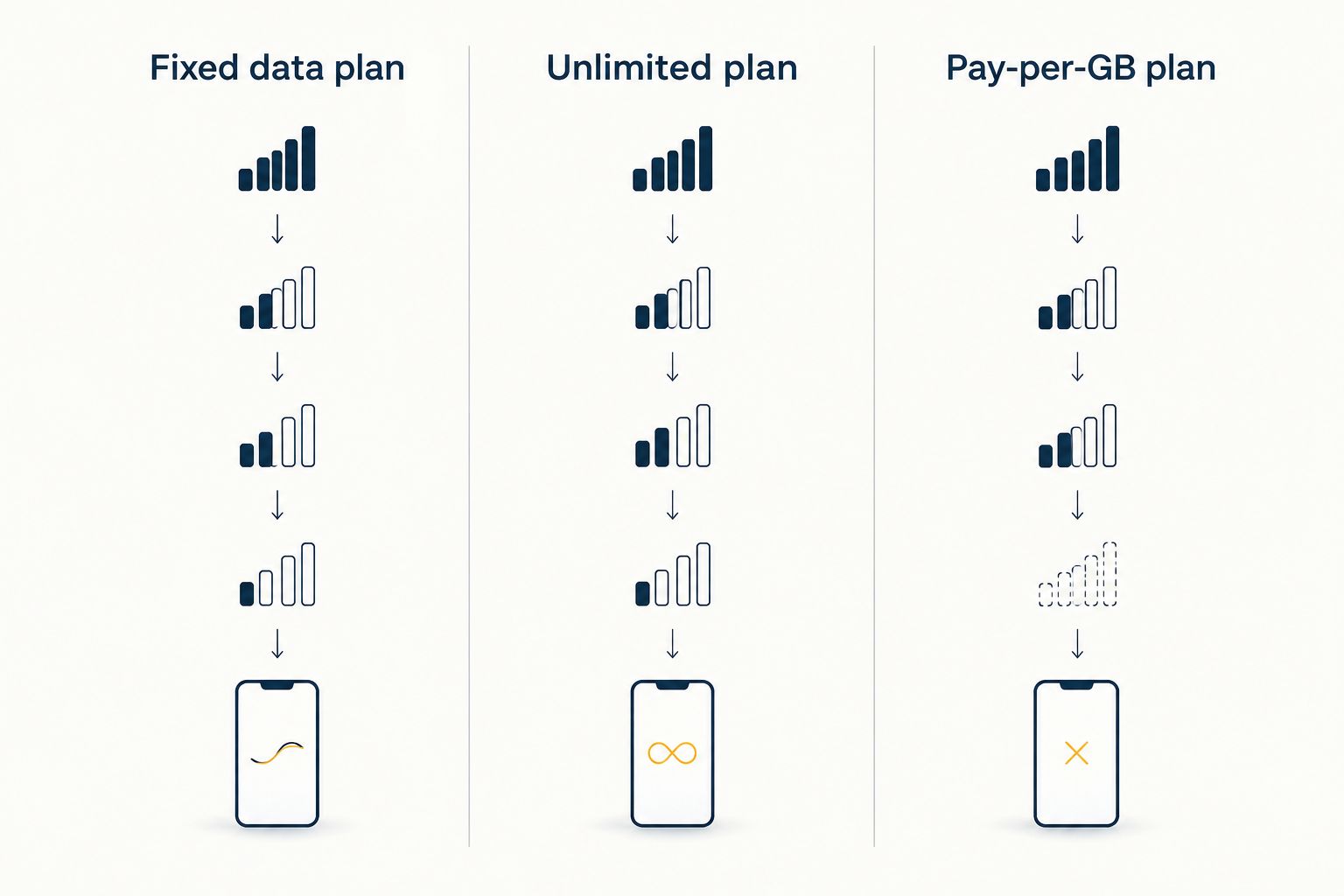
Yes — most travel eSIM plans throttle your connection to a slower speed tier once you hit the data limit instead of cutting service off completely, but the exact behavior depends on whether you're on a fixed-data plan, an unlimited plan, or a pay-per-GB setup. The catch travelers miss: a throttled connection still shows "connected" on your phone, but it can be too slow for video calls, live maps, or ride-share apps in 2026.
- Whether eSIM data is throttled after hitting the limit depends on plan type: fixed-data and unlimited plans throttle, pay-per-GB plans cut off.
- Fixed-data eSIM plans typically throttle speed to roughly 128-256 kbps instead of disconnecting you.
- Unlimited eSIM plans apply the same fair-use throttle once you pass a high-speed threshold, not before.
- Pay-per-GB or add-on eSIM plans usually stop data entirely until you top up.
- A-Sim lets you track usage and top up eSIM data mid-trip so a hard throttle doesn't catch you off guard.
Why this matters
Hitting your data cap without knowing what happens next means you could lose maps mid-drive or get hit with an unexpected dead zone right when you need directions to a gate. Travel eSIM providers build their plans around two different philosophies: some throttle speed to protect network capacity for everyone, others simply block usage until you buy more. Matching a plan to how you'll actually use data — see the best eSIM plans ranked by data speed — keeps you from getting stuck at a crawl during check-in.
The difference isn't cosmetic. A throttled connection at 128-256 kbps loads a text message fine but stalls a video call. A hard cutoff kills everything until you act. Knowing which one your plan does in 2026 changes how you plan a trip, not just how you react to a slow bar of signal.
Is eSIM data throttled after you hit the limit?
The honest answer is "it depends on the plan," and the table below breaks down what each type actually does once you cross the line.
| Plan type | What happens after the limit | Best for |
|---|---|---|
| Fixed-data plan | Speed throttles to roughly 128-256 kbps for the rest of the plan's validity | Short trips with predictable data needs — Best for budget travelers |
| Unlimited plan | Fair-use threshold triggers the same throttle, usually resets the next cycle | Long stays, heavy streaming — Best for digital nomads |
| Pay-per-GB / top-up plan | Data stops completely until you add more through the app | Unpredictable usage, avoiding automatic slowdowns — Best for occasional travelers |
Verdict: if your eSIM plan is labeled "fixed" or "unlimited," expect a throttle, not a dead connection. If it's a pay-per-GB or add-on style plan, expect a full stop.
Fixed-data eSIM plans: throttled to 128-256 kbps after the cap
Fixed-data plans — the classic "5GB for 10 days" style offer — are built to keep you connected even after you burn through the high-speed allotment. Once you cross the cap, the network drops your speed to a slower tier, commonly in the 128-256 kbps range that's long been the travel eSIM industry's fallback speed. That's enough for texting, basic email, and static maps, but streaming and video calls will buffer or fail outright.
This throttle usually lasts until the plan's validity period ends, not until midnight or the next billing cycle. If you bought a 10-day plan and hit the cap on day 3, you're stuck at reduced speed for the remaining 7 days unless you add more data.
Unlimited eSIM plans: same fair-use throttle, just a higher trigger point
"Unlimited" rarely means unlimited at full speed. Most unlimited eSIM plans in 2026 carry a fair-use threshold — often described in the fine print — after which the same throttle mechanism kicks in. The trigger point sits higher than a fixed plan's cap, which is why unlimited plans suit longer stays and heavier daily use. Check the best unlimited data eSIM plans for how different providers structure that threshold.
The practical difference from a fixed plan is timing, not mechanism: you'll likely need to stream video or upload large files daily to ever notice the throttle on an unlimited plan.
Pay-per-GB and top-up plans: data stops until you refill
Pay-per-GB and add-on style eSIM plans work differently: once the purchased data runs out, the connection stops rather than slowing down. There's no throttle tier to fall back on because the plan wasn't designed with one. You're offline until you buy more.
This is where checking usage matters most. A-Sim lets you monitor remaining data and top up your eSIM directly through the app, so a pay-per-GB plan doesn't leave you stranded mid-trip — see how to top up your A-Sim data automatically before you leave.
“A throttled eSIM isn't broken — it's just slow. A cut-off eSIM is the one that leaves you stranded.”
Why the throttle speed and cutoff policy varies
No single rule governs every provider or destination. A handful of factors decide whether you get slowed down or shut off:
- Plan structure — fixed-data and unlimited plans are built to throttle; pay-per-GB plans are built to stop.
- Network partner agreements — the local carrier an eSIM connects through sets the technical throttle speed, which is why it can differ slightly by country even on the same plan type.
- Fair-use policy wording — "unlimited" plans define their trigger threshold differently across providers, even in 2026.
- Validity period remaining — a throttle on a fixed plan typically lasts until the plan expires, not until a fixed reset time.
- Whether auto top-up is enabled — plans linked to an app-based top-up option can avoid a throttle entirely by refilling before the cap hits.
- Network congestion — some providers throttle harder during peak hours in high-traffic tourist areas regardless of your plan's stated speed.
Knowing which of these applies to your plan before you land is the difference between a mild slowdown and being fully offline in a new city.
Skip the throttle guesswork
Track your data and top up in one tap before you hit the cap.
Related questions travelers ask
Does eSIM data top up automatically when it runs out?
Some plans support automatic top-up, but it usually has to be turned on in the app before your data runs low — it isn't the default in 2026. Enabling it ahead of a trip means you avoid both the throttle and a full cutoff.
Can I switch eSIM plans mid-trip if I hit the limit?
Yes, most travel eSIM apps let you add a new data plan or top-up pack the moment you notice speeds drop, without needing a new physical SIM. The new allotment typically activates immediately, restoring full speed right away.
Does throttled eSIM data still work for maps and messaging?
Throttled data at roughly 128-256 kbps still handles text messages, basic maps, and lightweight browsing. Video calls, streaming, and large app downloads struggle or fail at that speed, so treat throttled data as "emergency only" rather than normal use.
FAQ
Does eSIM data get throttled or cut off completely after the limit?
It depends on the plan type. Fixed-data and unlimited eSIM plans throttle speed to a slower tier, while pay-per-GB or add-on plans typically cut off data entirely until you top up.
What speed does eSIM data throttle to after the cap?
Throttled eSIM data commonly drops to around 128-256 kbps, a speed tier long used across the travel eSIM industry. That's enough for texting and basic maps but too slow for video or streaming.
Is unlimited eSIM data really unlimited?
No, unlimited eSIM plans carry a fair-use threshold. Once you pass it, the same throttle mechanism used on fixed-data plans kicks in, just at a higher usage point.
Can I avoid eSIM throttling by topping up early?
Yes, topping up before you hit the cap keeps your connection at full speed. Apps that support in-app top-up let you refill mid-trip without waiting for a throttle to hit.
Does throttled eSIM data still work for messaging apps like WhatsApp?
Text-based messaging still works on throttled eSIM data. Voice or video calls through the same apps usually degrade or drop because the throttled speed can't sustain them.
How do I know how much eSIM data I've used?
Check usage inside your eSIM provider's app, which tracks remaining data in real time. Setting a usage alert catches you before a throttle or cutoff happens, not after.
Do all countries have the same eSIM throttle rules?
No, throttle speed and timing depend on the provider's agreement with the local network partner in each country, not on any single global rule. The same plan can throttle slightly differently across destinations.
One last thing
The 128-256 kbps throttle speed most eSIM plans fall back to is roughly what 3G networks ran at a decade ago — slow by 2026 standards, but not dead. The smarter move isn't waiting to see what happens at the cap: set a usage alert at 80% inside your eSIM app and top up before the throttle, not after you're already stuck loading a map pin one pixel at a time.