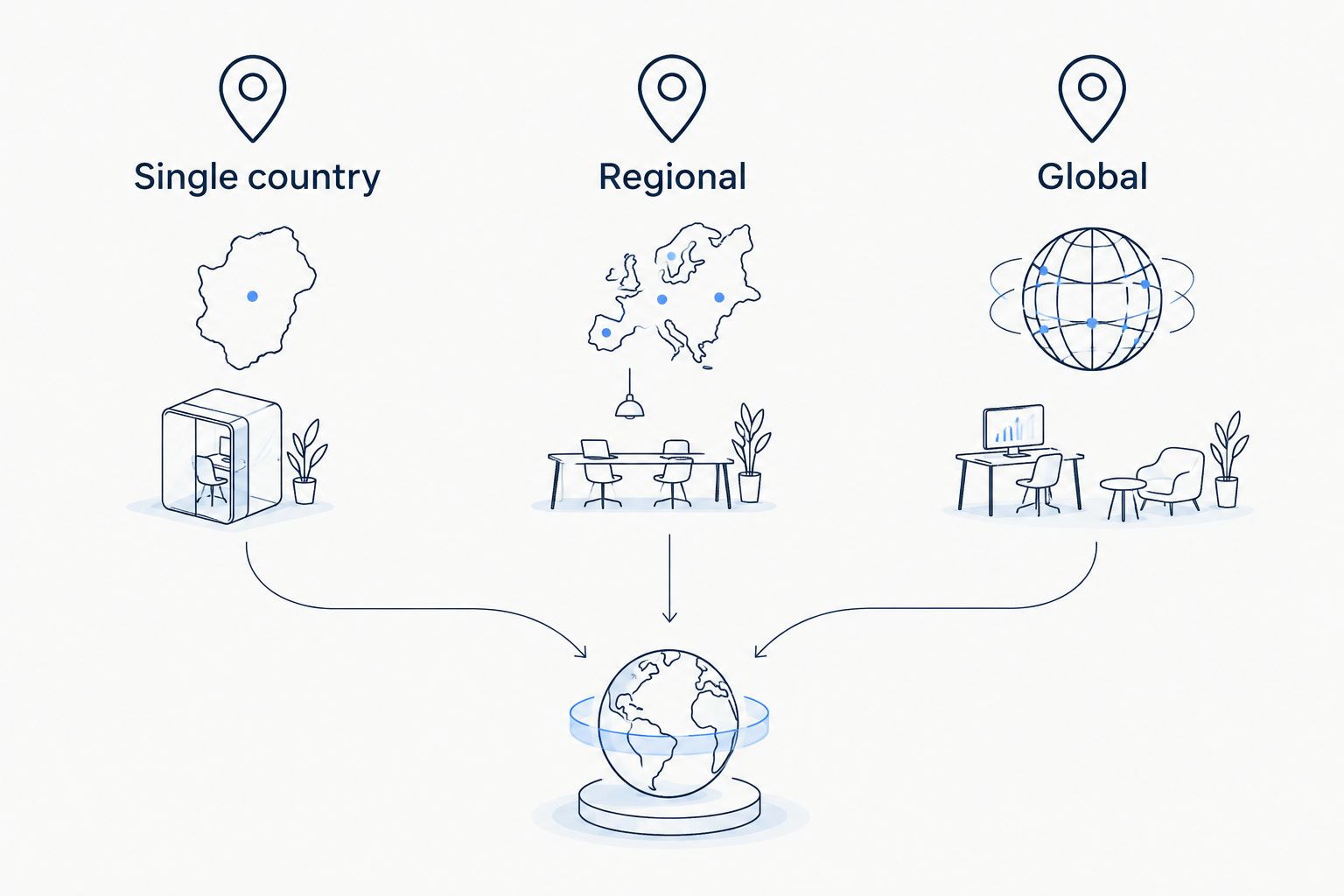
Best overall for multi-region itineraries: global coverage. Best for neighbouring-country trips: regional coverage. Best for a long stay in one destination: single-country coverage. For 2026, A-sim eSIM data plans for long-term travel offer these three coverage types, with usage management and top-ups through the app.
- Choose A-sim eSIM data plans for long-term travel when you want app-managed usage and top-ups.
- Global coverage fits multi-region travel; regional coverage fits a route within the plan’s listed countries.
- Single-country coverage fits an extended stay in one destination, not a cross-border itinerary.
- Check validity, covered countries, hotspot terms, and phone compatibility before choosing a travel eSIM.
Why this matters
Long-term travel needs a repeatable connection plan, not just an arrival connection. Your first airport transfer matters, but so do the weeks after it: checking your balance, crossing borders, and keeping essential apps connected.
For a 2026 itinerary, separate coverage from duration. A global plan describes geographic scope, not how long your data lasts. A single-country plan describes a destination, not whether its allowance will cover your entire stay.
The right choice starts with your route. Then check whether the plan’s validity and renewal arrangements match your travel calendar.
What makes the best long-term travel eSIM?
Use these six criteria before comparing coverage types:
- Destination fit: Check every country on your actual itinerary, including overnight stopovers where you need mobile data.
- Usable validity: Read when the validity clock starts and when unused data expires.
- Repeatable top-ups: Establish how you add data and whether a top-up changes the expiry date.
- Usage visibility: Choose a setup that lets you check your remaining allowance during the trip.
- Work suitability: Verify hotspot permission and any speed restrictions if your laptop depends on the connection.
- Device readiness: Confirm eSIM support, carrier-unlock status, and the supported installation method for your exact phone.
These criteria matter more than a broad coverage label. A plan that includes your destinations still needs enough usable time and the right connection terms for your routine.
Long-term travel eSIM options at a glance
| Rank and coverage type | Best for | Standout feature | Key limitation |
|---|---|---|---|
| 1. Global | Trips across multiple regions | A coverage scope designed around international itineraries | The country list still needs checking; global does not mean everywhere |
| 2. Regional | Several destinations within one covered region | Groups eligible neighbouring destinations under a regional scope | A nearby country is not automatically included |
| 3. Single country | An extended stay in one destination | A clearly defined destination scope | Does not provide coverage for an onward country outside that scope |
These are coverage choices, not interchangeable promises about speed, validity, or hotspot access. Read those terms separately for the specific plan you select.
1. Global coverage: best for multi-region long-term travel
A global travel eSIM is the first option to assess when your itinerary crosses regions. A-sim offers global travel eSIMs alongside regional and single-country options, with purchases through its app or website and usage management through its app.
Best for: Travellers whose confirmed route includes destinations across multiple regions.
The main benefit is geographic fit. Instead of treating each destination as an isolated purchase decision, you can assess the whole route against one global coverage list. That is a useful starting point for a 2026 trip with several international legs.
Do not treat the word global as a substitute for checking countries. Include stopovers where you will leave the airport, and verify the plan’s validity independently of its geographic reach.
Global coverage pros:
- Suits itineraries that cross regional boundaries.
- Lets you compare a broad route against one coverage list.
- Gives you an option to assess before splitting the trip into separate country plans.
Global coverage cons:
- The label alone does not confirm coverage in every country.
- Broad coverage does not establish a long validity period.
- A country-by-country check is still necessary when your route changes.
Before choosing global coverage, write down the destinations you actually expect to visit. Separate confirmed bookings from places you are merely considering; an unconfirmed detour should not determine your entire connection setup.
Verdict: Buy global coverage when its listed destinations match a confirmed multi-region itinerary.
2. Regional coverage: best for neighbouring-country itineraries
A regional travel eSIM groups covered destinations within a defined region. It fits a trip built around several countries in that region rather than an itinerary that jumps between continents.
Best for: Travellers moving between multiple included countries within one region.
Start with the country list, not the region’s name. Geographic neighbours do not automatically share the same plan coverage, and political or geographic groupings are not a substitute for the provider’s destination list.
Regional coverage gives you a practical middle option. You are not assessing an entire global footprint, but you are also not limiting the decision to a single destination.
Regional coverage pros:
- Matches a multi-country route within a defined area.
- Lets you assess included border crossings together.
- Keeps the coverage decision focused on one part of your journey.
Regional coverage cons:
- Countries outside the listed region need a separate coverage decision.
- A regional name does not prove that every nearby country is included.
- A route change beyond the included destinations requires another check.
Use regional coverage for a complete travel leg, not automatically for your whole trip. If you spend an extended period in one region before moving elsewhere, assess each leg against its own dates and destinations.
Also check return visits. A route that leaves the covered area and later comes back needs a validity check, even if the returning destination remains included.
Verdict: Buy regional coverage when every destination in that travel leg appears on the plan’s country list.
3. Single-country coverage: best for an extended stay
A single-country travel eSIM focuses on one destination. It is the clearest starting point when you will spend most of your time in the same country and have no confirmed cross-border travel.
Best for: Travellers settling into one destination for an extended stay.
Your main decision shifts from geographic breadth to continuity. Check how the allowance, validity, and top-up process support your stay, especially if you do not yet know your departure date.
A country-specific plan also creates a clear boundary: it covers the named destination according to its terms. Do not assume it follows you on a weekend trip abroad.
Single-country coverage pros:
- Matches an itinerary centred on one destination.
- Keeps the geographic scope straightforward.
- Lets you focus your comparison on validity, data allowance, and renewal terms.
Single-country coverage cons:
- Does not cover an onward destination outside its country scope.
- Cross-border excursions need a separate connection plan.
- A long stay still requires checking expiry and top-up arrangements.
Single-country coverage deserves consideration even when your overall journey lasts months. The length of the trip does not, by itself, create a need for global coverage.
For example, a hypothetical 90-day stay in one destination is geographically simpler than a shorter trip through several regions. Duration and destination count answer different questions.
Verdict: Buy single-country coverage when your confirmed stay is concentrated in one destination.
How we ranked these coverage choices
The ranking prioritizes itinerary fit, followed by validity, repeatable data management, and device readiness. Global coverage ranks first for a multi-region journey; regional and single-country coverage win their own distinct use cases.
A-sim supports the app-based management criterion through usage tracking and top-ups. The final choice still depends on the specific plan’s destination list and terms, not the position of its coverage type in this guide.
Match coverage to your route before buying
For your 2026 trip, use a simple decision sequence: identify the destinations, group them into travel legs, and then choose the narrowest coverage scope that includes each confirmed leg. Broader coverage is not automatically a better fit.
- Single country: Your confirmed stay is in one destination.
- Regional: Your confirmed destinations fit one plan’s regional country list.
- Global: Your confirmed route crosses regions and fits a global plan’s country list.
Keep a short connection checklist beside your itinerary. Record the covered destinations, expiry trigger, top-up process, and hotspot terms so that you do not have to reconstruct the decision at each border.
Plan for expiry, not just remaining data
Unused data and usable data are not always the same thing. A remaining allowance only helps while the plan remains valid under its terms.
For a hypothetical 90-day trip, a plan with 30 days of validity does not cover the full travel calendar merely because you still have data left. You need a renewal, top-up, or replacement arrangement that explicitly covers the remaining time.
The distinction between an installed profile and a usable data package matters here: eSIM plan validity periods determine the package’s usable window, while an eSIM profile’s continued presence on your phone does not prove that its data remains active.
Before you commit, answer these questions:
- Does validity begin at purchase, installation, activation, or a qualifying network connection?
- Does adding data extend validity, or does the existing expiry remain?
- Does the top-up apply to the current package or create a separate package?
- What happens to unused data when that package expires?
For a 2026 departure, check the terms attached to your selected plan rather than relying on an earlier trip’s setup. Save the relevant instructions somewhere you can access without mobile data.
Build a data routine you can repeat
Estimate your allowance from your own usage, not somebody else’s travel habits. A traveller using maps and messages has a different routine from someone uploading video or connecting a laptop.
Start with your phone’s recorded mobile-data use. Separate essential activity from tasks you can move to Wi-Fi, such as large downloads, software updates, and photo backups.
Use a 7-day observation window as a planning exercise, not a universal allowance recommendation. If that week includes unusually heavy uploads or unusually little travel, adjust the estimate before applying it to a longer stay.
For the next step, use the monthly travel data planning guide to structure your allowance decision around the apps you actually use.
Make checking the balance part of your travel routine. Review it after arrival, after a heavy-use day, and before leaving dependable Wi-Fi. Do not wait until you need a ride or boarding pass to discover that you must add data.
Keep work access and your home number separate
A travel data connection does not establish that a plan includes a local phone number, ordinary calls, or SMS. Check those features independently if your trip depends on them.
For work, confirm hotspot permission before relying on your phone as a laptop connection. Then test the actual tasks you need: joining a meeting, opening a shared document, and sending a work file.
Your home line needs its own settings review. On a supported dual-SIM phone, choose the intended mobile-data line and review automatic data switching and home-carrier roaming settings before departure.
Keep account recovery in mind, too. If an essential account depends on messages to your home number, arrange an appropriate recovery method before changing your phone setup abroad.
Which long-term travel eSIM should you choose?
Choose A-sim eSIM data plans for long-term travel when app-based usage tracking and top-ups match how you manage your trip. Choose the coverage type separately: global for a confirmed multi-region route, regional for included neighbouring destinations, and single country for an extended stay in one place.
For an undecided traveller in 2026, the default is straightforward: select the narrowest coverage scope that includes the confirmed itinerary. Then check validity, device support, and the next top-up step before buying.
FAQ
What are the best eSIM data plans for long-term travel?
The best eSIM data plans for long-term travel match your confirmed destinations, usable validity period, and data routine. Choose global coverage for multi-region routes, regional coverage for included neighbouring countries, or single-country coverage for an extended stay in one destination.
Is a global eSIM better than a regional eSIM for a long trip?
Global coverage is a better fit when your confirmed route crosses regions and its country list includes your destinations. Regional coverage fits a route contained within its listed countries; trip length alone does not decide between them.
Can I manage and top up A-sim through an app?
A-sim supports usage management and top-ups through its app. Check the selected plan’s terms to establish how added data affects validity and expiry.
Does an eSIM last for my entire stay abroad?
An eSIM data package lasts according to its validity terms, not the length of your stay. Check when validity starts, when it ends, and what renewal or top-up arrangements apply.
How much data do I need for several months abroad?
Base your allowance on your own recorded mobile-data use and planned activities. Review video uploads, laptop tethering, navigation, and background backups separately rather than applying one universal monthly estimate.
Can I use a travel eSIM for remote work?
A travel eSIM can support remote work when the selected plan permits your required use and the connection supports your tasks. Verify hotspot terms before depending on it for a laptop, and test your essential work apps after arrival.
Will a travel eSIM keep my home phone number active?
A travel eSIM does not by itself keep your home number active. Your home carrier service, phone capabilities, and line settings determine whether you can retain access while using a separate travel-data connection.
One last thing
Before you need your first top-up, know how you will complete it without relying on the connection you are trying to restore. Save the relevant instructions and account-access details securely, and check your balance while you still have working data or dependable Wi-Fi.