eSIM Circle deserves to stay on your shortlist when its destination coverage and plan terms fit your trip. The reason to look elsewhere is a specific mismatch: your route, how you manage data, or whether you need your existing phone service abroad. The best eSIM Circle alternative in 2026 is A-sim if you want country, regional or global travel eSIMs with in-app usage management and top-ups; your home carrier’s roaming service if keeping your existing line is the priority.
- For eSIM Circle alternatives, choose A-sim travel eSIMs when country, regional or global options and in-app top-ups fit your trip.
- Compare home-carrier roaming when keeping your existing line matters more than adding a separate travel connection.
- Consider a local carrier eSIM when you need destination-specific service, subject to its registration and device requirements.
- Keep eSIM Circle if its current plan already meets your route, validity and phone requirements.
Why this matters
A travel connection has to match your itinerary, not just your destination. A plan that suits a city break can be the wrong choice for a longer stay or a route crossing several borders.
For your 2026 comparison, separate three decisions: where the plan works, what service it includes, and how you manage it. A country list does not answer whether you can receive ordinary texts. An app does not answer when the plan expires.
Start with the task you need to complete abroad. Maps and messaging need a data connection; keeping access to your home number requires separate attention to your existing line and carrier terms.
eSIM Circle alternatives at a glance
The table below compares service models rather than claiming an unsupported speed or coverage winner. For eSIM Circle, use the exact plan you are considering as the benchmark—not assumptions about its entire catalogue.
| Option | Best for | Standout feature or decision point | How it differs from eSIM Circle |
|---|---|---|---|
| eSIM Circle | Travellers whose selected plan already fits | Check the exact destination list, validity and service inclusions | Your benchmark; switch only to solve a defined mismatch |
| A-sim | Travellers wanting app-managed travel eSIMs | Country, regional and global options; usage management and top-ups through the app | Compare its stated management features against your selected Circle plan |
| Home-carrier roaming | Travellers prioritizing their existing line | Uses your existing carrier relationship, subject to roaming terms | An alternative to adding a separate travel service |
| Local carrier eSIM | Travellers evaluating service from a destination carrier | Direct carrier service, subject to local eligibility and plan terms | Changes the provider relationship from a travel service to a local carrier |
Choose the service model first, then compare the exact plan. Otherwise, you risk treating a data connection, a home-number service and a local mobile subscription as interchangeable.
1. A-sim: best for app-managed travel eSIMs
A-sim travel eSIMs cover single-country, regional and global options. You can access the service through the website or app, manage usage in the app and top up through the app.
That makes it a practical first alternative when your decision centres on managing travel data from your phone. For a 2026 itinerary, match the coverage scope to your actual stops before choosing a plan.
Where A-sim shines
- Coverage scope: You can evaluate country, regional and global options against your route.
- Usage management: The app lets you manage usage during the trip.
- Top-up access: You can top up through the app rather than treating the original purchase as your only data decision.
- Purchase channel: You can use the website or app.
Where A-sim falls short
- It is not a fit for a phone that cannot use the required eSIM service. Check the exact device and carrier-lock status first.
- A travel eSIM does not automatically replace every function of your home mobile line. Confirm voice, SMS and number requirements separately.
- Country, regional and global categories do not establish that a particular plan covers every stop. Read the selected plan’s destination list.
These are buying constraints, not reasons to reject the service. They matter most when you need more than mobile data or your itinerary includes an unusual transit stop.
| Decision | This alternative | eSIM Circle benchmark |
|---|---|---|
| Trip scope | Country, regional and global options are stated | Check the selected plan’s destination list |
| Usage management | Managed through the app | Check the selected service’s usage tools |
| Adding data | Top-ups through the app | Check the selected plan’s top-up rules |
| Purchase route | Website or app | Confirm the purchase and installation process |
Best for: Travellers who want travel eSIM options across different trip scopes and app-based usage management. Verdict: Buy only after the selected plan passes your coverage and device checks.
2. Home-carrier roaming: best for keeping your existing line
Your home carrier’s roaming service belongs in the comparison when your existing number is central to the trip. It keeps the decision with your current carrier rather than adding a separate travel provider.
Do not assume that retaining your number settles every question. You still need to check how your carrier handles calls, texts, mobile data and each country on your itinerary.
Where home-carrier roaming shines
- Existing line: You retain your current carrier relationship and number.
- Familiar account: You manage the service through the account you already use.
- Clear comparison: You can compare the carrier’s roaming terms directly against adding a travel eSIM.
Where home-carrier roaming falls short
- Roaming eligibility and included services depend on your existing carrier and plan.
- A trip crossing borders requires checking every destination, not just the first arrival country.
- Keeping the same line does not remove the need to control background data or understand usage limits.
| Decision | Home-carrier roaming | eSIM Circle benchmark |
|---|---|---|
| Provider relationship | Your existing carrier | A separate provider choice |
| Existing number | Remains attached to your home line | Check whether the selected service includes a number |
| Service inclusions | Check home-carrier roaming terms | Check the selected plan’s data, voice and SMS terms |
Best for: Travellers whose main requirement is continued use of their existing line. Verdict: Hold until you have checked the roaming terms for the whole route.
3. Local carrier eSIM: best for evaluating destination service
A local carrier eSIM is another route when you want to assess mobile service directly from a carrier in your destination. It deserves attention for a longer stay, especially when local calling or a local number is part of your requirements.
Those features are plan-specific. Do not treat the words “local carrier” as proof that an offer includes calls, texts or a particular registration process.
Where a local carrier eSIM shines
- Direct comparison: You can assess the destination carrier’s own service terms.
- Local requirements: You can look specifically for the local number or calling features you need.
- Stay-specific fit: You can compare validity against the full length of your visit.
Where a local carrier eSIM falls short
- Registration, identity checks and visitor eligibility depend on the destination and carrier.
- A plan for one country does not establish coverage for the next country on your route.
- Device compatibility still matters; choosing a local provider does not bypass it.
Best for: Travellers willing to check local eligibility and plan details in exchange for a destination-specific option. Verdict: Wait until the carrier confirms your eligibility and required services.
How to compare the plans without missing a deal-breaker
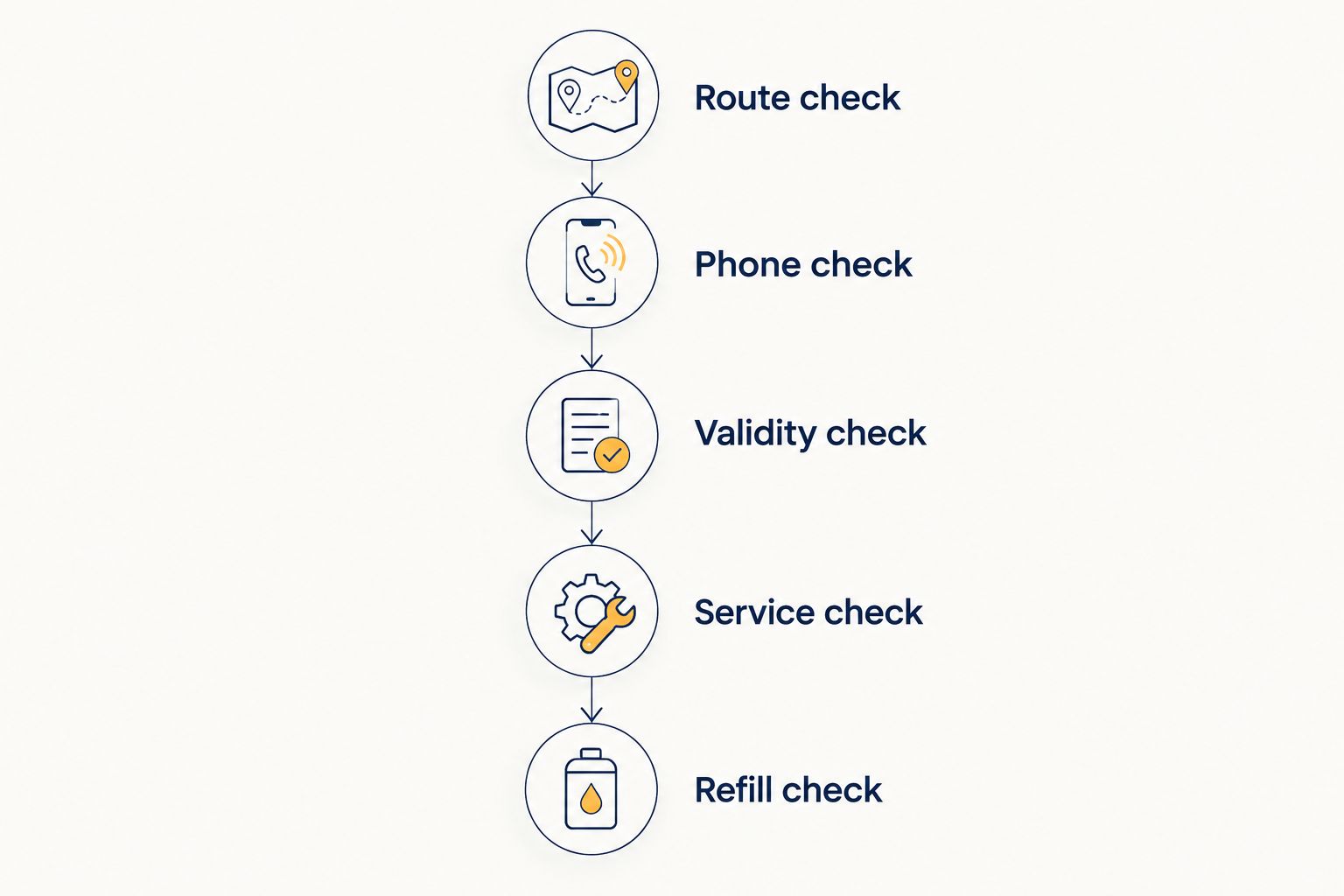
Use this sequence for your 2026 shortlist. Check the hard constraints before spending time on app preferences or installation convenience.
Route check
Write down every country where you need a connection, including stopovers where you expect to leave the airport. Compare that list with the selected plan’s included destinations.
A regional label is not enough. Read the country list, especially when a route crosses the boundary between regions.
Phone check
Confirm that your exact phone supports eSIM and that its carrier-lock status permits the service you want to add. Model names alone can be insufficient because device variants differ.
Check installation instructions before departure. The eSIM activation guide is a useful next read when you are separating installation from activation.
Validity check
Match the plan’s validity to your travel dates and identify what starts the clock. Installation, activation and first network use are different events; follow the selected plan’s stated rules.
For a hypothetical 7-day trip, check that the validity spans arrival through departure. For a hypothetical 14-day trip, repeat that check rather than assuming a shorter-trip plan extends automatically.
Service check
List whether you need data, ordinary calls, SMS or access to your home number. These are separate requirements, even when your phone displays them together.
If you expect to share data with a laptop, check tethering terms too. A working phone connection does not, by itself, establish that hotspot use is included.
Refill check
Decide what you will do if your allowance runs low. Check whether the selected plan supports a top-up, whether validity changes and how you complete the purchase.
For a hypothetical 30-day stay, review both the initial allowance and the refill process. Those example trip lengths are planning exercises, not claims about any provider’s plans.
Once those checks pass, compare convenience. An app-based workflow matters when you want to monitor usage and add data from the same place; it does not override a missing destination or incompatible phone.
Check your travel eSIM options
Compare country, regional and global options against your itinerary.
Why switch from eSIM Circle?
Switch to solve a documented mismatch, not because an alternatives list places another provider first. Your 2026 decision should have a reason you can state in one sentence.
- Your route does not match: The selected plan excludes a country where you need service.
- Your dates do not match: The validity rules do not cover the full trip.
- Your service needs differ: You need voice, SMS or a local number that the selected plan does not include.
- Your management preference differs: You want a specific usage-monitoring or top-up workflow and have confirmed the alternative provides it.
These are reasons to compare, not claims that eSIM Circle has those shortcomings. Read the current plan details before deciding that a mismatch exists.
Avoid switching merely to collect another installed profile. A second purchase only helps when it addresses a requirement the original option does not meet.
When staying with eSIM Circle is the right call
Keep eSIM Circle if your selected plan covers the route, fits your travel dates, works with your phone and includes the service you need. Familiarity is a valid reason to stay when the practical requirements already pass.
There is no benefit in changing providers solely because a different name ranks first on a list. Keep the plan that fits; replace the plan that fails a requirement.
For repeat travel in 2026, check the terms again rather than relying on what worked on a previous trip. A different destination or longer stay creates a new comparison.
FAQ
What is the best eSIM Circle alternative in 2026?
A-sim is the best fit on this shortlist for travellers seeking country, regional or global travel eSIM options with in-app usage management and top-ups. Confirm the selected plan covers your itinerary and works with your phone before buying.
Is a travel eSIM better than my home carrier’s roaming service?
A travel eSIM is the better fit when you want a separate travel connection that meets your route and data needs. Home-carrier roaming belongs in the comparison when continued use of your existing line is the priority; check calls, texts and data separately.
Can I keep my home number when I add a travel eSIM?
You can keep your home number by retaining your existing mobile line, subject to your device and carrier arrangements. Adding a travel eSIM does not automatically transfer your home number to it or change your home carrier’s roaming terms.
Do regional eSIM plans cover every country in a region?
You must check the selected plan’s destination list rather than assume every country is included. Match that list to your full route, including stopovers where you need mobile service.
Should I install an eSIM before leaving home?
Install before departure only after checking the provider’s installation and activation instructions. Confirm what starts the validity period so an early setup does not conflict with your travel dates.
Is a local carrier eSIM better for a long stay?
A local carrier eSIM deserves comparison when you need destination-specific service during a long stay. Check visitor eligibility, registration requirements, validity and whether the plan includes the local number or calling features you need.
When should I stay with eSIM Circle instead of switching?
Stay with eSIM Circle when the selected plan already meets your coverage, validity, device and service requirements. Switch only when an alternative solves a specific mismatch or provides a management feature you need.
One last thing
Installing an eSIM and making it your phone’s mobile-data line are separate decisions. After setup, check which line handles mobile data and whether automatic data switching matches your intentions.
Then test the connection before you need it for a boarding pass, directions or a message to your accommodation. A successful installation is not the same as confirming your travel setup works.