MyBestSim is useful for comparing travel eSIM offers before you choose a provider. Once you need to buy, install, monitor usage and top up, the decision shifts from comparison to managing your connection. The best MyBestSim alternative in 2026 is A-sim if you want travel eSIM purchasing and in-app management; your home carrier’s roaming service is the alternative to check if keeping your existing mobile service is the priority.
- For mybestsim alternatives, choose A-sim for travel eSIM purchasing, usage tracking and in-app top-ups.
- MyBestSim suits provider research; a travel eSIM provider handles the connection you select.
- Compare country coverage, phone compatibility and activation terms before choosing international data.
- Consider home-carrier roaming for your existing service, or a local SIM for a destination-specific connection.
Why this matters
A comparison service and a travel eSIM provider solve different problems. One helps you assess options; the other supplies the plan you use abroad. Treating them as interchangeable makes the shortlist less useful.
For your 2026 trip, start with the task you need to finish. Are you still researching providers, ready to install travel data, or trying to keep your existing number working? Those questions lead to different answers, even for the same destination.
Choose the connection workflow, not just the comparison page. You can use a comparison service to research a trip and still buy directly from the provider you select. There is no need to abandon a useful research tool to simplify what happens after purchase.
MyBestSim alternatives at a glance
This comparison separates research tools from connection options. It does not rank network speed, coverage quality or value: those depend on the specific destination and plan you choose.
| Option | Best for | Standout function | How it differs from MyBestSim | Main limitation |
|---|---|---|---|---|
| MyBestSim | Researching travel eSIM providers | Comparing eSIM offers | The research benchmark | Comparing offers does not settle your phone compatibility or plan requirements |
| A-sim | Buying and managing travel eSIMs | Website or app purchasing, with usage management and top-ups in the app | Moves from provider research to managing travel data | Requires an eSIM-compatible phone and a suitable destination plan |
| Home-carrier roaming | Using your existing mobile service abroad | International use through your existing carrier, subject to its terms | Starts with your current service rather than choosing a travel eSIM provider | Destination coverage and roaming conditions depend on your carrier |
| Local carrier SIM or eSIM | Arranging service for a particular destination | A direct relationship with a destination carrier | Starts with a local carrier rather than a travel-provider comparison | Setup, identification requirements and eligibility vary |
1. A-sim: best for app-managed travel eSIMs
A-sim is a travel eSIM provider with global, regional and single-country options. You can purchase through its website or app, then manage usage and top up through the app. It supports installation on compatible iPhone and Android devices.
Best for: Travellers who want to move from researching international data to purchasing and managing their travel connection.
Where A-sim shines
- Purchase through either route. Use the website or app rather than relying on a single purchasing interface.
- Match coverage to the itinerary. Choose among 3 coverage types: single-country, regional and global.
- Manage usage in the app. Keep track of consumption during the trip.
- Top up in the app. Add data through the same app used for usage management.
Where A-sim falls short
- Phone compatibility remains a prerequisite. An eSIM service does not make an incompatible handset support eSIM.
- Coverage labels need checking. A regional or global option still needs to include the countries on your itinerary.
- It serves a different purpose from broad provider comparison. Direct purchasing is useful when you are ready to choose, not a substitute for researching other providers when that is your goal.
Head-to-head: direct management versus comparison
| Dimension | A-sim | MyBestSim |
|---|---|---|
| Primary purpose | Supply travel eSIMs | Help compare travel eSIM offers |
| Coverage selection | Single-country, regional and global options | Research offers for your travel needs |
| During-trip workflow | App-based usage management and top-ups | Comparison remains a research function |
The practical advantage is continuity between choosing a plan and managing it abroad. That matters if you want to check consumption during your trip rather than treat purchase as the end of the process.
For a 2026 itinerary, write down every destination before choosing the coverage type. Do not assume that the broadest label automatically matches your route, or that separate country plans are necessary before checking regional coverage.
Verdict: Buy only after confirming your handset, destination coverage and plan terms.
2. Home-carrier roaming: best for keeping your existing service
Your home carrier’s roaming service is an alternative to buying a separate travel connection, not another comparison website. It is the route to examine when your existing number and carrier relationship matter more than selecting a new travel eSIM provider.
Best for: Travellers who want to understand whether their current mobile service already meets their overseas needs.
Where home-carrier roaming shines
- Existing account relationship. You deal with the carrier that already supplies your mobile service.
- Existing-number continuity. Check how your carrier handles calls and texts abroad through your current line.
- No separate provider search. You can assess your carrier’s international terms directly.
Where home-carrier roaming falls short
- Terms are carrier-specific. Your domestic allowance does not establish what applies overseas.
- Coverage is destination-specific. Check every stop, including transit countries where you intend to connect.
- Background use needs attention. Your phone’s data settings determine which line carries mobile data.
For Canadian travellers heading abroad in 2026, the deciding document is your own carrier’s international-service terms. Confirm data treatment, calls, texts and any usage restrictions before enabling roaming.
Do not interpret a working signal as confirmation that your intended roaming arrangement applies. Check the account and handset settings before using mobile data.
Verdict: Hold your existing service if its verified international terms fit the trip.
3. Local carrier SIM or eSIM: best for a destination-first setup
A local carrier connection starts with the country you are visiting. You investigate that carrier’s service, eligibility and setup process directly, rather than beginning with a travel eSIM comparison.
Best for: Travellers who want to assess a destination carrier, particularly when local-number requirements shape the decision.
Where a local carrier connection shines
- Destination focus. You assess a carrier serving the country where you need connectivity.
- Choice of format. Check whether the carrier supports a physical SIM, eSIM or both for your circumstances.
- Local-number research. You can specifically investigate plans that include a local number rather than assuming travel data includes one.
Where a local carrier connection falls short
- Setup requirements vary. Identification and activation procedures depend on the carrier and destination.
- A local connection is not automatically a multi-country solution. Check roaming terms before crossing borders.
- Device restrictions still apply. A carrier-locked handset can prevent you from using another provider’s SIM or eSIM.
A longer stay makes this route worth investigating, but trip length alone does not prove it is the right choice. Compare the actual service requirements with the effort needed to arrange it.
Verdict: Wait until you verify eligibility, setup requirements and any local-number need.
Why people switch from MyBestSim
The reason to move beyond a comparison service is a change in task, not a demonstrated fault with MyBestSim. Research ends when you have enough information to choose; managing the resulting connection is a separate job.
These are practical reasons to consider a different route, not claims about measured customer behaviour:
- You are ready to purchase. A direct provider becomes relevant once your destination and phone requirements are clear.
- You need during-trip controls. Usage tracking and top-ups matter after installation, not just while comparing offers.
- Your existing number is the deciding factor. Start with your home carrier’s call and text arrangements.
- You need destination-specific service. Investigate a local carrier when local-number or residency requirements drive the choice.
For 2026, make the shortlist around what you must do after arrival. Opening maps, receiving account messages and joining work calls are different needs; do not assume one plan includes every service just because it provides mobile data.
There is no evidence here for switching because of a MyBestSim outage, service deterioration or changed commercial terms. The useful distinction is simpler: comparison helps you choose, while a provider supplies the connection.
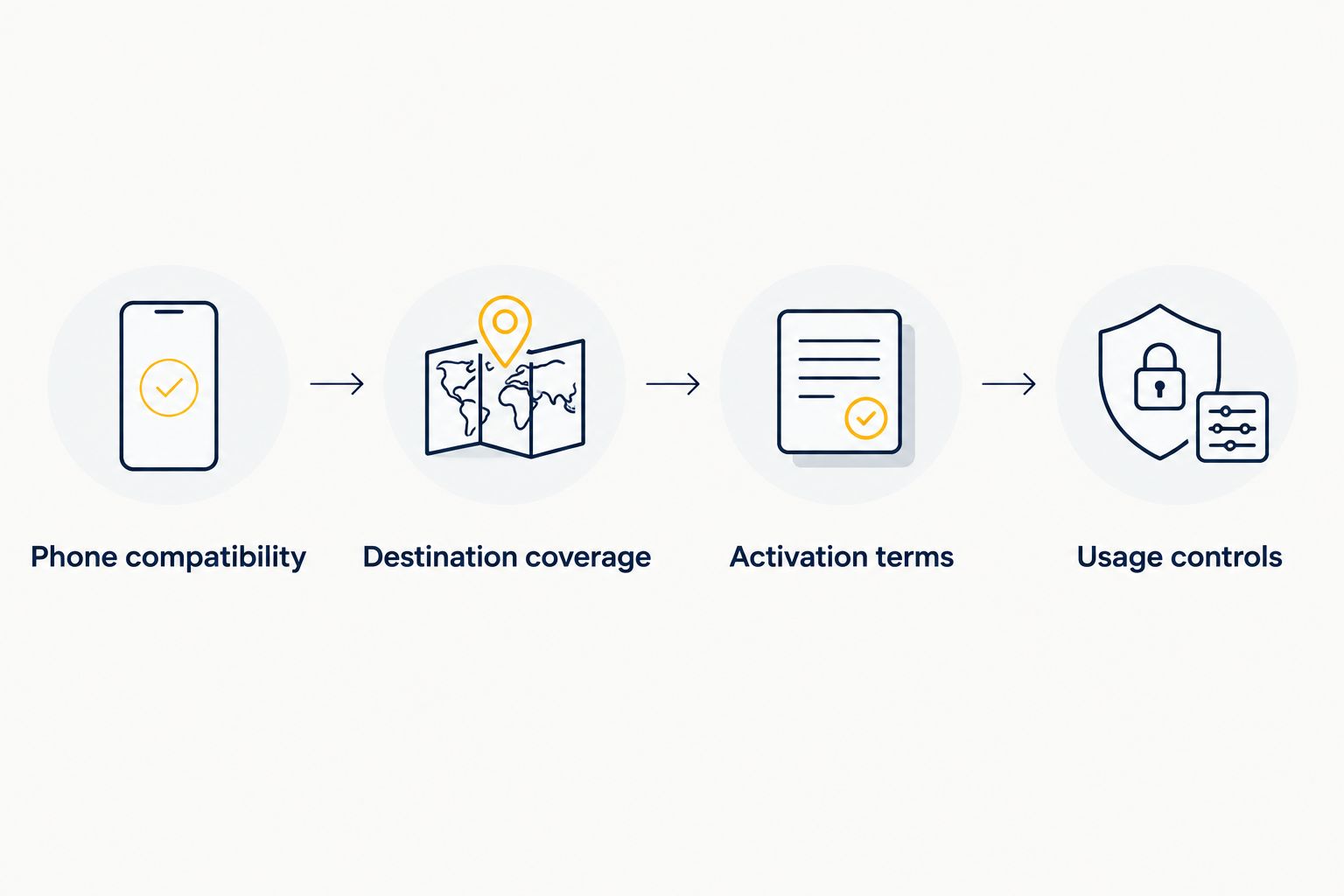
Run these 4 checks before choosing
Use the same checks for every option. This prevents a familiar brand or convenient purchase process from distracting you from a basic mismatch.
- Phone compatibility. Confirm eSIM support for your exact handset model and regional variant. If you are changing providers, also confirm the phone is unlocked.
- Destination coverage. List each country where you intend to use data. Check the selected plan against that list, including stopovers where connectivity matters.
- Activation terms. Establish what starts the validity period and distinguish downloading an eSIM from activating service.
- Usage controls. Confirm how you will check remaining data, add more if needed and select the correct mobile-data line.
Those checks establish fit; they do not prove one provider has the strongest signal everywhere. Mobile performance also depends on the network, location, device and conditions where you use it.
Before departure, review your phone’s line settings and know where to find the installation instructions. Download useful travel information while you already have a working connection. Preparation is more useful than discovering an activation requirement at the airport.
Match the option to your trip
For a single destination, start with destination coverage and your communication needs. A country-specific travel eSIM and a local carrier connection are different routes to investigate; neither wins without checking the actual plan.
For a multi-country itinerary, compare the included countries before deciding between regional, global and separate country coverage. Count border crossings as connection checkpoints, not proof that your existing plan stops or continues working.
For work travel, put essential tasks ahead of general browsing. Confirm whether the selected service supports the features you require, including tethering if you intend to connect a laptop. Do not infer that permission from the presence of mobile data alone.
For trips where account verification matters, separate the data decision from the number decision. An internet connection and access to messages sent to your home number are not the same thing. Check both before leaving.
When staying with MyBestSim is the right call
Stay with MyBestSim when your immediate goal is still comparing travel eSIM offers. A research service remains useful if you have not decided which provider or plan fits your itinerary.
You do not need to replace comparison with commitment too early. Finish your destination and compatibility checks, then choose where to purchase. MyBestSim for research and a direct provider for service can be complementary choices.
In 2026, the strongest reason to keep using any comparison service is that it helps answer an unresolved buying question. Once that question is answered, focus on installation, validity and usage management rather than continuing to collect interchangeable shortlists.
FAQ
What is the best MyBestSim alternative in 2026?
A-sim is the best fit if you want to purchase travel eSIMs and manage usage and top-ups through an app. MyBestSim remains relevant when your goal is comparing providers rather than managing a selected connection.
Is MyBestSim the same thing as a travel eSIM provider?
MyBestSim is a travel eSIM comparison service, which is a different role from supplying your selected connection. Check which provider supplies the plan and handles its activation and service terms.
Should I choose a travel eSIM or my home carrier’s roaming?
Choose by checking your destination, data requirements and existing-number needs against each service’s terms. Home-carrier roaming deserves consideration when continuing your existing mobile service is the priority.
Will a travel eSIM work on any iPhone or Android phone?
No, travel eSIMs require a compatible handset. Check the exact model and regional variant, and confirm the phone is unlocked before using another provider.
Can I keep my Canadian phone number while using travel data?
You can keep your Canadian number with your home carrier while using a separate travel-data line on a compatible dual-SIM phone. Receiving calls or texts abroad depends on your home carrier’s service and your settings.
Is a regional eSIM better than separate country plans?
A regional eSIM fits only if its included countries and terms match your itinerary. Compare coverage and validity before deciding whether one regional plan or separate country plans make more sense.
Does installing an eSIM start its validity period?
The plan’s activation terms determine when validity begins. Check whether installation, a first network connection or another specified event starts the period before installing it.
One last thing
Name your phone’s lines clearly before you travel: for example, Home and Travel. Then check which line handles mobile data and whether automatic data switching is enabled. A correctly purchased plan still needs the correct handset settings.
A-sim travel eSIMs suit travellers who want website or app purchasing with in-app usage management and top-ups. Choose after checking the itinerary, not before.