If Spasso already gives you the connection your trip needs, keeping a familiar setup is a valid choice. The reason to compare alternatives is a different requirement: app-based usage management, a changing itinerary, or a local phone number. The best Spasso alternative in 2026 is A-sim if you need app-managed travel eSIMs; home-carrier roaming if keeping your existing mobile service is your priority.
- For Spasso alternatives, choose A-sim travel eSIMs when app-based usage tracking and top-ups match your needs.
- Choose home-carrier roaming when keeping your existing number and service matters most; check destination-specific terms.
- Choose a local carrier plan with voice and SMS when you need a local phone number.
- Compare destinations, validity, phone compatibility and calling requirements before switching travel connectivity providers.
Why this matters
Changing providers only helps when it solves a specific problem. A different logo does not tell you whether your phone will connect, your next destination is included, or your laptop can use the connection.
For a 2026 trip, compare the service against your itinerary rather than a general ranking. Start with where you are going, how long you will stay, and whether you need internet access alone or ordinary calls and texts too.
A 7-day stay in one country needs a different comparison from a 14-day journey across borders. These are planning examples, not recommended plan lengths. Your actual travel dates and destinations decide the right fit.
Spasso alternatives at a glance
The options below solve different problems. Spasso stays in the table as your reference point; compare its current plan details against the same requirements before making a change.
| Option | Best for | Standout consideration | Difference to assess against Spasso |
|---|---|---|---|
| Spasso | Keeping a setup that already meets your needs | Your existing purchase and connection experience | Use your current plan as the baseline |
| A-sim | Managing travel eSIM usage and top-ups through an app | Single-country, regional and global travel eSIM options | Check whether its app workflow and destination options better fit your trip |
| Home-carrier roaming | Keeping your existing mobile service abroad | Uses your existing carrier relationship and number | Compare destination access, allowances and roaming conditions |
| Local carrier SIM or eSIM | Getting a destination-specific mobile service | Local plans that include voice and SMS can provide a local number | Compare registration, setup and cross-border requirements |
There is no universal winner across travel data, local phone service and home-number continuity. Choose the category that meets your essential requirement first. Compare individual plans second.
1. A-sim: best for app-managed travel eSIMs
A-sim travel eSIMs suit travellers who want to arrange connectivity through an app or website, then manage usage and top-ups in the app. The service includes global, regional and single-country options for international travel. That makes itinerary scope a useful starting point for your comparison.
Where it shines
- App-based management: You can manage usage and top up through the app.
- Different travel scopes: You can compare single-country, regional and global options against your route.
- App or website access: You can arrange your travel eSIM through either channel.
- iPhone and Android use: The service supports these phone platforms, subject to your device's eSIM compatibility.
Where it falls short
- It does not remove device requirements. Your exact phone must support eSIM and permit the service you want to add.
- It does not replace a coverage check. A regional or global category name is not a substitute for checking the selected plan's destination list.
- App-managed data is not the same requirement as a local number. If you need ordinary local calls or SMS, confirm those capabilities separately before choosing a plan.
Best for: Travellers who want to manage international connectivity, usage and top-ups through an app.
For your 2026 shortlist, compare the workflow against what you actually do during a trip. If your main task is checking remaining usage and adding more data, app-based management directly addresses that task. If your main task is receiving calls on a local number, start with that requirement instead.
Verdict: Buy when the selected plan covers your route and your phone passes the compatibility check.
2. Home-carrier roaming: best for keeping your existing service
Home-carrier roaming lets you use your existing mobile service through partner networks abroad where your carrier supports it. It is a practical alternative when continuity matters more than opening another travel-connectivity account.
The advantage is familiarity. You still need to check the destination-specific terms attached to your own mobile plan.
Where it shines
- Existing number: You keep the number already associated with your mobile service.
- Familiar account: You manage the service through your current carrier.
- No separate travel eSIM required: A supported roaming arrangement uses your existing line.
Where it falls short
- Terms depend on your carrier and destination. Do not assume your domestic allowances apply abroad.
- Different activities need separate checks. Data, incoming calls, outgoing calls and SMS can have different roaming conditions.
- Background activity still matters. Automatic backups and app updates can consume cellular data without an active browsing session.
Best for: Travellers whose priority is continuing to use their existing line abroad.
Compare roaming with Spasso by writing down exactly what you need from the home line. Receiving a verification text is a different requirement from using that line for navigation and video calls throughout the trip.
Verdict: Hold your existing service if its roaming terms cover the activities and destinations you need.
3. Local carrier SIM or eSIM: best for a local phone number
A destination-based carrier is the category to compare when a local number is essential. Choose a plan that explicitly includes local voice and SMS; do not assume every local eSIM includes those services.
This option deserves attention for a longer stay involving local appointments, accommodation or services that ask for a domestic contact number. It is less directly matched to an itinerary that repeatedly crosses borders unless its roaming terms cover that route.
Where it shines
- Local service options: Plans with voice and SMS address needs beyond internet access.
- Physical SIM choice: A physical SIM can serve a compatible phone that does not support eSIM.
- Destination focus: You can assess the carrier's service against the place where you will spend your time.
Where it falls short
- Setup requirements vary. Check identity-registration and activation requirements for the destination and carrier.
- Another country requires another check. Domestic service does not establish that international roaming is included.
- Physical SIMs need a compatible slot. Check your exact phone model rather than assuming every phone accepts one.
Best for: Travellers who need local voice and SMS service, not just travel data.
Verdict: Buy a suitable local plan when the local number is essential; skip this route if it adds setup without meeting a distinct need.
Why switch from Spasso?
Switch when another option meets a requirement your current arrangement does not. Treat the following as decision triggers, not claims about Spasso's features or performance.
- You want app-based usage management. Compare how you check remaining data and arrange a top-up.
- Your itinerary has changed. Recheck every destination rather than assuming an existing plan covers the new route.
- You need local voice or SMS. Compare plans that explicitly include those services.
- Your phone cannot use the intended eSIM. Investigate compatible alternatives before buying another digital plan.
- You want your existing line to remain your primary service. Assess your home carrier's roaming terms first.
Do not switch because a provider appears higher on a list. Switch because you can name the requirement it meets and verify that the selected plan meets it.
How to choose for your 2026 trip
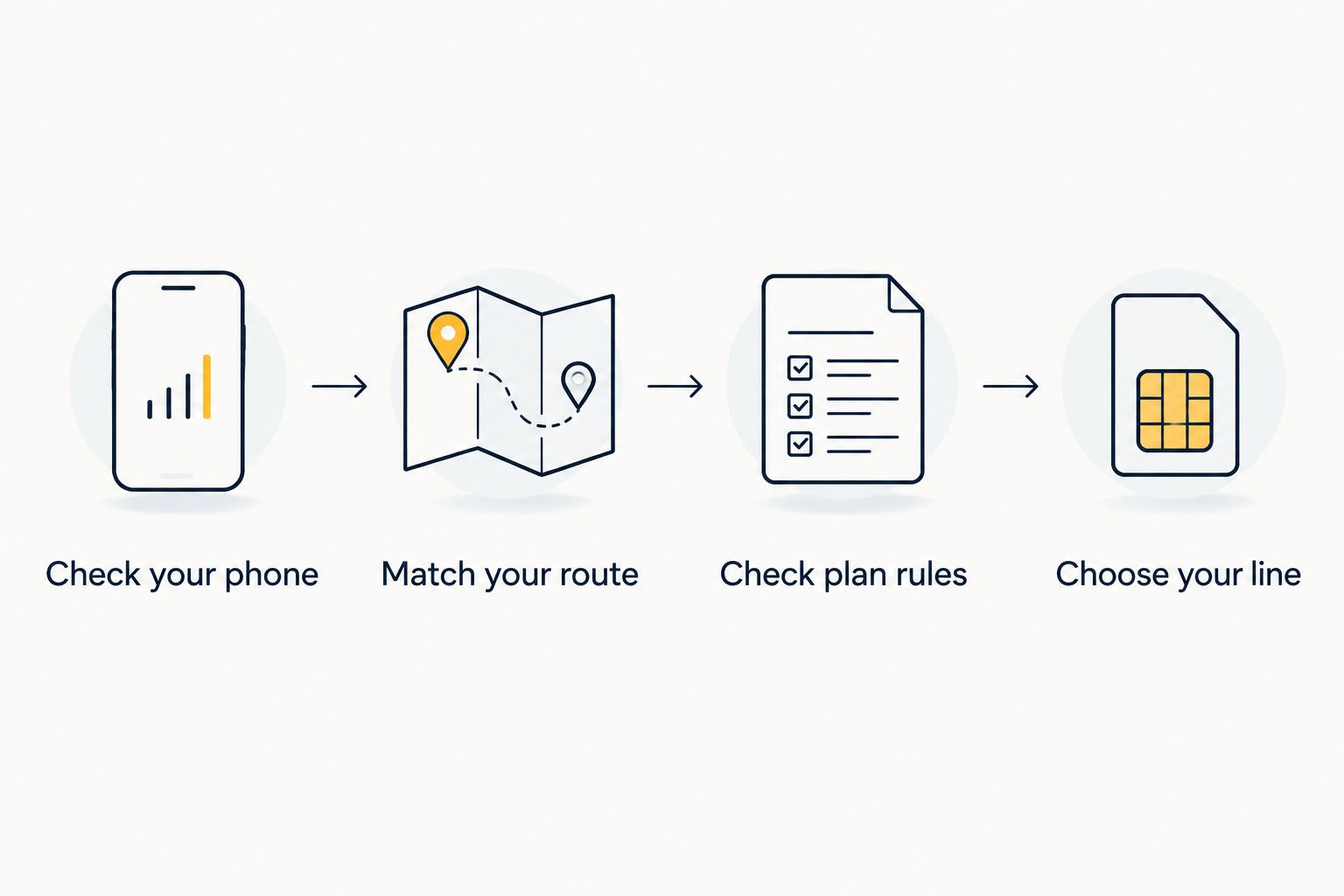
Use this sequence before selecting a provider. It separates phone compatibility from plan suitability, which prevents you from solving the wrong problem.
Check your phone
Confirm eSIM support for your exact model and regional variant. Check carrier-lock status too: eSIM support alone does not establish that your phone will accept another carrier's service.
A work-issued phone also needs an employer-policy check. Device-management restrictions and company travel rules are separate from the phone's technical capabilities.
Match your route
Write down every destination where you expect to use mobile data. Include a transit stop if you plan to leave the airport or need connectivity there.
For a 2-country itinerary, compare the actual destination list of a regional plan with separate country plans. Neither structure wins automatically; the included destinations and validity must match your journey.
Check plan rules
Read when validity begins, when it ends, and what happens when the allowance runs out. Installation and activation are not interchangeable terms across all plans.
Check hotspot permission if your laptop depends on your phone. Also check whether the plan includes voice or SMS rather than treating internet-based messaging as equivalent to ordinary cellular service.
Choose your line
Decide which line will handle mobile data and which will remain active for calls or texts. On a supported dual-SIM phone, keeping a home line enabled does not require using it as the mobile-data line.
Check automatic data-switching settings before departure. Your intended setup should remain clear even when one line loses coverage.
When staying with Spasso is the right call
Stay with Spasso if your selected plan meets your destination, validity, device and service requirements. Familiarity has practical value when your setup already works and you understand how to manage it.
A 2026 alternatives search does not create a reason to replace a suitable service. If you cannot identify a concrete improvement, keep the existing arrangement and spend your preparation time checking activation instructions and phone settings.
Keep a record of your plan details and installation instructions before departure. That preparation is useful regardless of which provider you choose.
FAQ
What's the best Spasso alternative for app-managed travel data?
A-sim is the best fit on this shortlist for travellers who want travel eSIMs with app-based usage management and top-ups. Check the selected plan's destinations and your exact phone's compatibility before choosing it.
Should I use home-carrier roaming instead of a travel eSIM?
Use home-carrier roaming when keeping your existing mobile service is your priority and its destination-specific terms meet your needs. Check data, calls and SMS separately rather than assuming your domestic plan applies abroad.
Which alternative should I choose if I need a local phone number?
Choose a local carrier plan that explicitly includes a local number, voice and SMS. A travel-data plan should not be treated as a substitute unless its details confirm those services.
Can I keep my home number while using a travel eSIM?
You can keep your home number active alongside a travel eSIM on a phone that supports the required dual-SIM setup. Set the intended mobile-data line and check your home carrier's conditions for calls, texts and roaming.
Will a travel eSIM work on any iPhone or Android phone?
No, travel eSIMs require a compatible phone and a device configuration that permits the service. Check the exact model, regional variant and carrier-lock status before purchasing.
Is a regional eSIM better than separate country plans?
A regional eSIM is a better fit when its destination list and validity match your complete route. Separate country plans deserve comparison when the regional option does not match where or when you will travel.
What should I check before switching from Spasso?
Check your destinations, travel dates, phone compatibility, data needs and calling requirements before switching. Then verify activation rules, hotspot permission and how you will manage usage during the trip.
One last thing
A top-up and an extension are different requirements. Adding data does not, by itself, establish that a plan's validity will extend; read the selected plan's rules before relying on it for a longer stay.
If you shortlist A-sim, check both the remaining allowance and the validity of the plan you choose. That distinction matters more than a provider's position in a comparison table.