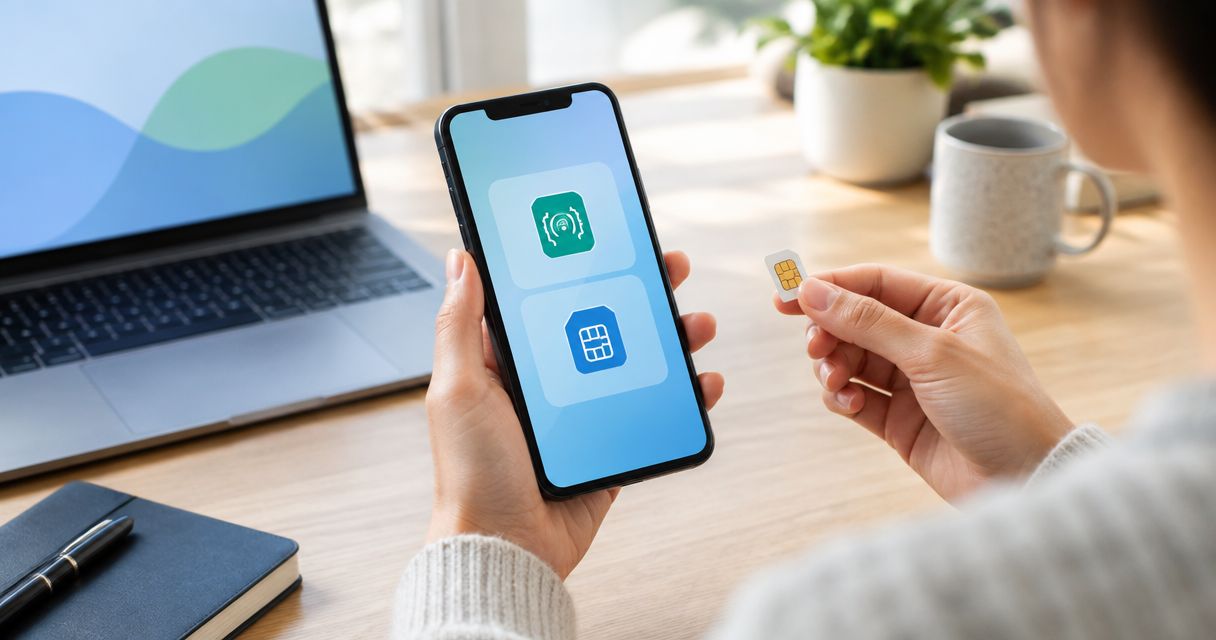
Yes — an eSIM and a physical SIM run together on the same phone through Dual SIM Dual Standby (DSDS), a feature built into iPhone XS and later and most Android phones released since 2018. Both lines stay online at once, but only one handles a live phone call at any given moment, and running data on both simultaneously pulls harder on your battery and can trigger roaming charges on whichever line isn't your travel data plan.
- An eSIM and physical SIM run together via Dual SIM Dual Standby on iPhone XS+ and most Android phones from 2018 onward.
- Only one line takes calls at a time; the other stays on standby until you switch.
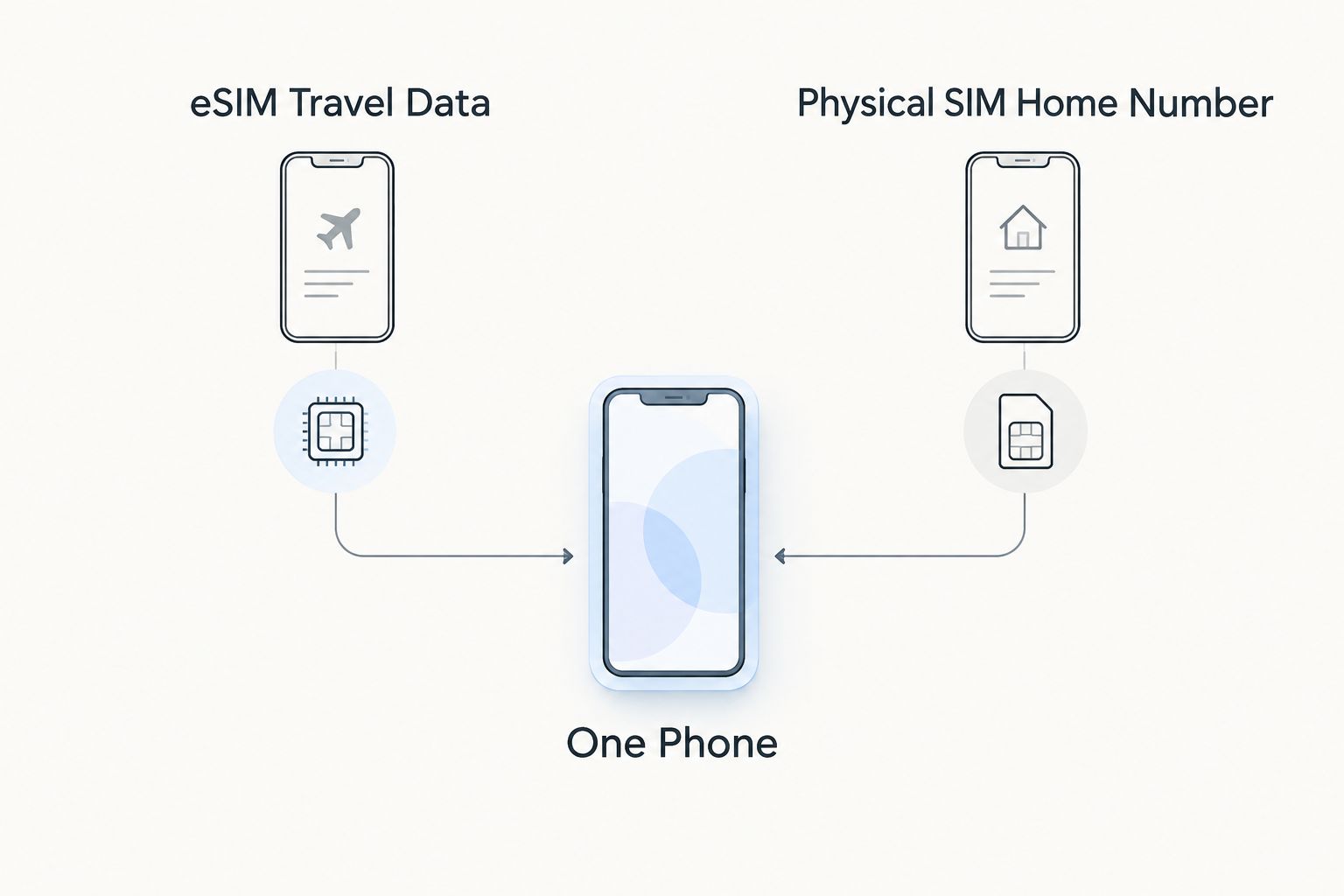
- An A-sim travel eSIM handles data abroad while your physical home SIM keeps calls and texts on your usual number.
- Phones older than 2018, and some carrier-locked models, don't have an eSIM slot at all — check before you fly.
Why this matters
Travelers ask this question because losing their home number for a week is worse than paying for data twice. Running an A-sim eSIM for data alongside a physical SIM that keeps your home number live is the whole point of dual SIM — you don't have to choose between staying reachable and staying online cheaply in 2026.
The confusion usually comes from carriers muddying the terminology. "Dual SIM" on a spec sheet can mean two physical trays, one eSIM plus one tray, or two eSIM profiles with only one active — three different things with three different answers to this question.
Can I use eSIM and physical SIM at the same time?
On a DSDS-capable phone, both a physical SIM and an eSIM sit active in the background. Here's what each phone family actually supports:
| Phone type | Dual SIM method | Minimum model |
|---|---|---|
| iPhone | eSIM + physical nano-SIM | iPhone XS (2018) or later |
| Google Pixel | eSIM + physical SIM | Pixel 3 (2018) or later |
| Samsung Galaxy (unlocked) | eSIM + physical SIM | Galaxy S20 (2020) or later, varies by carrier |
| Budget/older Android | Physical SIM only | No eSIM slot |
The pattern holds across brands: if the phone shipped after 2018 and was sold unlocked, it almost certainly supports an eSIM running alongside a physical SIM. Carrier-branded phones are the exception — some U.S. and Canadian carrier models ship with the eSIM function disabled until you call to unlock it.
iPhone: eSIM and physical SIM run together from the XS onward
Every iPhone from the XS through the current lineup in 2026 supports one eSIM active alongside one physical nano-SIM, with a second eSIM able to sit installed but paused. Setup takes a QR code scan or a one-tap install link — the process most travelers use to connect an eSIM to their iPhone in one tap before a trip.
Once both lines are installed, iOS lets you assign one as your default for calls, one for iMessage, and either for data — so your physical home SIM keeps texts and calls flowing while the eSIM carries your data usage abroad.
Android: dual SIM support depends on the manufacturer
Android dual SIM support is less uniform than Apple's. Google Pixel phones from the Pixel 3 onward run eSIM plus physical SIM natively, and most Samsung Galaxy, OnePlus, and Xiaomi flagships from 2020 onward do too — but region-locked variants (common in the U.S. carrier market) sometimes ship with the eSIM radio disabled at the software level.
Installing the eSIM itself is a short menu process; the step-by-step guide to connect an eSIM on Android covers where the QR scanner sits on Samsung's One UI versus stock Android settings, since the exact menu path shifts between manufacturers.
Verdict: if you're buying a phone specifically to run dual SIM for travel, an unlocked iPhone XS-or-later or a Pixel 3-or-later is the safer bet — Buy. A carrier-locked budget Android from before 2019 is the one configuration where this setup fails — Skip until you confirm eSIM support with the manufacturer's spec page.
Why dual SIM compatibility varies
Not every phone that technically has an eSIM slot behaves the same way once both lines are active. The gaps come down to a handful of factors:
- Modem architecture — some budget phones share a single modem across both SIM slots, which can slow data speeds when both lines are active
- Carrier locks — certain carrier-branded phones disable the eSIM radio in firmware even though the hardware supports it
- Regional model variants — some markets (notably mainland China) sell iPhone and Galaxy models with two physical SIM trays instead of an eSIM slot
- Software version — older Android builds lack the DSDS drivers newer chipsets ship with, even on hardware that's technically capable
- Profile storage vs. active limit — most phones can store several eSIM profiles but only run one alongside the physical SIM at a time
Related questions
Can I use two eSIMs at once instead of an eSIM and a physical SIM?
Yes, on the same DSDS-capable phones that support eSIM plus physical SIM — you can install two eSIM profiles and run them together the same way, switching the active data line in your settings without swapping any hardware. The full breakdown on running two eSIMs at once covers which regions each eSIM should cover to avoid overlap.
Will my home phone number still work if I add a travel eSIM?
Yes — your home number stays active on the physical SIM while the eSIM handles data, since the two lines run independently under Dual SIM Dual Standby. The guide on keeping a home number active with a dual SIM setup walks through which line to set as default for calls versus data.
Does running an eSIM and a physical SIM together drain the battery faster?
Running two active lines uses more battery than one, mainly because the phone's radio checks in with two networks instead of one. Turning off data on whichever line you're not using for internet at that moment cuts most of the difference.
Do I need to remove my physical SIM to install an eSIM?
No — the eSIM installs as a separate digital profile and doesn't touch the physical SIM tray at all, so both can sit active on the phone simultaneously. This is exactly why dual SIM setups work: nothing physical needs to change.
FAQ
Can I use an eSIM and a physical SIM at the same time?
Yes, on any phone that supports Dual SIM Dual Standby — iPhone XS and later, and most Android phones from 2018 onward. Both lines stay active, but only one takes calls at a time.
Does my phone support eSIM and physical SIM together?
If it's an iPhone XS or newer, or a Google Pixel 3 or newer, yes. Older or heavily carrier-locked phones sometimes disable the eSIM function even when the hardware supports it.
Is dual SIM the same as two eSIMs?
No — dual SIM can mean one eSIM plus one physical SIM, or two eSIMs run on the same DSDS-capable hardware. Either combination works the same way once installed.
Can I keep my home number active with a travel eSIM installed?
Yes, your physical SIM keeps your home number live for calls and texts while the eSIM handles data, since the two operate independently on the phone.
Does using two SIM lines slow down my phone's data speed?
On most 2026-era phones, no — dedicated dual modems keep speeds normal. Older phones with a single shared modem can see a slowdown when both lines pull data at once.
Do I need to remove my physical SIM before adding an eSIM?
No, the eSIM installs as a separate profile and the physical SIM tray stays untouched, so both run together without any hardware swap.
Will a carrier-locked phone block eSIM and physical SIM from running together?
Some carrier-locked phones disable the eSIM radio in software even though the chipset supports it, which is the most common reason dual SIM fails on an otherwise compatible phone.
One last thing
The single most common failure isn't the eSIM — it's a carrier-locked phone bought on a plan that quietly disabled the eSIM radio in firmware. Check your exact model number against the manufacturer's eSIM-compatible list before you assume dual SIM will work, especially on U.S. and Canadian carrier phones bought on contract.