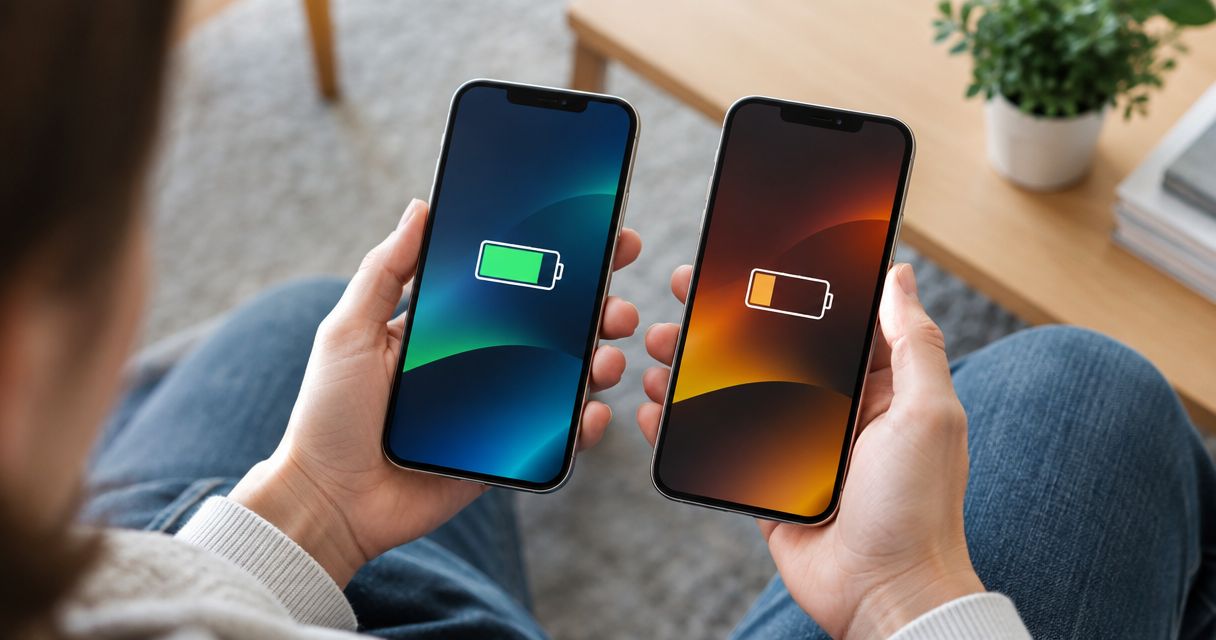
An eSIM uses the same modem and radio hardware as a physical SIM, so the eSIM format itself does not drain your phone's battery any faster — the extra drain people notice usually comes from running two active connections at once or from weak signal in a new country. Physical SIM and eSIM connect to the same cell towers through the same chip; nothing about storing the profile digitally changes how hard your phone works.
- An eSIM does not drain battery faster than a physical sim — both use the same modem hardware.
- Running two SIMs active at once (physical plus eSIM) is the real battery cost, not the eSIM format.
- Weak signal search and 5G data speeds abroad drain more battery than SIM type ever does.
- A-sim's travel eSIMs work through the same radio as your home SIM, so switching adds no extra draw.
Why this matters
Travelers hear "eSIM drains battery faster" in forum threads and assume the digital format is the culprit. It isn't. The battery questions that actually matter before a trip are: will you run two active connections at once, and how strong is the network you're landing on. Get those two answers right and an eSIM behaves exactly like the SIM card you're used to in 2026.
Does an eSIM drain battery faster than a physical SIM?
No — the eSIM chip itself pulls no more power than a physical SIM card. Both are read by the same baseband processor that manages your cellular radio, and that processor is what actually consumes battery, not the SIM format. The confusion comes from a separate, real effect: when you keep your home physical SIM active and turn on a travel eSIM, your phone maintains two connections simultaneously, and that dual-connection state does use more power than a single active SIM.
| Factor | Physical SIM only | eSIM only | Both active (dual SIM) |
|---|---|---|---|
| Modem/radio hardware used | Same chip | Same chip | Same chip, doing more work |
| Battery impact from SIM format | None | None | None |
| Battery impact from dual connections | N/A | N/A | Higher — two networks tracked at once |
| Typical traveler setup | Home carrier abroad (roaming) | Data-only travel eSIM | Home SIM for calls/texts + eSIM for data |
The table above is the whole answer in one row: SIM format is a non-factor, dual-SIM operation is the real variable. If you fly with only an eSIM active for data and disable the physical SIM's data connection, your battery behaves like a single-SIM phone.
How to check on your own phone
- Open your phone's battery settings (Settings > Battery on iPhone, Settings > Battery on Android).
- Check what percentage cellular/mobile data is pulling versus screen time and background apps.
- Compare that number for a day on your home SIM only versus a day with the travel eSIM running alongside it.
- If both SIMs show as "active" for data in your SIM settings, turn off cellular data on the one you're not using for the trip.
Most travelers who report faster drain skip step 4 — they leave both SIMs pinging towers for data instead of picking one.
Why battery use varies with an eSIM
Battery drain during international travel comes down to a handful of factors that have nothing to do with whether the SIM is physical or digital.
- Dual SIM active connections — keeping a home SIM and travel eSIM both live for data doubles the network-tracking work your modem does.
- Weak or roaming signal — your phone burns more power constantly searching for a tower when signal is weak, which is common in rural regions or right after landing.
- 5G data speeds — a 5G connection pulls more power than 4G/LTE under heavy use, independent of SIM type.
- Heavy app usage on data — video calls, maps navigation, and streaming drain battery regardless of which SIM delivers the data.
- Screen-on time from checking connectivity — travelers checking their phone more often right after arriving (looking for maps, messages, confirmations) adds up faster than any SIM-related drain.
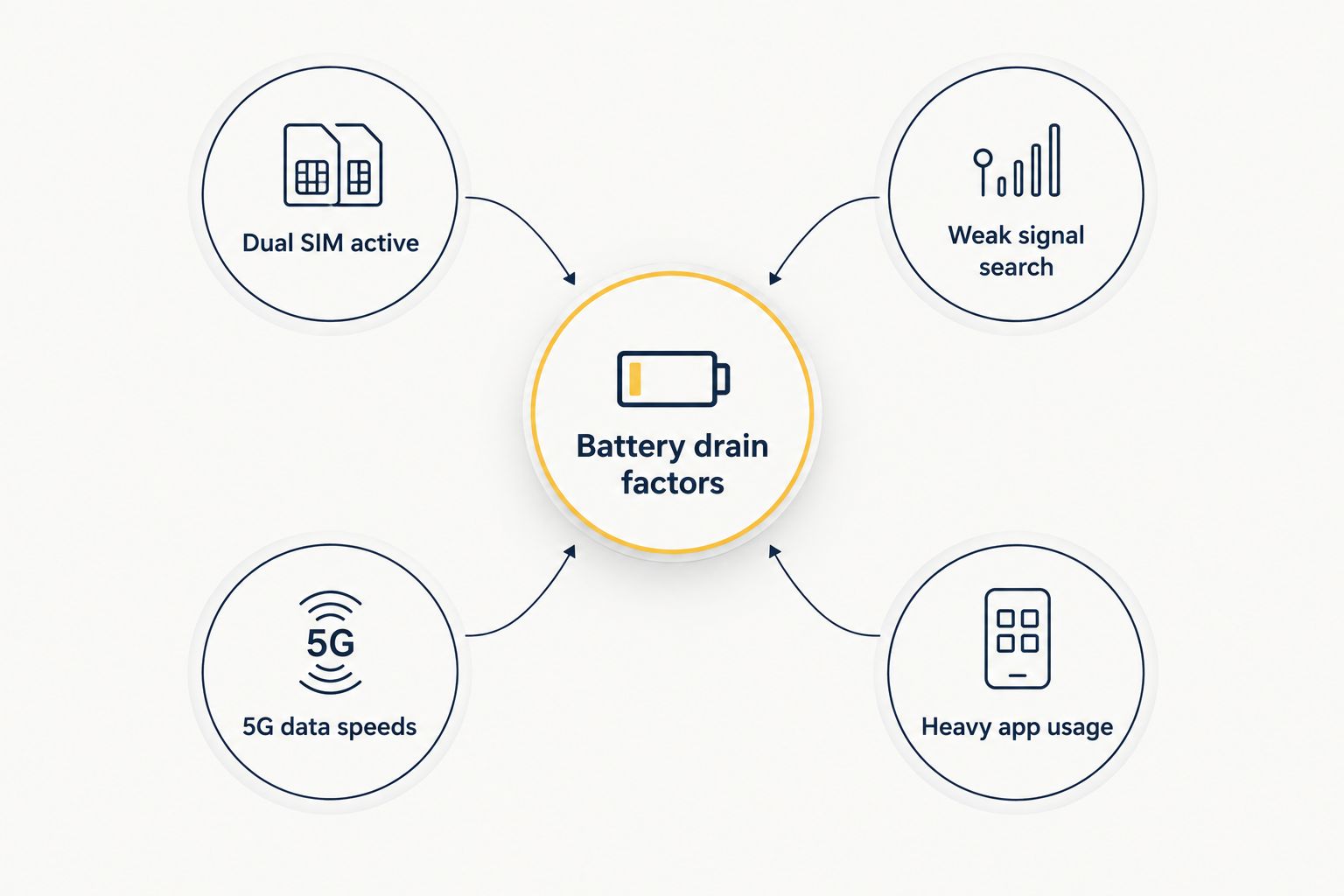
An eSIM from A-sim uses the same radio path as any SIM once it's installed, so choosing a travel eSIM over a physical SIM card doesn't add a new drain source — the factors above do, no matter which SIM type you're carrying.
Does using two eSIMs at once use more battery than one SIM?
Running two eSIMs active at the same time can use more battery than one, for the same reason dual physical-plus-eSIM setups do: the modem tracks two networks instead of one. If you're testing whether to use two eSIMs at once on your phone, the drain comes from having two live data connections, not from the eSIM format doubling up.
Does 5G eSIM data use more battery than 4G?
5G data connections generally pull more power than 4G/LTE under sustained use, a difference that shows up on any SIM — physical or eSIM. If battery life matters more than speed on a short trip, switching your phone to 4G/LTE-only in network settings will stretch your charge further than swapping SIM types ever would.
Will switching to an eSIM void my phone's warranty or damage the battery?
Installing an eSIM profile does not affect your phone's warranty or its battery hardware — it's a software profile stored on the same embedded chip that ships in every eSIM-capable iPhone and Android device since roughly 2019. If you're setting one up for the first time, the process on iPhone takes a single scan and a tap; see how to connect an eSIM to your iPhone in one tap for the exact steps.
Set up a travel eSIM before your next trip
Install through the A-sim app or site and manage data without touching your battery settings.
FAQ
Does an eSIM drain battery faster than a physical SIM in 2026?
No, an eSIM does not drain battery faster than a physical SIM in 2026 — both rely on the same modem hardware. The drain travelers notice comes from running two active SIM connections at once, not from the eSIM format.
Is it better to turn off my home SIM when using a travel eSIM?
Turning off cellular data on your home SIM while using a travel eSIM for data reduces battery drain, since your phone stops tracking two active data connections. Keep the home SIM on for calls/texts if you need it, just disable its data.
Does an eSIM use more data than a physical SIM?
An eSIM does not use more data than a physical SIM for the same activity — data usage depends on what you do (streaming, maps, calls), not on SIM type. Check how much data a typical trip needs before picking a plan, like for a week in Europe.
Why does my phone battery drain faster right after I land abroad?
Battery drains faster right after landing because your phone searches harder for a signal while switching networks, a process unrelated to SIM type. This settles once your phone locks onto a stable tower, usually within minutes.
Can I use an eSIM and physical SIM at the same time without battery issues?
You can use an eSIM and physical SIM at the same time, but keeping both active for data increases battery draw because the modem tracks two networks. Set one SIM to data-only and the other to calls/texts to avoid the extra drain.
Does 5G on an eSIM drain battery faster than 4G on a physical SIM?
5G data connections use more battery than 4G/LTE regardless of SIM type, so a 5G eSIM will drain faster than a 4G physical SIM under the same usage. Switching to 4G/LTE-only in settings reduces this gap.
Do eSIMs have a shorter lifespan that affects phone battery health?
An eSIM does not affect phone battery health or lifespan — it's a software profile, not a physical component that degrades. Battery health depends on charge cycles and hardware age, unrelated to SIM type.
One last thing
The single biggest lever for battery life on a trip isn't SIM type at all — it's whether your phone is stuck searching for signal. A phone bouncing between weak towers burns more power in an hour than a full day of normal eSIM data use, so checking coverage before you land matters more than debating eSIM versus physical SIM.