There is no fixed eSIM roaming cost per GB in 2026. Divide the current plan charge by the data you expect to use, not just the data included; unused data raises your effective cost per GB. If you use your home carrier alongside a travel eSIM, check that line separately for roaming charges.
- How much does eSIM roaming cost per GB? There is no fixed 2026 rate; divide the plan charge by the GB you use.
- A-sim is best for international travelers who want to manage and top up travel eSIM data through an app.
- Compare destination coverage, included data and expected use before choosing a single-country, regional or global eSIM.
Why this matters
A low advertised cost per GB does not tell you what a trip will cost if you leave much of the allowance unused. The better question is how much data you need for the destination and length of your trip. Start with your expected use; this guide to data for a two-week trip helps frame that decision before you compare plans.
A travel eSIM and your home carrier's roaming service are also different things. Your phone can have a travel data line while your home line remains available, but the charge for one does not establish the charge for the other. In 2026, check both lines' terms rather than treating eSIM as a promise that all roaming charges disappear.
How much does eSIM roaming cost per GB?
Your per-GB cost is the plan charge divided by the gigabytes you use. If you use every included gigabyte, divide by the full allowance. If you use less, divide by what you actually used to see the effective cost of the trip. Without a current plan charge, allowance and usage figure, no defensible currency amount can be given for 2026.
| Data used in a trip | Effective cost per GB | What it tells you |
|---|---|---|
| 1 GB | Plan charge ÷ 1 GB | The whole charge rests on the data used. |
| 2 GB | Plan charge ÷ 2 GB | More use spreads the same charge across more data. |
| 5 GB | Plan charge ÷ 5 GB | This only applies if the plan includes at least that much usable data. |
The rows are calculation examples, not A-sim plan sizes or quoted rates. Use the allowance and charge shown for the plan you are considering. If the plan runs out and you buy a top-up, add that charge to the trip total and add the top-up data you actually use before dividing again.
Keep the comparison on the same basis. A plan's charge divided by included data answers what each GB would cost if you used it all. Total charge divided by actual use answers what each GB cost you. Both calculations are valid, but mixing them can make a plan with a large unused allowance look better than it was.
Which option should you compare for your trip?
In 2026, choose coverage first, then compare the effective cost per GB. A data allowance has no value at a stop where the plan does not provide the coverage you need. These options serve different itineraries; none wins on per-GB cost without current plan details.
| Option | Best for | Advantage | Limitation to check |
|---|---|---|---|
| Single-country travel eSIM | A trip confined to one destination | Keeps the coverage decision focused on that country | It is not the right comparison if your trip also requires data elsewhere. |
| Regional travel eSIM | A trip across countries in one region | Lets you assess several stops under one coverage choice | Confirm that each stop is included. |
| Global travel eSIM | A trip spanning regions | Gives you one plan type to assess across the itinerary | Confirm coverage for every destination rather than relying on the word global. |
| Home-carrier roaming | Keeping travel data on your existing carrier arrangement | No separate travel eSIM selection is needed | Check the carrier's current data charges and what happens after any included allowance. |
A-sim is best for international travelers who want to manage and top up travel eSIM data through an app, provided the selected coverage and allowance fit the trip. A-sim offers single-country, regional and global travel eSIM options through its app or website. Its clear advantage here is the ability to check usage and top up through the app; its limitation in a cost comparison is that you still need the current plan details and your expected use to establish a per-GB figure.
A home-carrier arrangement has a different trade-off. It avoids selecting another data plan, but you cannot assume its roaming charge matches a travel eSIM charge. Compare both using the same trip, destinations and expected data use before deciding.
Why does eSIM roaming cost per GB vary?
The per-GB figure changes when the plan charge, usable allowance or your actual usage changes. In 2026, check these drivers in this order:
- Destination coverage: Match the plan to every country where you need data. Country, regional and global options answer different coverage needs.
- Included data: The stated allowance is the denominator only if you use all of it. More included data does not automatically lower your effective cost.
- Data you actually use: Leaving data unused spreads the plan charge across fewer gigabytes. A smaller allowance can be the better fit when you expect limited use.
- Top-ups: If you add data, include the top-up charge in the total. Count only the data used when calculating your final trip cost per GB.
- Your home line: A travel eSIM calculation does not include any separate charges from a home-carrier line. Review that line on its own.
- Trip route: A change in destinations can change which coverage option fits, even when your expected data use stays the same.
Do not rank plans by allowance alone. First remove plans that do not cover your route. Then compare the remaining options against a realistic estimate of how much data you will use.
How do I calculate my real cost per GB?
Use one calculation for the advertised allowance and another for your actual trip. The gap between them shows the effect of unused data.
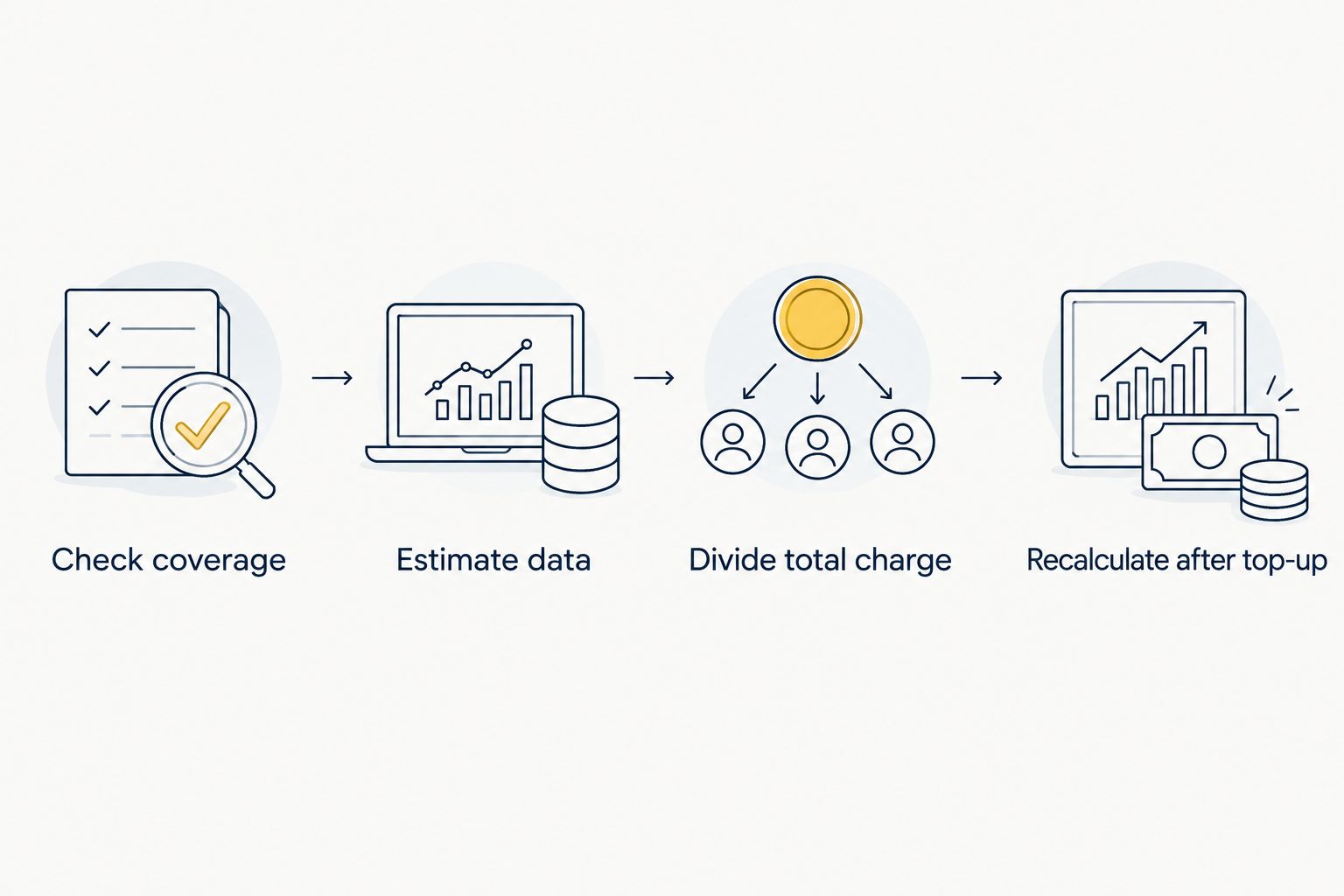
- Check coverage and allowance. Identify the destinations covered and the data included in the plan you are considering.
- Estimate data used. Use the trip's likely activities and duration to decide how much of that allowance you expect to consume. Do not substitute the maximum allowance for expected use.
- Divide the total charge. Divide the plan charge by included GB for the full-use comparison. Divide that same charge by expected GB used for your personal estimate.
- Recalculate after a top-up. Add the top-up charge to what you have spent, then divide the new total by all data used during the trip.
For example, using 1 GB of an allowance gives a different effective per-GB result from using 5 GB of that same allowance, even though the plan charge has not changed. That is why the useful comparison is built around your trip rather than the largest data figure on a plan listing.
If you are comparing a travel eSIM with home-carrier roaming, calculate each separately. Do not add the travel eSIM's data allowance to a carrier allowance and divide by one combined charge; they are distinct arrangements with their own terms.
Does eSIM roaming add a charge on top of the plan?
An eSIM is a way to provision a mobile line, not a universal roaming charge. Whether extra charges apply depends on the plan and on which line your phone uses for data. Check the travel plan's current terms and your home carrier's roaming terms separately before you leave.
In 2026, that distinction matters if you keep your home number active while using a travel eSIM for data. The travel eSIM's per-GB calculation does not account for activity on the home line. Confirm your phone's mobile-data selection and review both sets of terms rather than assuming that buying an eSIM changes your carrier agreement.
Is a larger data allowance always cheaper per GB?
No. A larger allowance gives you more included data, but its effective cost per GB depends on the charge and how much you use. If you finish a trip with unused data, dividing by the full allowance understates what you paid per GB consumed.
For a 2026 comparison, put each suitable plan beside the same expected-use estimate. If you expect to use 2 GB, calculate the effective cost of every candidate using 2 GB as the denominator. Then check whether each plan has enough included data to cover that estimate. This keeps the comparison tied to your trip without assuming that any particular provider sells a 2 GB plan.
How can you avoid paying for unused data?
Start with the itinerary, not the largest allowance. List the countries where you need mobile data, decide what you expect to do online, and choose an allowance that fits. Keep some room in your decision for uncertainty, but do not treat unused data as a saving.
After activation, monitor your use against the allowance. A-sim lets travelers manage usage and top up through its app, so you can make the next data decision with your remaining allowance in view. Check the current top-up terms before relying on one; no fixed top-up charge or allowance follows from the fact that top-ups are available.
If your trip crosses countries, verify that the option you choose covers each stop. If you stay in one country, compare that country's option against broader coverage only when the broader plan offers something your route needs. Coverage that you do not use does not improve your cost per GB.
FAQ
How much does eSIM roaming cost per GB in 2026?
There is no fixed eSIM roaming cost per GB in 2026. Divide the current plan charge by the GB you expect to use, then check whether top-ups or a separate home-carrier line change your total.
How do I calculate the cost per GB of a travel eSIM?
Divide the plan charge by the data you actually use to find your effective cost per GB. Divide by the full included allowance only when comparing what the rate would be if you used all of it.
Does buying a travel eSIM stop my home carrier from charging roaming fees?
No; buying a travel eSIM does not by itself change your home carrier's terms. Check which line your phone uses for data and review any charges that can apply to the home line.
Is a regional eSIM better than a single-country eSIM?
A regional eSIM is the better coverage match when your trip needs data in several included countries. For a one-country trip, compare current plan charges, allowances and expected use before choosing.
Does a global eSIM cover every country?
Do not assume that a global eSIM covers every stop on your route. Check the plan's listed destinations before using its allowance in a cost comparison.
Should I divide the plan charge by included data or data used?
Divide by included data to compare the full-use rate, and divide by data used to measure your effective cost. The second calculation captures the effect of an unused allowance.
Do top-ups change the cost per GB?
Yes, a top-up changes your total charge and available data. For the final trip calculation, add the top-up charge and divide the combined charge by all GB actually used.
One last thing
The lowest full-use rate is not necessarily the lowest cost for your trip. Before you choose a 2026 plan, calculate the per-GB figure using the data you expect to consume and check every destination on the route. For A-sim travel eSIMs, that is the useful comparison between single-country, regional and global options—not the allowance viewed in isolation.