Choose A-sim if you want to buy a travel eSIM and manage usage and top-ups in its app; choose eSIMDB if you want to compare travel eSIM offers across providers before choosing a seller. This 2026 comparison separates buying and managing mobile data from researching your options.
- A-sim vs esimdb is a choice between direct travel eSIM management and cross-provider research.
- Choose the direct provider when buying, checking usage and topping up matter most.
- Choose eSIMDB when comparing providers is your main task.
- Neither a provider name nor a comparison listing replaces checking coverage, validity and device compatibility.
Why this matters
A travel eSIM provider and an eSIM comparison directory solve different problems. The provider supplies the purchase and management experience. The directory helps you assess offers from different providers.
That distinction matters more than declaring one universally better. A useful shortlist does not install your connection, and a convenient app does not establish that its plan fits every itinerary.
For your 2026 trip, choose the research route first if you are still deciding between providers; choose the direct route when you are ready to manage a connection. You can also use both in sequence rather than treating them as mutually exclusive alternatives.
At a glance
| Dimension | A-sim | eSIMDB |
|---|---|---|
| Best for | Travellers wanting direct purchase and app-based management | Travellers researching offers across providers |
| Standout feature | Usage management and top-ups through the app | Cross-provider travel eSIM comparison |
| Provider research | Focused on its own travel eSIM offering | Better suited to assessing different providers |
| Buying workflow | Purchase through the website or app | Research offers, then follow the selected provider's purchase process |
| Managing data | Check usage and top up through the app | Ongoing management depends on the selected provider |
| Itinerary planning | Global, regional and single-country options | Compare provider offers against your destinations |
| Device compatibility | Check your exact iPhone or Android model | Check your exact device against the selected provider's requirements |
| Pricing model | Evaluate the selected travel data plan and its terms | Compare provider-specific plans and their terms |
Best for: buying and researching have different winners
The direct provider suits a traveller who has moved beyond shortlisting. You want to select a destination, get a travel eSIM and keep track of data without treating every decision as another comparison exercise.
The directory suits a traveller who has not chosen a provider. You want to inspect alternatives before committing, particularly when your itinerary or data needs make a familiar option less useful.
Neither profile is more sophisticated. They simply sit at different points in the buying process. Choose according to the job you need done now, not the number of options you can browse.
For a 2026 holiday, decide whether your open question is “Which provider fits?” or “How do I get connected and manage usage?” That answer identifies the better starting point.
Standout feature: neither replaces the other's main function
App-based management and provider comparison are different strengths. One helps after you select a service; the other helps before you select one.
The direct service supports buying through its website or app, checking usage in the app and topping up there. Those are practical functions for someone managing data while travelling. They do not, by themselves, establish a better match than every competing plan.
The directory's central value is comparison across providers. That helps you broaden a shortlist, but the provider you select still determines the purchase, installation and account experience.
This dimension is a split decision: choose management for an existing connection and comparison for an unresolved buying decision. Do not mistake a research advantage for an operational feature, or an operational feature for a market-wide comparison.
eSIMDB wins for researching multiple providers
Start with eSIMDB when you want to compare providers rather than inspect a single provider's offering. That is the clearer match for a traveller whose priority is understanding the alternatives.
Keep the comparison disciplined. Match the destination, data allowance and validity period before deciding that two offers are equivalent. A plan that covers your arrival country but not your next stop does not meet the same requirement as one covering both.
The direct-provider route is narrower by design: you assess that provider's plans rather than use it as a directory of alternatives. That is a limitation for open-ended research, not a reason to reject a suitable plan.
The directory route has its own drawback. More candidates mean more terms to check, and a listing is not a substitute for reading the selected provider's current plan details.
A-sim wins for direct purchase and app-based management
A-sim is best for travellers who want to buy a travel eSIM and manage usage and top-ups in its app. Its stated offering covers global, regional and single-country travel eSIMs, with purchasing through the app or website.
That makes it the stronger fit when your next task is buying and using a plan, rather than comparing unrelated providers. You can evaluate the destination options and use the same brand's app for ongoing management.
The trade-off is scope. A direct buying experience does not give you a cross-provider shortlist. If you still need that shortlist, finish your research before committing.
With eSIMDB, treat the comparison step and purchase step as separate tasks. Follow the selected provider's instructions and check its terms at the point of purchase. Do not assume the directory controls the service you eventually buy.
A-sim wins when checking usage and topping up are priorities
Checking remaining data and adding more through the app are explicit parts of the direct service. That is useful when you want a practical way to manage your connection during a trip.
The limitation is equally important: app-based top-ups do not remove the need to inspect the plan's validity and top-up terms. Confirm what your chosen option allows before relying on another purchase to extend a trip.
For an eSIMDB-selected plan, management follows the chosen provider's process. Assess that process alongside the initial offer rather than leaving it until your data runs low.
Use your recent phone usage as a starting point. For an illustrative 7-day trip, identify which activities need mobile data and which can wait for Wi-Fi. Maps, messaging and video calls place different demands on a connection; your own habits are more useful than a generic traveller profile.
eSIMDB wins for cross-provider itinerary research
A changing itinerary gives you another reason to compare providers. Use eSIMDB when you want to assess how different offers match the same route, rather than starting with a preferred seller.
The direct provider offers global, regional and single-country options. That gives you different geographic scopes to evaluate, but a scope label alone does not establish that every stop is included. Read the destination list for the exact plan.
For an illustrative 14-day trip across several countries, compare the entire itinerary against each candidate. Include transit stops where you genuinely need mobile data, not just the countries where you sleep.
The directory wins on cross-provider research, not on guaranteed coverage. Neither a directory listing nor the word “global” proves that a plan serves every location you intend to visit.
Device compatibility is a tie: your exact phone decides
Neither route bypasses your phone's requirements. Confirm that your exact device supports eSIM and that carrier restrictions do not prevent using another provider's service.
The direct service describes integration with iPhone and Android devices. That does not mean every model, regional version or carrier-locked handset qualifies. With a directory-selected offer, the same compatibility check applies to the chosen provider.
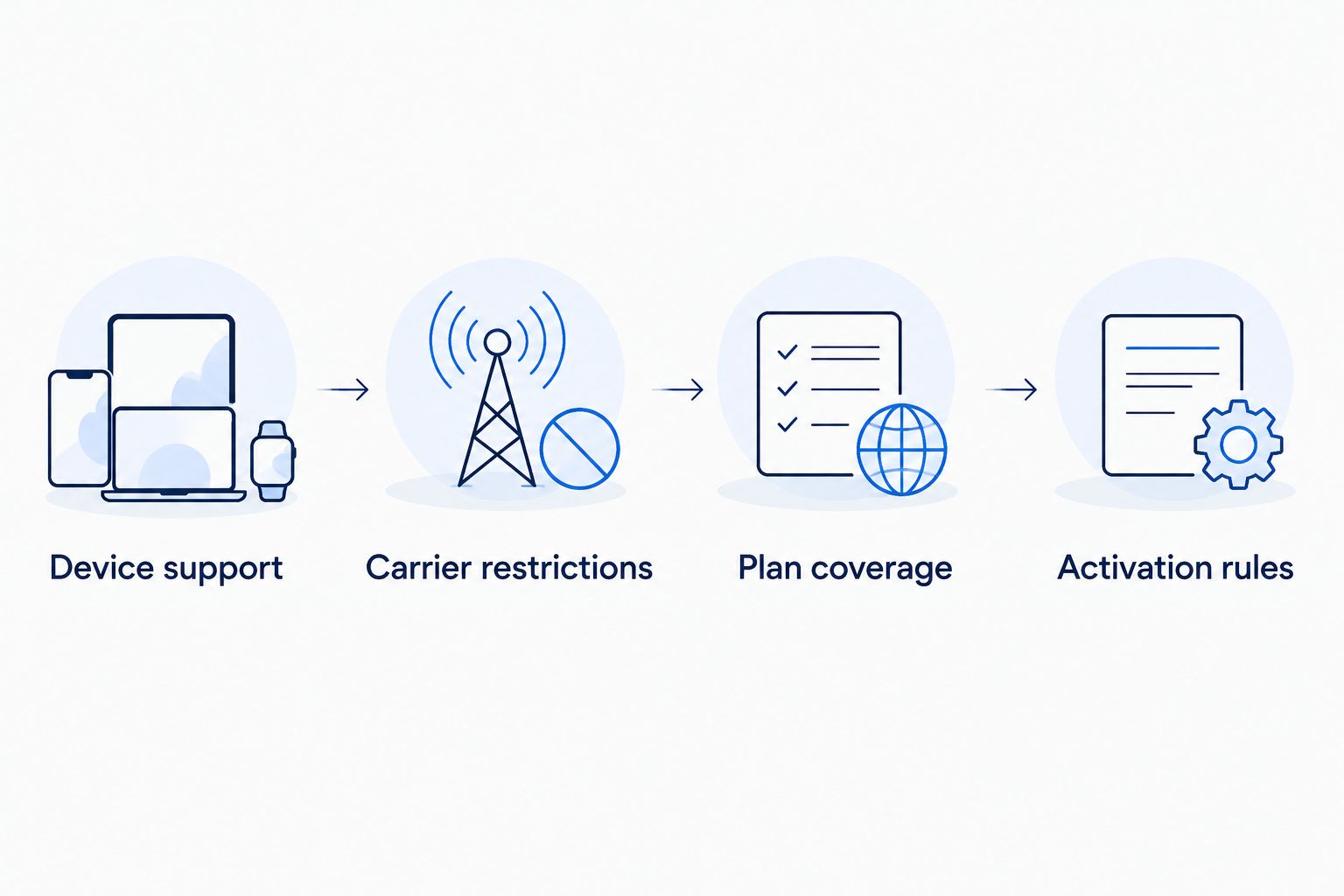
Before buying, complete these checks:
- Device support: Confirm eSIM support for the exact model you carry.
- Carrier restrictions: Check whether the phone permits another provider's connection.
- Plan coverage: Match every required destination to the plan details.
- Activation rules: Read when validity begins and how installation differs from activation.
These checks apply to either route in 2026. For the installation step, read the guide to installing an eSIM before you travel.
Pricing: compare equivalent plans, not different workflows
Neither buying directly nor using a comparison directory establishes the better-value plan. Evaluate the actual offer against your travel needs. The purchase route alone does not settle that decision.
With the direct provider, review the selected travel data plan and its terms. With eSIMDB, compare provider-specific offers, then confirm the details with the provider you choose. The directory is a research layer, not a single shared plan covering every listed service.
Build a like-for-like comparison around these questions:
- Does the plan cover every destination where you need data?
- Does its validity cover the full period you need connectivity?
- Does its data allowance fit your intended use?
- What happens when the allowance or validity ends?
- Does the plan permit the features you need, such as hotspot use?
For example, 3 GB is a data allowance, not a statement about trip suitability. Compare an illustrative 3 GB option with another offer covering the same destinations and travel period before judging value.
For your 2026 comparison, also separate predictable needs from flexibility. Selecting enough data upfront reduces the number of purchase decisions during travel. Adding data later offers flexibility, but requires checking the selected plan's top-up rules. Neither approach eliminates the need to read the terms.
Final verdict: choose your route by traveller profile
Choose A-sim if you want a direct travel eSIM workflow
Best for: the traveller ready to buy and manage a connection. You want global, regional or single-country options, purchasing through a website or app, and app-based usage management and top-ups.
Accept the limitation: this is a provider choice, not a cross-provider research tool. Check your itinerary, phone and plan terms before purchase. The management features are the reason to choose this route, not evidence that every plan wins every comparison.
Choose eSIMDB if you are still comparing providers
Best for: the researcher building a travel eSIM shortlist. You want to compare alternatives before deciding who should supply your connection.
Accept the limitation: the chosen provider determines the service experience after selection. Research installation, usage tracking and top-ups alongside the plan itself. A strong shortlist is useful only when the final choice also works for your trip.
One-glance scorecard
| Dimension | Winner |
|---|---|
| Best for | Split: direct buyer versus provider researcher |
| Standout feature | Split: app management versus comparison |
| Provider research | eSIMDB |
| Buying workflow | Direct provider |
| Managing data | Direct provider |
| Itinerary planning across providers | eSIMDB |
| Device compatibility | Tie: exact device and restrictions decide |
| Pricing model | No universal winner: compare equivalent plans |
FAQ
Is A-sim better than eSIMDB for travel eSIMs?
A-sim is the better fit for direct purchase and app-based usage management; eSIMDB is the better fit for comparing providers. Choose according to whether you need a connection to manage or a shortlist to assess.
Can I use eSIMDB to manage my data after buying?
Plan management depends on the provider you select through your research. Check that provider's process for viewing usage, adding data and getting help before purchasing.
Can I compare providers first and then buy directly?
Yes, provider comparison and direct purchase can be consecutive steps. Use the comparison stage to narrow your options, then confirm the selected provider's current plan details before buying.
Which option is better for a trip across several countries?
Use eSIMDB for cross-provider research, and assess a direct provider when you are ready to choose a plan. For either route, verify that the exact destination list includes every country where you need connectivity.
Will either option work on any iPhone or Android phone?
No, you must check the exact phone's eSIM support and carrier restrictions. An iPhone or Android label alone does not establish compatibility for every model or regional version.
How should I compare travel eSIM plans in 2026?
Compare plans covering the same destinations, travel period and intended data use. Then inspect activation rules, top-up terms and any features you need, including hotspot use.
Does comparing eSIM plans guarantee better mobile coverage?
No, comparison does not guarantee coverage. Check the selected plan's destination and network information, especially when your itinerary includes locations outside major population centres.
One last thing
Installation and the start of plan validity are not necessarily the same event. Read the selected plan's activation rules before installing, rather than assuming your travel dates control when the allowance begins.
Make that your final 2026 check. A carefully compared plan still needs the right activation timing, and a convenient app cannot correct a purchase based on the wrong travel period.