
Choose A-sim if you want travel eSIMs with app-based usage tracking and top-ups; choose Holafly if your destination’s unlimited-data offer fits your trip and its usage conditions fit your needs. This 2026 comparison separates everyday account control from the appeal of an unlimited allowance, then shows what to check before buying either option.
- A-sim vs Holafly: choose app-based usage control or a destination plan whose unlimited-data conditions suit your trip.
- A-sim travel eSIMs suit travellers who want to monitor usage and top up through an app.
- Choose Holafly for an unlimited-data offer only after checking speed, hotspot and validity conditions.
- Neither an unlimited label nor a regional label replaces checking the actual plan terms.
Why this matters
A travel eSIM needs to match your journey, not just your destination. A phone used for maps and messages has a different job from a phone sharing data with a work laptop.
For a 2026 trip, compare the exact destination, travel dates and intended use before comparing providers. The wrong validity window or hotspot restriction matters more than a convenient checkout.
Choose the plan that covers your actual usage, including the awkward parts: border crossings, laptop connections and changes to your return date. A broad product description cannot answer those questions for every trip.
At a glance
| Dimension | A-sim | Holafly |
|---|---|---|
| Best for | Travellers wanting app-based usage tracking and top-ups | Travellers choosing an unlimited-data destination offer |
| Standout feature | Usage management and top-ups through the app | Unlimited-data proposition, subject to the selected offer’s terms |
| Itinerary fit | Global, regional and single-country travel eSIMs | Match the selected destination offer to every stop |
| Setup | Purchase through the website or app; use on compatible iPhone or Android devices | Check the selected offer’s device and installation requirements |
| Data approach | Monitor usage and top up through the app | Assess unlimited-data conditions against your expected use |
| Laptop sharing | Confirm tethering permission and any separate allowance | Confirm tethering permission and any separate allowance |
| Pricing model | Compare the initial purchase with the top-ups you expect to need | Compare the selected offer’s duration and included usage conditions |
| Overall decision | Strong fit for active usage management | Strong fit when the unlimited-data offer matches the trip |
A-sim wins for travellers who want app-based control
A-sim travel eSIMs suit travellers who want to monitor usage and top up through an app. You can obtain an eSIM through the website or app, then manage usage and add data through the app.
That workflow suits a traveller whose plans change. You can check consumption during the trip instead of making every decision before departure. The benefit is control, not a promise that every destination has the same allowance or renewal rules.
The trade-off is attention. If you choose an allowance that needs replenishing, checking usage becomes part of managing your connection. A top-up feature also does not mean every extension, destination change or validity question resolves automatically.
Before purchase, establish what a top-up changes. Ask whether it adds data, changes validity, or requires a separate selection. Those are distinct outcomes, even when the purchase happens in the same app.
Holafly wins when an unlimited-data offer matches your trip
Holafly is the better fit for a traveller specifically seeking an unlimited-data offer whose conditions match their destination and usage. That is a different priority from actively watching an allowance and deciding when to add more.
The advantage is the plan structure you are choosing. If you do not want to budget ordinary phone usage against a fixed allowance, an unlimited-data offer addresses that preference directly.
The limitation sits in the conditions. Do not treat unlimited data as a guarantee of unrestricted speed, unrestricted hotspot use or connectivity everywhere. Read the destination offer’s fair-use and tethering terms before making it your only connection.
For a 2026 booking, save the conditions that apply to your selected offer. A general comparison cannot replace the terms attached to the destination and travel period you actually purchase.
Itinerary fit is a tie until you check every stop
Global, regional and single-country options give you different ways to organise a trip. The correct scope follows your route: a single-country stay needs a different coverage check from a journey with several border crossings.
Start with a complete itinerary. Include overnight stops and any transit stop where you expect to leave the airport and use mobile data. Do not infer country coverage from a regional name alone.
Consider these illustrative planning windows, not recommended plan sizes:
- 7 days: Check that activation and expiry cover arrival through departure.
- 14 days: Include side trips and any overnight stop outside the main destination.
- 30 days: Check what happens if the trip extends or your usage changes.
Neither provider wins because a coverage label sounds broader. The itinerary winner is the offer that explicitly covers your route for the full period you need.
Both require a compatible phone and correct setup
An eSIM is a digital SIM, not a way around a locked or incompatible phone. Check the exact device model, its eSIM support and its carrier-lock status before purchasing a travel plan.
An iPhone or Android label is not enough. Device variants and carrier restrictions matter, so inspect the settings on the actual phone you will take abroad rather than relying on a similar model owned by someone else.
Use this setup sequence for either provider:
- Check compatibility: Confirm eSIM support and carrier-lock status.
- Read activation: Establish which action starts the plan’s validity.
- Install profile: Follow the purchased plan’s installation instructions.
- Select data: Choose the travel line for mobile data when appropriate.
- Test connection: Confirm that the intended line connects at the destination.
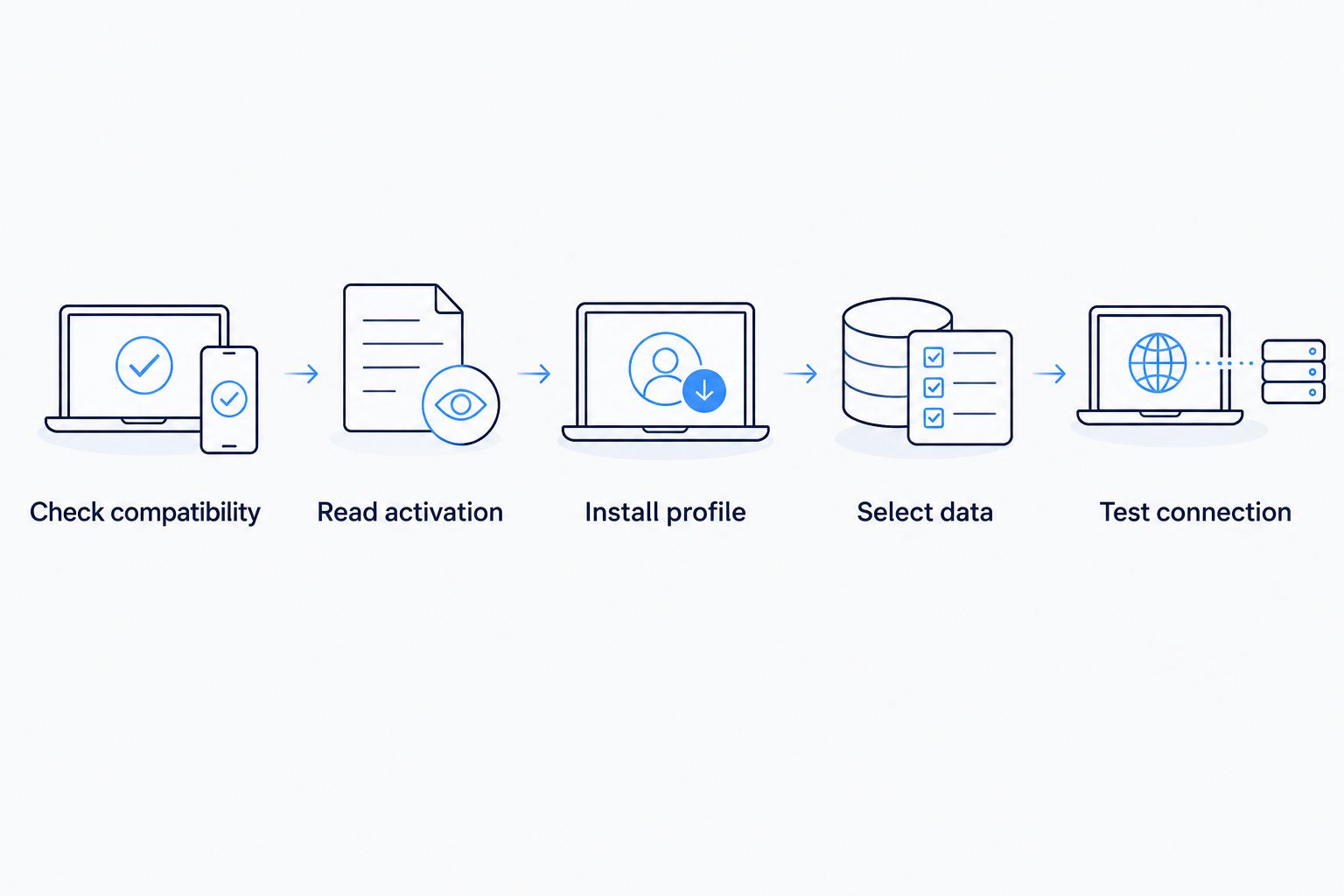
Installation convenience is valuable, but it does not determine network performance. Keep device readiness, installation and the destination connection separate when evaluating the result.
Data control wins for variable use; unlimited wins for less budgeting
The useful comparison is not simply limited versus unlimited. It is whether you prefer monitoring consumption or selecting an offer intended to remove allowance budgeting from ordinary phone use.
For variable usage, app-based tracking gives you a decision point. You can review what you have used and decide whether to add more. The cost of that control is having to pay attention to the remaining allowance and validity.
For an unlimited-data offer, the attraction is less focus on counting consumption. The limitation is that the wording still needs interpretation: fair-use conditions, speed management and sharing rules remain relevant to the activities you intend to perform.
For your 2026 shortlist, distinguish three separate questions: how much data the plan includes, how long it lasts, and whether another device can share it. The distinction behind eSIM data limits matters here: an installed eSIM profile and the allowance attached to a purchased plan are not the same thing.
Do not delete a working profile merely because you need more data. Follow the provider’s instructions for adding an allowance, extending service or installing a different plan; those actions are not interchangeable.
Laptop sharing is a tie until the tethering terms are clear
A phone connection and a laptop connection are different buying requirements. If your laptop must connect through your phone, tethering is essential, not an optional extra.
Check whether the selected offer permits hotspot use and whether it applies a separate sharing allowance. An unlimited phone-data description does not, by itself, answer either question.
For either provider, make the work requirement explicit before purchase:
- Email and documents: Confirm that sharing is permitted for the devices you need.
- Video meetings: Check speed-management conditions, not just the data label.
- Large transfers: Establish whether your intended usage falls within the offer’s terms.
- Backup access: Keep essential documents accessible without a live connection.
Neither provider earns a laptop-sharing win without plan-level confirmation. A travel plan that suits messaging on your phone is not automatically the right connection for your workday.
The same discipline applies to coverage. A plan’s country list does not guarantee a strong signal inside every building or along every route. Avoid turning a coverage claim into a promise about a particular meeting location.
Pricing: compare the purchase model with your likely changes
There is no universal cost winner in this comparison. Compare the current destination offers using the same trip dates, usage needs and sharing requirements; otherwise you are comparing different purchases.
An allowance-and-top-up approach makes added consumption a separate purchase decision. Its practical advantage is control over whether to buy more. Its limitation is that the initial purchase alone does not describe the full trip if you need additional data.
A duration-based unlimited offer shifts the decision toward travel length and usage conditions. Its practical advantage is less allowance planning. Its limitation is that the offer still needs to cover your exact dates and intended activities.
Build your 2026 comparison around the whole journey:
- Match the start and end dates.
- Include every destination that needs coverage.
- Account for any expected top-up or extension.
- Confirm the payment currency before completing checkout.
- Read cancellation and refund conditions before installation or activation.
Do not assume that an unused plan is refundable or that a top-up extends validity. Both questions belong in the purchase decision, not in troubleshooting after departure.
Final verdict: choose by how you want to manage data
Choose A-sim if you want active usage control
Best for: the independent traveller who wants usage tracking and app-based top-ups. Choose this option when managing your connection during the trip is part of how you prefer to travel.
The confirmed fit is the workflow: purchase through the website or app, use a compatible iPhone or Android device, and manage usage through the app. Check the selected plan’s allowance, validity and sharing rules before committing.
Choose Holafly if the unlimited offer fits your requirements
Best for: the traveller who wants an unlimited-data offer rather than budgeting a fixed allowance. Choose this option when the destination offer covers your dates and its fair-use and hotspot conditions suit your actual use.
Do not choose on the unlimited label alone. If laptop sharing or a particular network condition is essential, make that a pass-or-fail requirement before purchase.
| Dimension | Winner |
|---|---|
| App-based usage control | Client option for the stated tracking-and-top-up workflow |
| Unlimited-data preference | Holafly, when the selected offer’s conditions fit |
| Itinerary fit | Tie until every stop and date is checked |
| Device readiness and setup | Tie; compatibility comes first |
| Data-management approach | Match monitoring against unlimited-data preference |
| Laptop sharing | Tie until tethering conditions are confirmed |
| Total trip cost | Compare current, like-for-like destination offers |
FAQ
Is A-sim better than Holafly for international travel?
A-sim is the clearer fit if you want app-based usage tracking and top-ups. Holafly is the clearer fit if you want an unlimited-data destination offer and its conditions match your trip.
Is unlimited travel eSIM data always unrestricted?
No, an unlimited-data label is not a guarantee of unrestricted speed or hotspot use. Read the selected offer’s fair-use and tethering conditions before buying.
Which option should I choose for a multi-country trip?
Choose the offer that explicitly covers every country where you need mobile data. Check the country list and validity window rather than relying on a regional or global label.
Can I use either travel eSIM with my laptop?
You can share a phone connection with a laptop only when your device supports tethering and the selected plan permits it. Confirm any separate hotspot allowance before relying on it for work.
Can I install a travel eSIM before leaving Canada?
Check the selected plan’s installation and activation instructions before installing it. Installation and the start of validity are separate concepts, and the trigger matters for your departure date.
Will a travel eSIM keep my Canadian phone number active?
A travel data eSIM does not replace your home phone number. On a compatible dual-SIM device, retaining the home line is a separate settings and carrier decision; check its roaming conditions.
Which provider is cheaper for my trip in 2026?
Compare current destination offers for the same travel dates and usage requirements. Include expected top-ups, extensions and hotspot needs rather than comparing the initial purchase alone.
One last thing
Before leaving, label your home line and travel line clearly in your phone settings. Then check which line supplies mobile data and whether automatic data switching is enabled.
That small setup check connects the purchase to the result you actually want: travel data on the intended line. Buying the right plan does not, by itself, select the right phone settings.