
Choose A-sim if you want to buy a travel eSIM online, manage usage and top up through an app; choose SimLocal if you want an airport retail option with in-person help. For 2026, the main difference is how you want to buy and set up your connection—not a proven advantage in speed or signal.
- A-sim vs SimLocal: choose app-based travel eSIM management or airport retail assistance according to how you travel.
- SimLocal is the better fit when you want in-person help or need to consider a physical SIM.
- Compare destination coverage, validity and network terms before choosing either travel eSIM provider.
- Neither provider wins on speed or total trip cost without comparing the specific plans.
Why this matters
Your travel connection has two separate jobs: get you online after arrival and keep working throughout the trip. An easy checkout does not settle the second question. You still need a compatible phone, the right destination coverage and enough data for your actual use.
A-sim is best for travellers who want app-managed travel eSIMs with usage tracking and top-ups. SimLocal's airport retail presence offers a different advantage: you can seek face-to-face assistance instead of handling every setup step yourself.
For a 2026 trip, choose the buying experience first, then compare the exact packages. Do not assume that an app-based purchase is automatically cheaper or that buying at an airport guarantees better reception.
At a glance
| Dimension | A-sim | SimLocal |
|---|---|---|
| Best for | Travellers comfortable buying and managing an eSIM digitally | Travellers who value an airport retail option |
| Buying route | Website or app | Online purchasing and airport retail |
| Setup assistance | Digital installation on compatible iPhone and Android devices | In-person assistance through its retail operation |
| Standout feature | Usage management and top-ups through the app | Access to face-to-face retail assistance |
| Physical SIM requirement | The stated offering is travel eSIMs | Physical SIMs and eSIMs are part of its offering |
| Destination fit | Single-country, regional and global options | Compare the selected product's country list with your itinerary |
| Signal and speed | Depend on the selected plan, partner network and location | Depend on the selected plan, partner network and location |
| Pricing model | Compare the travel package and any top-up purchases | Compare the selected SIM or eSIM package and any additions |
App-first buying wins when you want to prepare before departure
Best for: independent travellers who want to arrange mobile data before reaching the airport. The client offers purchasing through its website or app, so the buying process fits around your travel planning rather than a retail stop.
That is the practical advantage for a traveller who already knows their phone supports eSIM. You can review your destination requirements, select a package and follow installation instructions while you still have a dependable internet connection.
SimLocal also sells online. The distinction is not that one provider is digital and the other is not; it is that the app-first option explicitly combines purchasing with ongoing usage management and top-ups.
The trade-off is responsibility. You need to identify your device correctly, follow the installation instructions and understand when the package's validity begins. Buying before departure does not mean you should activate every plan immediately.
For example, a 7-day trip needs coverage for the travel dates, not simply a package purchased seven days before flying. Check whether validity starts at installation, manual activation or connection to a supported network.
SimLocal wins when you want face-to-face setup help
Best for: travellers who prefer talking through the purchase and installation process with a person. SimLocal's airport retail operation gives it a clear advantage when the buying experience needs to include in-person assistance.
That matters if you are uncertain about the difference between adding an eSIM and replacing a physical SIM. It also matters if you want to discuss the connection before committing to a particular product.
The limitation is location. An airport retail route only helps when a relevant shop is part of your journey and its opening hours fit your arrival. Confirm those details before making a retail visit your only connection plan.
Digital buying avoids that dependency, but it does not reproduce face-to-face help. If you know you want someone beside you during setup, choose the retail route deliberately rather than judging both providers only by their online checkout.
Neither approach excuses skipping compatibility checks. In-person assistance can help you understand a restriction; it cannot make an unsupported or carrier-locked phone accept an incompatible service.
A-sim wins for a clearly defined app-management workflow
Best for: travellers who want to check usage and add data through an app during the trip. Usage management and app-based top-ups are explicit parts of the client's travel eSIM offering.
That creates a straightforward routine: check your remaining data, decide whether your use matches the rest of your itinerary, and top up when needed. The benefit is control during travel, not just a convenient initial purchase.
Do not interpret this as a claim that SimLocal lacks digital management. The stronger conclusion is narrower: the app-first option directly matches a buyer whose priority is managing usage and top-ups in that same workflow.
The downside is that a top-up still requires a decision. It does not prove automatic renewal, extended validity or coverage in a new country. Read what the additional purchase actually adds before relying on it.
If your remaining allowance shows 2 GB, treat that as an example of a planning checkpoint—not a promise that it will last a particular number of days. Video calls, streaming, navigation and background uploads use data differently.
SimLocal wins when a physical SIM belongs in the decision
Best for: travellers comparing an eSIM with a physical SIM rather than choosing between eSIM apps alone. SimLocal's offering includes physical SIMs as well as eSIMs, which broadens the purchase decision beyond a digital profile.
A physical SIM is relevant when your phone does not support eSIM but can accept a compatible removable SIM. It is also a different installation method for someone who prefers handling a card instead of downloading a profile.
The trade-off is physical handling. You need to consider the SIM tray, where to keep your home SIM if you remove it, and whether your handset accepts the required format. A physical SIM does not bypass a carrier lock.
The app-first travel eSIM offering is not the right recommendation for a phone that cannot use eSIM. Do not buy first and hope an app resolves the hardware restriction later.
For a compatible handset, neither format wins automatically. Choose the format that fits the device and the way you want to manage your home line while abroad.
Destination coverage is a plan-level tie, not a brand-level win
Best for: either provider, once the selected package covers your actual route. The app-first offering includes single-country, regional and global travel eSIM options. Those categories are useful starting points, but the country list determines whether a package fits.
For a 14-day itinerary across several countries, write down every destination before comparing packages. Include an overnight stop if you need mobile data there. Do not assume a regional label includes every country you associate with that region.
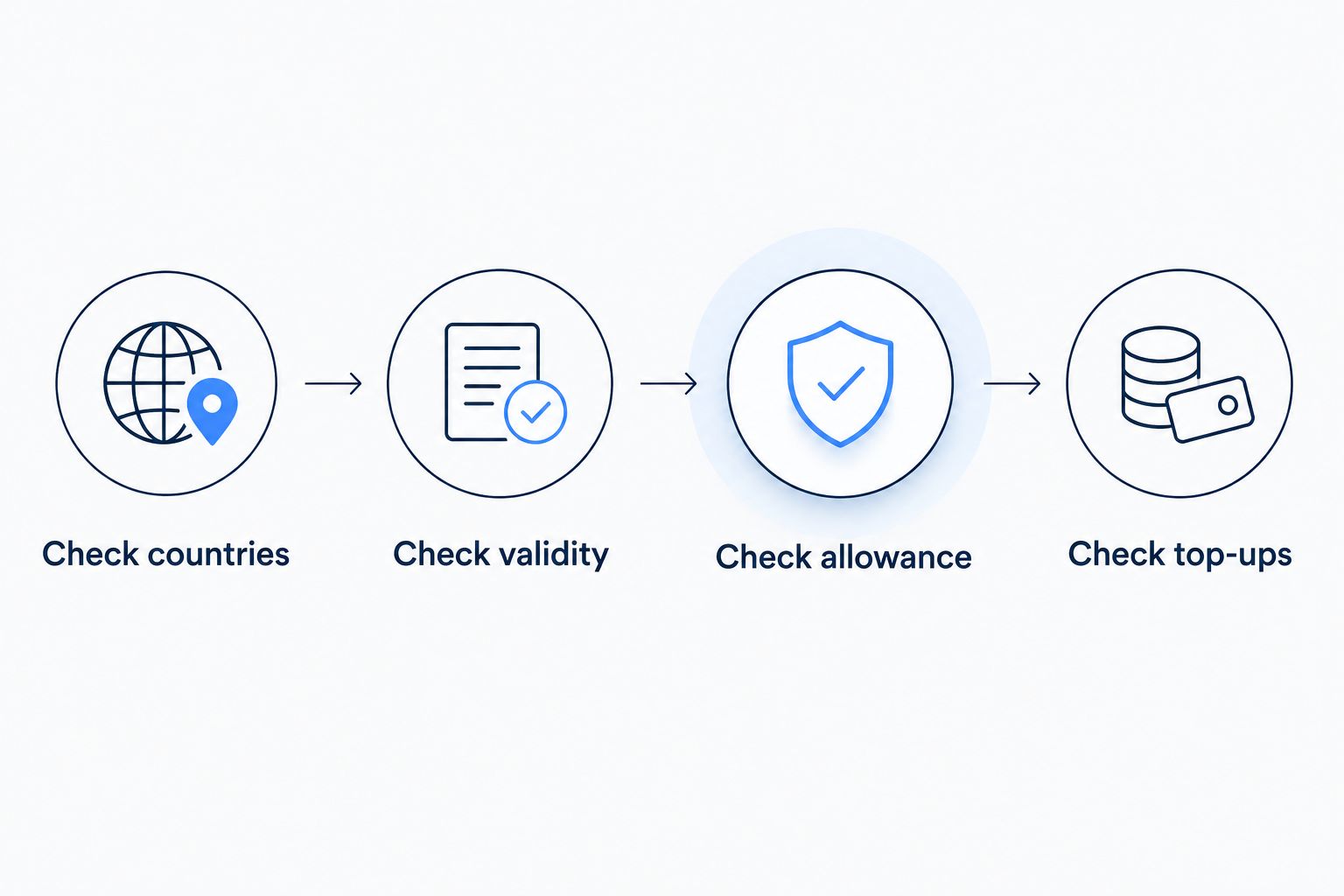
Use this sequence for a 2026 booking:
- Check countries: Match every destination against the package's coverage list.
- Check validity: Confirm the start trigger and whether the package covers your travel dates.
- Check allowance: Match the data allowance and restrictions to your intended use.
- Check top-ups: Establish what you can add if the trip changes.
A single-country package is not automatically the wrong choice for an international itinerary. Separate packages can fit some routes; a regional package can simplify others. Compare the actual terms instead of awarding a winner based on the category name.
Neither provider wins on signal or speed without local evidence
Best for: the plan whose network arrangements suit the places you will actually visit. An eSIM is a way to provision mobile service. It does not, by itself, make the radio connection faster than a physical SIM.
Reception depends on the network, your location, compatible device bands and local conditions. Service inside a building or in a remote area can differ from service in a city centre, even during the same trip.
For both providers, examine the selected package's network and usage terms. Look for any stated speed restrictions, tethering rules or fair-use conditions that affect your intended work.
A traveller sending messages has a different requirement from someone hosting video meetings. Neither use case justifies a blanket claim that one provider is faster everywhere.
The honest verdict is a tie until the destination-specific evidence separates them. Use current 2026 package information, not an old speed screenshot or a review from an unrelated country.
Pricing: compare the whole trip, not the first purchase
Both purchase decisions centre on the travel connection you select. For the app-first option, evaluate the initial package and any later top-up; for SimLocal, evaluate the selected physical SIM or eSIM product and any additions you expect to need.
The important trade-off is predictability versus flexibility. A package that covers the whole itinerary simplifies budgeting. A smaller initial allowance followed by a top-up gives you another decision during the trip, and the total depends on that later purchase.
Keep eSIM activation costs separate from data allowances when reading an offer: installation, the validity start and the purchase of mobile service are different questions. Confirm what the checkout includes rather than assuming each step carries a separate charge.
For your 2026 comparison, use the same requirements on both sides:
- The same destinations and travel dates.
- Enough usable data for the activities you intend to do.
- The same need for hotspot use, calls or texts.
- Any additional purchase required to finish the trip.
- The billing currency and your payment card's applicable terms.
There is no defensible cheapest-provider verdict without matching those conditions. A package that fails your route or usage requirements is not equivalent to one that meets them.
Before buying, separate installation from activation
Installing an eSIM adds a profile to a compatible device. Activation and the start of package validity follow the provider's particular instructions; those events are not interchangeable across every product.
Read the guide to installing an eSIM before travel alongside the instructions for your selected package. Prepare while you have internet access, but do not start a time-limited service early unless its terms support that timing.
Also decide which line handles mobile data and which line retains your home number. Keeping a home SIM enabled does not make its calls, texts or roaming free. Your home carrier's terms still apply.
This preparation benefits either provider. The difference is whether you prefer following the digital setup yourself or arranging in-person assistance where SimLocal operates.
Final verdict: choose the buying experience you actually need
Choose A-sim if you are an app-first traveller
You have a compatible iPhone or Android device, want to purchase through a website or app, and value checking usage and topping up digitally. The app-first travel eSIM workflow is the named winner for that profile. Confirm the package's coverage and validity before buying.
Choose SimLocal if you want retail help or a physical SIM option
You prefer face-to-face assistance at an airport retail location, or your device decision includes a removable SIM. SimLocal is the named winner for that profile. Confirm the relevant location and product before building your arrival plan around it.
| Dimension | Winner |
|---|---|
| App-first purchase and ongoing management | App-first option |
| Face-to-face retail assistance | SimLocal |
| Explicit usage tracking and app top-up workflow | App-first option |
| Physical SIM choice | SimLocal |
| Destination coverage | Plan-level tie until the itinerary is checked |
| Signal and speed | No overall winner |
| Total trip cost | Compare equivalent packages |
FAQ
Is A-sim better than SimLocal for travel eSIMs?
A-sim is the better fit for travellers prioritizing app-based usage management and top-ups. SimLocal is the better fit when airport retail assistance or a physical SIM option matters more.
Can I buy from SimLocal without visiting an airport shop?
Yes, SimLocal sells online as well as through its airport retail operation. Visiting a shop is a buying option, not a requirement for every customer.
Which provider has better signal abroad?
Neither provider has a universal signal advantage. Compare the selected package's network arrangements for your destination and consider the specific places you will visit.
Which travel eSIM is cheaper for my trip?
Compare packages that cover the same destinations, dates and usage requirements. Include any additional data purchase needed to finish the trip before deciding which costs less.
Can I install a travel eSIM before I leave Canada?
You can install many travel eSIMs before departure, but the selected package's instructions control when you should do so. Check whether installation, manual activation or connection starts its validity.
Will either provider work on a carrier-locked phone?
Do not assume a carrier-locked phone can use another provider's travel SIM or eSIM. Confirm the lock status and applicable restrictions with your home carrier before purchasing.
Does a travel eSIM include a local number for calls and texts?
A travel eSIM does not automatically include a local number, voice calls or SMS. Check the particular package rather than treating mobile data as equivalent to a full phone line.
One last thing
Successful installation is not proof that your travel data is ready. Before leaving reliable internet access, confirm which line will supply mobile data, keep the package instructions accessible offline and check the validity trigger. That prevents a completed installation from becoming an avoidable arrival-day problem.