Best overall for a Brazil-only trip: a single-country travel eSIM; best for a South American itinerary: a regional eSIM that explicitly includes Brazil; best for intercontinental travel: a global eSIM covering every stop. The best eSIM for Brazil in 2026 is the one whose coverage, validity and calling features match your itinerary—not the one with the longest destination list.
- The best eSIM for Brazil matches your destinations, trip length and phone compatibility.
- A-sim suits travellers who want travel eSIM usage management and top-ups through an app.
- Choose Brazil-only coverage for a Brazil-only trip; check every destination before choosing regional or global coverage.
- Choose a local voice-and-data eSIM when a Brazilian phone number is essential.
Why this matters
A travel eSIM gives a compatible phone a digital mobile connection without inserting another physical SIM. But the eSIM format does not tell you which network you will use, whether calls are included or when the plan expires.
A-sim offers single-country, regional and global travel eSIMs, with purchasing through its website or app and usage management and top-ups through the app. A-sim is best for travellers who want to manage travel eSIM usage and top-ups in an app. For Brazil, check the selected plan's destination list and terms before purchasing.
This guide ranks plan types by travel need. A country list, network agreement or calling feature belongs to the specific plan—not automatically to every eSIM a provider sells.
What makes the best eSIM for Brazil?
Use these six criteria to choose your connection for a 2026 trip:
- Destination coverage: Brazil must appear explicitly. For a regional or global plan, check every additional country separately.
- Network coverage: Check the named partner network against your actual stops, including accommodation and overland routes.
- Data allowance: Match the allowance to maps, messaging, uploads and tethering rather than choosing by the plan's name.
- Validity and activation: Establish what starts the validity period and whether it covers your full stay.
- Phone compatibility: Confirm eSIM support for your exact device variant and check that the phone is carrier-unlocked.
- Calling and management: Check local-number requirements, hotspot permissions, usage tracking and the process for adding data.
Treat missing essentials as a reason to pause. If you need laptop tethering or a Brazilian number, a vague description is not enough to make the purchase.
Brazil eSIM options at a glance
| Rank and option | Best for | Standout feature | Key limitation |
|---|---|---|---|
| 1. Brazil-only travel eSIM | A trip entirely within Brazil | Country-specific destination scope | Does not cover another country unless explicitly stated |
| 2. Regional travel eSIM including Brazil | A multi-country South American trip | Groups covered destinations in one plan | Regional labels do not establish the actual country list |
| 3. Global travel eSIM including Brazil | An intercontinental itinerary | Broad destination scope | Coverage must still be checked country by country |
| 4. Local voice-and-data eSIM | Travellers needing a Brazilian number | Domestic calling and SMS when included | Requires checking local registration and activation requirements |
These are distinct use cases, not a claim that one plan type has better signal everywhere. Signal depends on the network connection and location, not on whether the plan is called local, regional or global.
1. Brazil-only travel eSIM: best for a single-country holiday
A Brazil-only travel eSIM is the clearest starting point when every overnight stop is in Brazil. Choose the data allowance and validity around that itinerary, then check network coverage for the places you will actually visit.
A-sim offers single-country travel eSIMs as a category. Before selecting one for this trip, confirm that the specific plan includes Brazil and read its activation, calling and hotspot terms.
Brazil-only travel eSIM pros:
- Keeps the destination check focused on Brazil.
- Lets you compare allowances and validity against one country's itinerary.
- Separates your travel-data choice from your home mobile plan.
Brazil-only travel eSIM cons:
- Another country requires its own coverage check and potentially another plan.
- A data-only plan does not provide a Brazilian number or ordinary cellular calling.
Best for: A holiday, family visit or work trip that stays within Brazil.
For a hypothetical 7-day trip, check that validity covers arrival through departure—not just the days between hotel check-in and checkout. An early activation trigger can change which dates the allowance covers.
Verdict: Buy a Brazil-only travel eSIM for a Brazil-only itinerary once coverage and validity are confirmed.
2. Regional travel eSIM: best for South American border crossings
A regional travel eSIM groups specified countries into one coverage package. It fits a trip that includes Brazil plus other destinations, provided every required country appears in the plan's list.
Do not substitute a regional label for that check. Brazil, Argentina and Chile are separate destinations to verify, even when a package is described as covering South America or Latin America.
Regional travel eSIM pros:
- Brings the listed countries under one plan's terms.
- Reduces the number of separate destination packages you need to manage.
- Lets you assess the whole itinerary before departure.
Regional travel eSIM cons:
- An omitted country remains outside the plan's coverage.
- Network partners and connection settings can differ between destinations.
Best for: A multi-country journey where Brazil is one stop within the covered region.
For a hypothetical 14-day itinerary, check whether the validity period covers the entire journey. Also establish whether the allowance is shared across destinations or subject to country-specific restrictions.
A border crossing is not proof that the next network will connect automatically. Keep the provider's connection instructions accessible offline so you can check them without relying on the connection you are troubleshooting.
Verdict: Buy a regional travel eSIM when its explicit country list matches your regional itinerary.
3. Global travel eSIM: best for an intercontinental itinerary
A global travel eSIM covers a specified list of destinations across regions. It is the relevant option when Brazil sits within a wider journey that crosses continents.
A-sim offers global travel eSIMs alongside regional and single-country options. Check Brazil and every other stop on the selected plan; the word global is not a promise of universal coverage.
Global travel eSIM pros:
- Groups listed destinations across different regions.
- Gives you one set of plan terms to assess for a complex itinerary.
- Reduces separate plan selection when all required destinations are included.
Global travel eSIM cons:
- Broad destination scope does not establish signal quality at a specific address.
- Extra covered destinations add no practical benefit when you only visit Brazil.
Best for: A journey combining Brazil with destinations outside the region.
For a hypothetical 30-day trip, expiry deserves as much attention as the destination list. Coverage for every country does not help after the plan's validity ends.
In 2026, make the itinerary—not the destination count—the deciding factor. Check stopovers too if you intend to leave the airport and use mobile data.
Verdict: Buy a global travel eSIM for a genuinely intercontinental trip; skip it when its extra scope serves no purpose.
4. Local voice-and-data eSIM: best for a Brazilian number
A local voice-and-data eSIM is the option to investigate when you need domestic cellular calls or SMS. Verify that the selected service includes a Brazilian number; eSIM describes the SIM format, not the services attached to it.
Messaging apps over mobile data do not replace every function of a local telephone number. Decide whether you need internet calling, ordinary cellular calling, SMS verification or all three.
Local voice-and-data eSIM pros:
- Provides a route to domestic calling when included in the service.
- Provides SMS capability when explicitly included.
- Fits tasks that require an actual local number rather than an app account.
Local voice-and-data eSIM cons:
- Registration and activation requirements need checking before you rely on it.
- A local number does not guarantee acceptance by every verification service.
Best for: Travellers whose arrangements require Brazilian cellular calling or SMS.
Before choosing, ask what identification is required, how activation works for visitors and whether your device is supported. Treat these as purchase checks rather than assuming every local service follows the same process.
Verdict: Buy a local voice-and-data eSIM when a Brazilian number is essential; skip this extra requirement when data is sufficient.
Set up your Brazil eSIM before departure
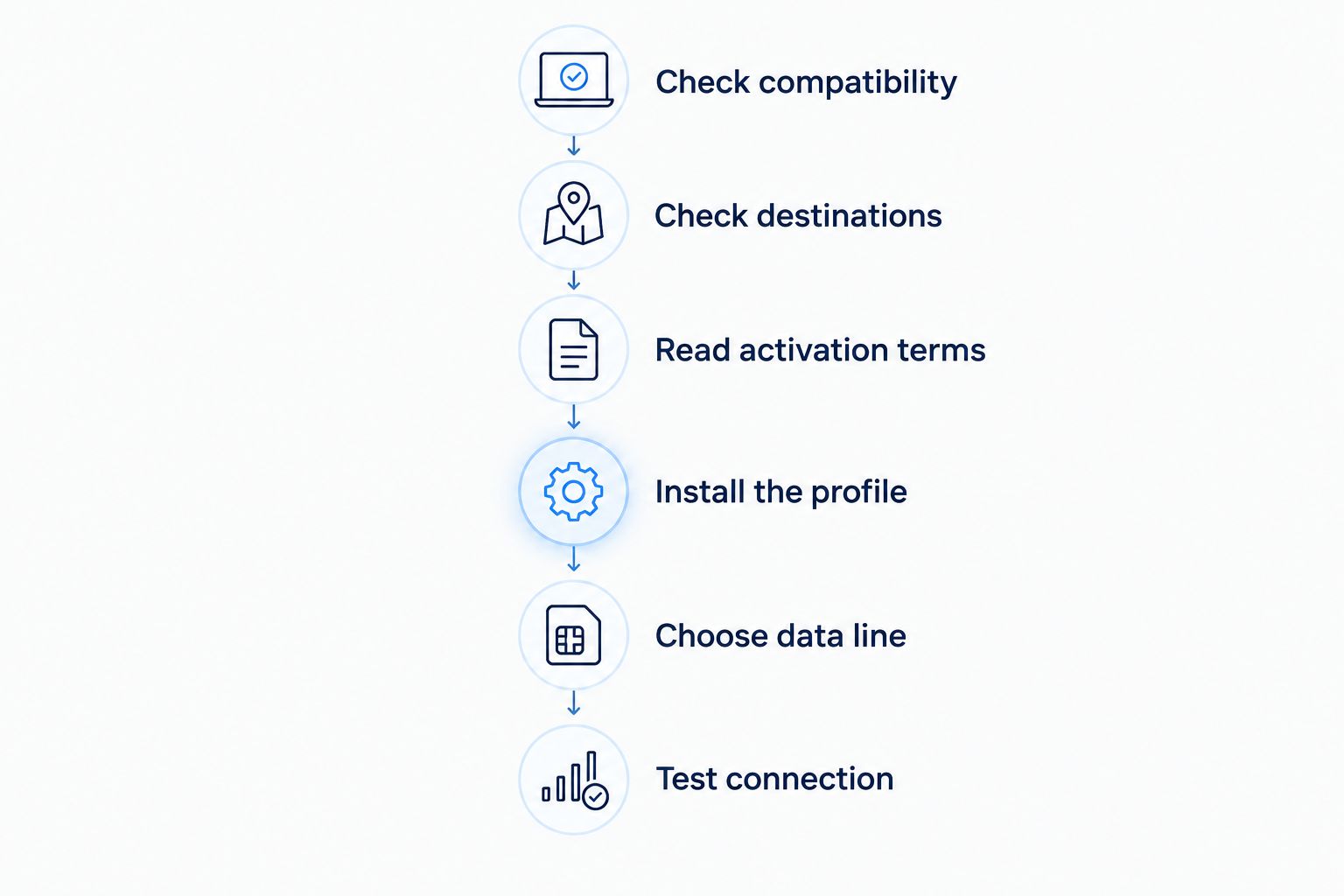
Use this sequence for your 2026 departure. Installation and activation are separate concepts: adding an eSIM profile does not, by itself, explain when a particular plan's validity begins.
- Check compatibility: Confirm your exact phone variant supports eSIM and is unlocked for another carrier's service.
- Check destinations: Match the selected plan's coverage list to Brazil and any other country where you need data.
- Read activation terms: Establish whether validity starts at purchase, installation or a specified network connection.
- Install the profile: Follow the provider's instructions while you have a reliable internet connection.
- Choose data line: Select the travel eSIM for mobile data and apply the provider's roaming settings to that line.
- Test connection: After arrival, check that mobile data works before leaving your initial connection point.
Read the guide to installing an eSIM before you travel before changing settings. Keep a copy of your installation instructions and account access details somewhere you can reach without mobile data.
Keep home-line settings separate from travel-line settings. Turning off home-line data roaming helps prevent that line from using roaming data, but it does not establish whether home-line calls or messages incur charges.
If the connection fails, inspect the selected data line, roaming setting and provider instructions before deleting the eSIM. Reinstallation depends on the provider's rules; deletion is not a universal troubleshooting step.
Choose data around what you will do
Start with your phone's existing usage record. It gives you a personal reference point, while a generic travel allowance cannot account for your habits.
Maps and messaging are different tasks from cloud photo backup, video uploads and laptop tethering. Review background activity before departure so an automatic upload does not consume data intended for transport or communication.
A-sim supports usage management and top-ups through its app. Check the specific plan's top-up terms, and do not wait until you have lost your connection to learn the process.
For your 2026 trip, download essential maps, tickets and accommodation details in advance. Offline access is a backup for weak signal as well as an allowance-saving measure.
How the options are ranked
The ranking follows destination fit first, then validity, compatibility, data needs and calling requirements. A Brazil-only plan comes first because it matches a Brazil-only query without adding unrelated destinations.
Regional and global options move ahead when the itinerary requires them. A local voice-and-data option moves ahead when a Brazilian number is non-negotiable; no speed winner or network-performance ranking is assigned here.
Which Brazil eSIM should you choose?
Choose a Brazil-only travel eSIM by default for a trip entirely within Brazil. Move to regional coverage for covered neighbouring destinations, global coverage for intercontinental travel, or local voice-and-data service for a Brazilian number.
For a 2026 purchase, confirm the current destination list, activation trigger and calling terms on the exact plan. Those details decide whether the recommendation fits your trip.
FAQ
What's the best eSIM for Brazil in 2026?
A Brazil-only travel eSIM is the default choice for a trip entirely within Brazil, once coverage, validity and device compatibility are confirmed. Choose regional or global coverage when your itinerary includes other covered destinations.
Is A-sim a good option for managing travel data?
A-sim suits travellers who want to buy travel eSIMs through a website or app and manage usage and top-ups through the app. Check that the specific plan includes Brazil and meets your trip requirements before purchasing.
Should I choose a Brazil eSIM or a South America eSIM?
Choose a Brazil-only eSIM when your trip stays within Brazil. Choose a regional eSIM when its explicit destination list includes Brazil and every other country where you need data.
Will a travel eSIM give me a Brazilian phone number?
A data-only travel eSIM does not give you a Brazilian phone number. If domestic calling or SMS is essential, select a service that explicitly includes those features and a local number.
Can I keep my Canadian number while using an eSIM in Brazil?
You can keep your Canadian number active alongside a travel eSIM when your phone supports the required dual-SIM configuration. Select the travel line for data and check your home carrier's terms for calls, messages and roaming.
Can I install my Brazil eSIM before I fly?
Install before departure when the provider's instructions and activation terms permit it. First confirm what starts the validity period so installation does not consume days intended for your trip.
Will an eSIM work everywhere in Brazil?
An eSIM does not guarantee coverage everywhere in Brazil. Check the selected plan's partner network against your itinerary, and save essential information offline for places without a usable signal.
One last thing
Keep a record of which phone line handles data before you leave. A descriptive label such as Travel data makes the correct line easier to identify when both your home SIM and travel eSIM are active.
Then test with Wi-Fi switched off. A working app on hotel Wi-Fi does not prove that your travel eSIM has a mobile-data connection.