Best overall for app-managed travel data: A-sim. Best for one destination: a single-country eSIM. Best for a multi-country itinerary: a regional eSIM. This 2026 guide ranks those options alongside global coverage so you can match your travel eSIM to your route, phone and communication needs.
- A-sim is best for Canadians who want travel eSIM data with app-based usage tracking and top-ups.
- The best esim for canadians matches the destination list, trip length and phone compatibility.
- Choose single-country coverage for one destination, regional coverage for a covered multi-country route, and global coverage for broader itineraries.
- Check voice, texts, hotspot rules and activation terms separately; an eSIM alone does not guarantee those features.
Why this matters
A Canadian phone number does not determine which travel eSIM you need. Your destination does. A plan covering Canada is not automatically the right choice for a Canadian travelling abroad.
The other distinction is between mobile data and your Canadian phone service. Travel data connects apps to the internet; keeping your usual number reachable involves your home line and its roaming terms. Decide whether you need maps and messaging apps, ordinary calls, verification texts, or all of them before choosing.
This guide compares coverage formats rather than claiming one provider has the fastest network or lowest charges. The useful decision is which format fits your itinerary without leaving an essential stop outside its coverage.
What makes the best eSIM for Canadians?
Use these criteria when comparing travel eSIMs in 2026. Treat missing answers as questions to resolve before purchasing, not details to discover at the airport.
- Destination fit: Check every country on your route, including stopovers where you intend to use mobile data. Regional names are not country lists.
- Phone compatibility: Confirm that your exact device supports eSIM and permits another provider's service. An iPhone or Android label alone is not enough.
- Validity and activation: Establish when the validity period starts and whether it covers your entire stay. Installing a profile and starting a plan are not necessarily the same event.
- Data management: Look for a clear way to check remaining data and understand the top-up process before you need it.
- Communication requirements: Verify voice, SMS and hotspot support separately. Do not treat a data connection as a replacement for every function of your Canadian line.
- Coverage detail: Check the supported network and destination restrictions. The words regional and global describe scope, not a guarantee of service everywhere.
Travel eSIM options at a glance
The ranking below prioritizes route fit, then management convenience. All three coverage formats are offered by A-sim; the distinction is which geography you need, not a claim that one format delivers better speeds.
| Rank and option | Best for | Standout feature | Key limitation |
|---|---|---|---|
| 1. Single-country eSIM | A trip based in one destination | Coverage selected around one country | Does not provide a multi-country solution by itself |
| 2. Regional eSIM | A route through several covered countries in one region | Coverage selected around a regional itinerary | Regional boundaries and included countries need checking |
| 3. Global eSIM | An itinerary spanning different regions | Coverage selected around a broader destination list | Global does not mean every country or location |
Start with the narrowest coverage format that includes your whole route. Move to a broader option when your itinerary requires it, not simply because its name sounds more complete.
1. Single-country eSIM: best for a trip to one destination
A single-country travel eSIM centres your choice on the country you will visit. It is the first format to assess for a holiday, family visit or work trip that stays within one destination.
For example, a Canadian travelling only to Japan should first examine Japan coverage rather than assume a global option is necessary. The important questions then become validity, data allowance and the supported network.
Single-country eSIM pros:
- Keeps the coverage decision focused on your actual destination.
- Makes it straightforward to check whether the named country matches your trip.
- Avoids treating unrelated destinations as essential selection criteria.
Single-country eSIM cons:
- Does not solve connectivity for another country on the same trip.
- Requires another coverage decision if your itinerary expands.
- Still needs a network and validity check; a country name is not a service-quality guarantee.
Best for: Canadians whose trip stays in one country and who do not need mobile data during an international connection elsewhere.
Before choosing, separate travel days from days at your destination. A late arrival, overnight connection or extension can change which validity period fits. Also check whether you need data before reaching your hotel rather than planning to finish setup after landing.
Verdict: Buy a single-country eSIM when one covered destination is your entire route.
2. Regional eSIM: best for a multi-country trip within one region
A regional travel eSIM groups coverage around a defined set of countries. It is the format to assess when you will cross borders within a region and want a coverage option built around that itinerary.
Think of a European rail holiday: the useful comparison is the plan's actual country list against each stop. A regional label alone does not establish that every destination is included.
Regional eSIM pros:
- Brings several covered destinations into one geographic selection.
- Fits itineraries where border crossings are part of the trip.
- Lets you evaluate the route as a whole rather than as unrelated country choices.
Regional eSIM cons:
- Excludes destinations outside its stated coverage list.
- Needs another check whenever you add a country or change a connection.
- Does not guarantee identical networks or performance across borders.
Best for: Canadians visiting several covered countries within the same region.
Build your checklist from the itinerary, not the map's regional label. Include island stops, side trips and the country where you change planes if you expect to leave the airport or use cellular data there.
For a 2026 multi-country trip, confirm each destination against the current plan details. Keep a copy of the coverage list with your travel documents so you know when the travel line is appropriate to use.
Verdict: Buy a regional eSIM when its country list covers every stop where you need data.
3. Global eSIM: best for travel across different regions
A global travel eSIM is the format to examine when your itinerary crosses regional boundaries. It suits the planning problem of a broader trip, but the word global is not a substitute for checking individual countries.
A route combining destinations in Europe and Asia deserves a different coverage comparison from a holiday spent entirely in one country. Evaluate the global option against the full route before considering separate country or regional choices.
Global eSIM pros:
- Provides a broader geographic format to assess for interregional travel.
- Fits itineraries that do not sit neatly within one regional category.
- Keeps the initial comparison focused on the complete destination list.
Global eSIM cons:
- Does not establish coverage in every country.
- Does not guarantee connectivity at sea, in flight or in remote terrain.
- Still requires checks on validity, data terms and supported destinations.
Best for: Canadians travelling across different regions who find every required destination in the plan's coverage list.
Do not choose global coverage merely because your itinerary is uncertain. Write down the confirmed stops first, then check how additional destinations would affect your choice. A broader label cannot resolve an unsupported destination.
Verdict: Buy a global eSIM for a covered interregional route; skip it as the automatic choice for a single-country trip.
How we ranked these travel eSIM options
The order follows itinerary fit, not measured network performance. Single-country coverage comes first for a focused route, regional coverage handles a covered regional itinerary, and global coverage addresses trips crossing regions.
A-sim provides single-country, regional and global travel eSIMs through its website or app, with usage management and top-ups in the app. Those features support the recommendation for travellers who want app-managed data; they do not establish a speed, signal or service ranking against other providers.
Match the coverage to your route
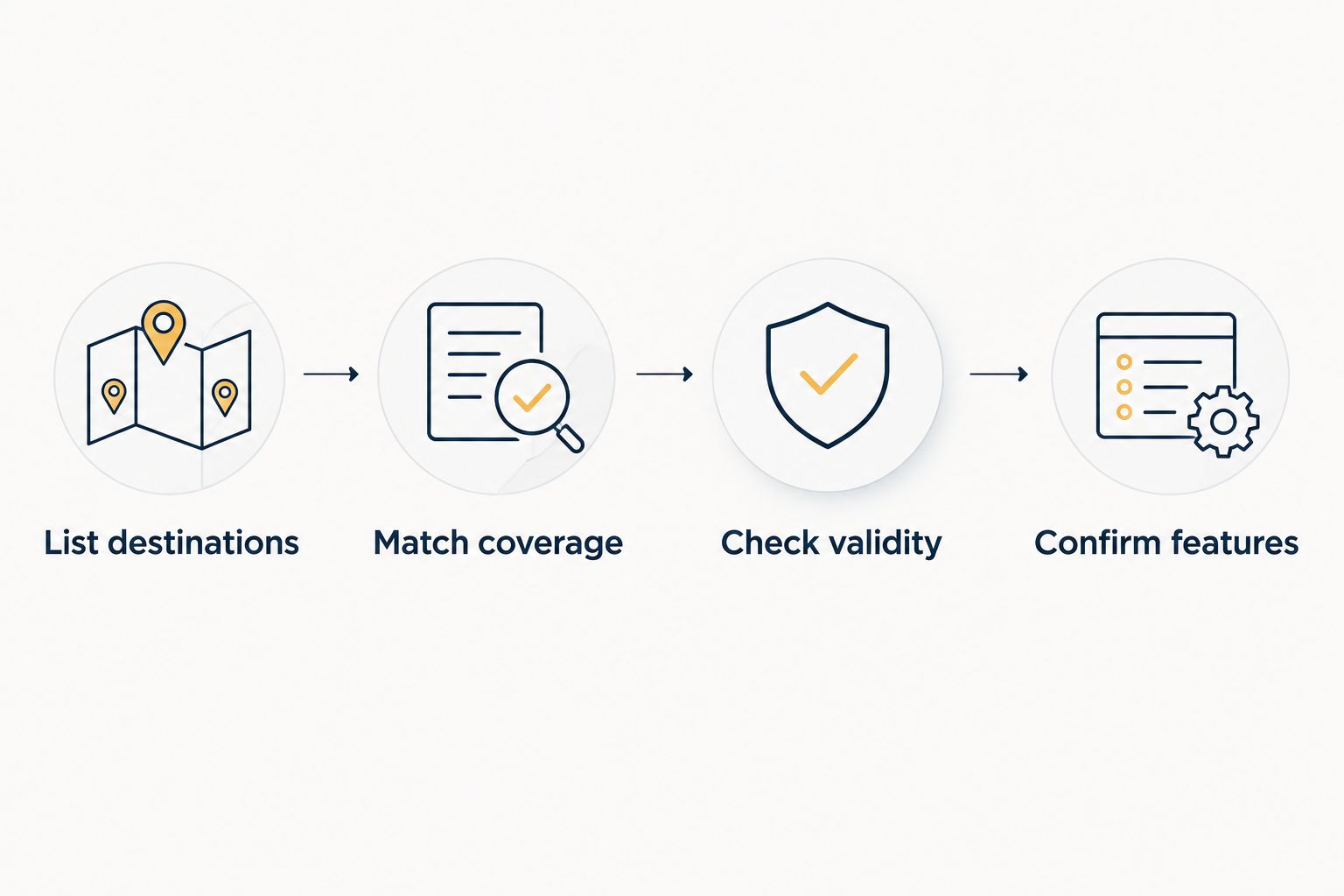
Use this decision sequence before comparing individual plans. The goal is to eliminate geographic mismatches before you spend time on secondary features.
- List destinations: Include every place where you expect to turn on cellular data.
- Match coverage: Start with single-country, regional or global scope according to that list.
- Check validity: Confirm the start trigger and whether the plan covers your stay.
- Confirm features: Check the device, hotspot, voice and SMS requirements that matter to you.
The sequence matters: a plan with convenient management still fails your trip if a required country is excluded. Resolve destination coverage first, then check the terms that affect everyday use.
Set up your phone before departure
For your 2026 trip, finish the compatibility and installation checks while you have a dependable internet connection. Follow the provider's installation instructions and check the activation trigger before proceeding.
Confirm the exact device
Check your phone's model and regional version, not just the product family. Verify eSIM support and any carrier lock or employer restriction before choosing service.
Label your lines clearly
If your phone supports the required dual-SIM setup, give the Canadian line and travel line distinct names. Select the intended travel line for mobile data and check whether automatic data switching can move traffic to the home line.
Separate the roaming controls
Follow the travel provider's instructions for roaming on the travel line. Separately check your Canadian line's data-roaming setting and carrier terms; leaving the home line active is not the same as preventing every roaming charge.
Prepare for essential tasks
Download maps, save accommodation details and keep installation instructions accessible offline. After connecting abroad, test a map search and a messaging app before relying on the connection for a time-sensitive task.
Which travel eSIM should you choose?
Choose A-sim travel eSIMs if app-based usage tracking and top-ups match how you want to manage data abroad. Then select the coverage format from your itinerary: single-country for one destination, regional for covered stops within a region, or global for a covered interregional route.
For an undecided traveller in 2026, the default is not the broadest plan. It is the narrowest format that covers the complete route and meets the phone, validity and communication requirements.
Match your eSIM to your trip
Explore single-country, regional and global travel eSIM options.
FAQ
What's the best eSIM for Canadians travelling abroad?
The best eSIM for Canadians matches the full itinerary and the traveller's phone. A-sim is a fit for travellers who want single-country, regional or global travel data with app-based usage tracking and top-ups.
Should I choose a single-country or regional eSIM?
Choose a single-country eSIM for one destination and assess a regional eSIM for several covered countries within one region. Check every stop against the actual coverage list before choosing.
Is a global eSIM better than a regional eSIM?
A global eSIM is a better geographic fit when your covered destinations span different regions. It is not automatically better for a trip contained within one regional plan's coverage.
Can I keep my Canadian phone number while using a travel eSIM?
You can keep your Canadian number on a separate active line when your phone and carrier support the required setup. Select the travel line for data and check your Canadian carrier's call, text and roaming terms separately.
Will a travel eSIM receive my bank verification texts?
Do not assume a travel eSIM will receive verification texts sent to your Canadian number. Those messages depend on the line associated with that number, its service and the bank's verification method.
Can I install my travel eSIM before leaving Canada?
Check the provider's installation and activation instructions before installing in Canada. Establish whether installation, manual activation or connection to a supported network starts the validity period.
Does a travel eSIM work on every iPhone or Android phone?
No, travel eSIM compatibility depends on the exact device, regional version and carrier restrictions. Confirm support for your specific phone before purchasing.
What should I check when choosing an eSIM in 2026?
Check destination coverage, device compatibility, validity, activation rules and the communication features you need. Confirm hotspot support separately if you intend to connect a laptop or another device.
One last thing
A travel eSIM does not change the phone number attached to your bank account. Before departure, check how you will receive essential verification codes and whether the account offers another authentication method. Sorting out that dependency at home is more useful than discovering it while trying to sign in abroad.