
Best for a China-only trip: a China-specific travel eSIM. Best for an Asian multi-stop itinerary: a regional eSIM that explicitly includes mainland China. Best for an intercontinental route: a global eSIM with every destination listed. This 2026 guide ranks those options by itinerary fit, then explains the checks that matter before you commit.
- The best eSIM for China explicitly covers mainland China and supports your exact phone model.
- Choose a China-specific eSIM for a single-country trip; compare regional coverage for additional Asian stops.
- A-sim suits travellers who want travel eSIM purchasing, usage tracking and top-ups through an app.
- Confirm app access, hotspot rules and activation timing separately; an eSIM label guarantees none of them.
Why this matters
A working data connection and access to your usual apps are different requirements in mainland China. Internet restrictions affect services including Google and WhatsApp. Buying an eSIM does not, by itself, establish which services you can reach.
A-sim offers country, regional and global travel eSIMs, with purchasing through its website or app and usage management and top-ups through the app. For a China trip, check the specific plan's destination list and terms before choosing any of those formats.
Your 2026 decision should start with the route, not the provider name. A plan covering the wrong territory fails the first test, regardless of how straightforward installation looks.
What makes the best eSIM for China?
Use these six criteria before comparing plan descriptions:
- Explicit mainland coverage: Look for mainland China by name. Do not substitute a Hong Kong or Macau listing.
- Exact device compatibility: Check your phone's model, purchase region and carrier-lock status, not just whether it is an iPhone or Android.
- Required app access: Ask about the services you actually need. General internet access is not an app-by-app guarantee.
- Usable allowance: Match data and validity to your trip, then check what happens when either runs out.
- Connection rules: Confirm hotspot permission, any speed restrictions and the activation trigger.
- Manageable top-ups: Understand how you check remaining data and obtain more before losing connectivity.
Treat missing answers as unresolved requirements, not implied features. A regional label does not establish mainland coverage, and a large data allowance does not establish unrestricted speed.
China eSIM options at a glance
These are plan-format recommendations, not a provider speed ranking. Each format serves a different route; actual coverage and connection terms belong to the individual plan.
| Rank | Option | Best for | Standout feature | Key limitation |
|---|---|---|---|---|
| 1 | China-specific travel eSIM | A mainland-only itinerary | Coverage selection centred on one destination | Does not establish coverage for onward stops |
| 2 | Regional travel eSIM including China | Mainland China plus other covered Asian destinations | Combines listed destinations in a regional plan | Regional boundaries and included territories differ |
| 3 | Global travel eSIM including China | A route spanning multiple regions | Combines listed destinations across regions | The global label does not mean every country is included |
Read the coverage list as a checklist against your tickets. If your route includes mainland China, Hong Kong and Japan, verify all three destinations individually rather than assuming one regional name covers them.
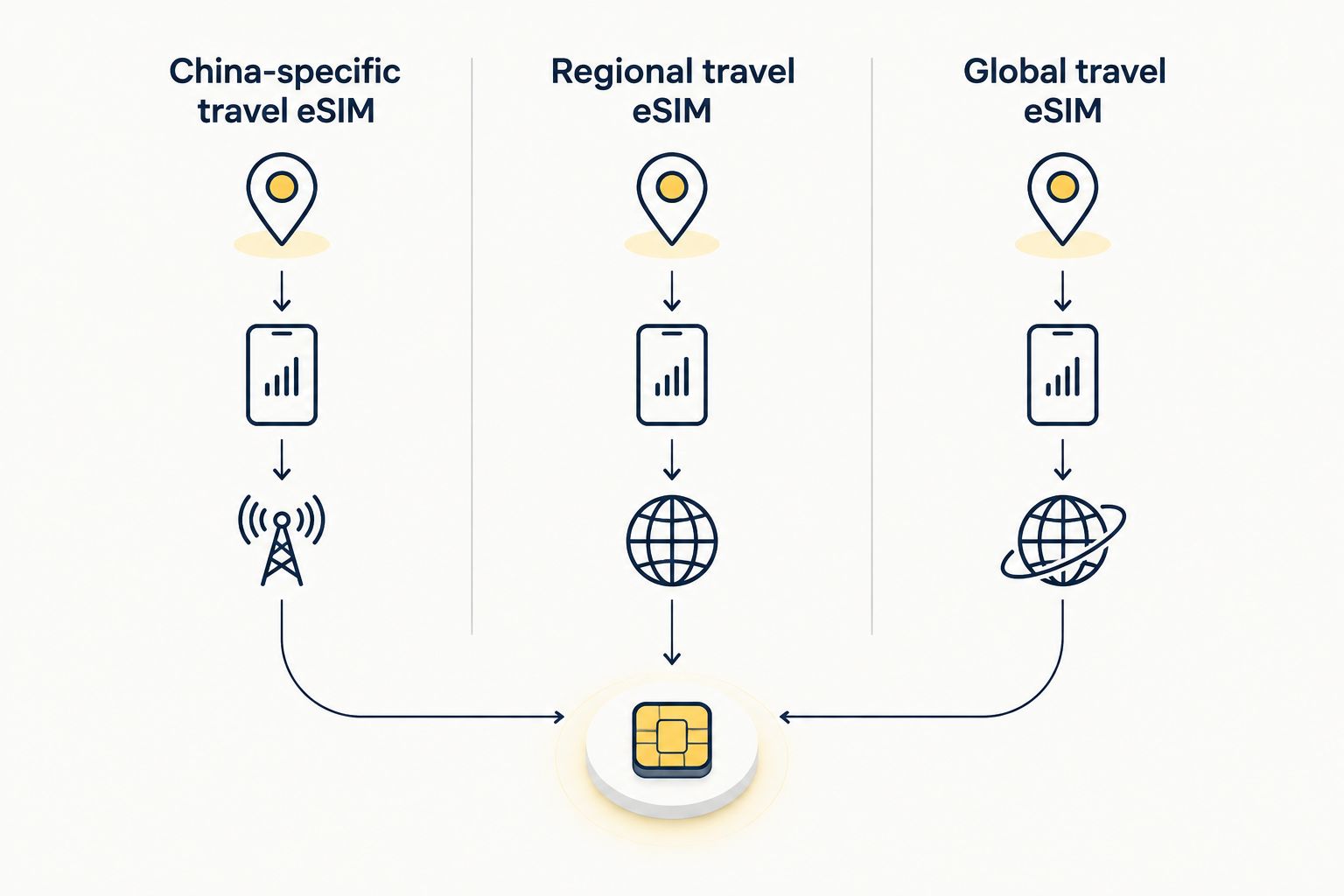
1. China-specific travel eSIM: best for mainland-only trips
A China-specific travel eSIM is the most direct starting point when mainland China is your only destination. You compare the allowance, validity and connection terms without needing coverage for an onward itinerary.
For an illustrative 7-day trip, check that validity covers your arrival through departure. Seven calendar days on your itinerary do not explain when the plan's clock starts; that depends on its activation terms.
China-specific travel eSIM pros:
- Keeps the destination check focused on mainland China.
- Makes a single-country itinerary straightforward to match against validity.
- Avoids choosing broader coverage solely because the destination list is longer.
China-specific travel eSIM cons:
- Mainland coverage does not establish coverage in Hong Kong or Macau.
- A destination-specific label says nothing about hotspot support or access to restricted apps.
Best for: Travellers staying in mainland China without additional international stops.
For 2026, make app access part of the purchase decision rather than an arrival-day experiment. If your work depends on a particular service, obtain a clear answer about that service and keep an alternative way to contact colleagues.
Do not interpret a country-specific plan as a promise of a local telephone number. Data, ordinary voice calls and SMS are separate features; check each one you need.
Verdict: Hold until mainland coverage, device compatibility and required services are confirmed; then choose this format for a mainland-only route.
2. Regional travel eSIM: best for an Asian multi-stop itinerary
A regional travel eSIM combines the destinations listed in its coverage terms. It fits a trip involving mainland China and other included Asian destinations, provided the allowance and validity cover the entire route.
The key word is included. An Asia label is not enough to establish mainland China coverage, and mainland China coverage does not establish Hong Kong or Macau coverage.
Regional travel eSIM pros:
- Lets you select coverage around several listed Asian destinations.
- Reduces the need to arrange a separate plan for each included stop.
- Lets you assess the full regional itinerary against one plan's terms.
Regional travel eSIM cons:
- Missing even one destination leaves a gap in your route.
- Connection settings, networks and app access need checking for each destination.
Best for: Travellers combining mainland China with other explicitly covered Asian stops.
For an illustrative 14-day itinerary, check when validity begins and whether the same allowance applies throughout the route. Do not assume crossing a border resets either the allowance or the validity period.
A regional plan is an itinerary choice, not proof of identical service everywhere. Before your 2026 departure, check the listed networks and any destination-specific restrictions that affect your plans.
Keep the installation instructions accessible offline. At a border crossing, you need to distinguish an excluded destination from a settings problem before changing or deleting anything.
Verdict: Hold until every stop is listed; then choose this format for a covered Asian multi-stop itinerary.
3. Global travel eSIM: best for intercontinental travel
A global travel eSIM groups destinations across regions within its stated coverage. It fits an itinerary where mainland China is one stop among destinations that do not sit within a suitable regional plan.
Global describes the format, not universal coverage. Check each destination, including stopovers where you intend to leave the airport or use mobile data.
Global travel eSIM pros:
- Supports planning around listed destinations across different regions.
- Reduces separate plan selection for included international stops.
- Gives frequent travellers a broader coverage format to compare against their route.
Global travel eSIM cons:
- A long country list can distract from an omitted destination you actually need.
- Broader coverage does not establish consistent speeds, networks or app access.
Best for: Travellers whose itinerary crosses regions and includes mainland China explicitly.
For an illustrative trip covering 3 destinations, verify all three rather than stopping at the word global. Then check whether the allowance is shared and whether the validity period spans the complete journey.
A-sim offers global travel eSIMs alongside regional and country options. Its app-based usage tracking and top-ups address plan management; they do not replace checking the individual plan's China coverage and connection terms.
Choose breadth only when your itinerary uses it. For a mainland-only visit, return to the country-specific comparison rather than treating the longest destination list as the strongest recommendation.
Verdict: Hold until the full route is confirmed; then choose this format when your journey spans regions.
China-specific checks before you commit
Confirm access to the apps you need
Mainland China's internet restrictions make service access a separate buying criterion. Ask the provider about your essential messaging, email, mapping and workplace services rather than requesting a vague assurance that the internet works.
International roaming routes and local internet connections can provide different access experiences. Do not translate that distinction into a blanket promise about any unnamed plan. Read the guide to using an eSIM in a country with internet censorship before relying on a particular service.
Check the exact handset
Phone families contain different regional models. Check the model identifier against the manufacturer's eSIM guidance, then confirm the handset is unlocked for another provider.
A phone bought in one market is not automatically equivalent to the same named model bought elsewhere. This matters before installation, not after landing.
Separate data from telephone service
Do not assume a travel data plan includes a Chinese number, ordinary calls or SMS. App-based messaging uses data, while receiving a verification text depends on the telephone line receiving that message.
If you retain your Canadian line, review its roaming terms separately. Turning off data roaming does not, by itself, explain charges for calls or other services.
Set up your connection before departure
Use this sequence for your 2026 trip. Follow the selected provider's instructions where menu names or activation rules differ.
- Check compatibility. Confirm the exact phone model supports the selected eSIM and accepts another provider's service.
- Read activation terms. Establish whether installation, manual activation or a network connection starts validity.
- Save instructions. Keep installation details, support information and your accommodation address accessible offline.
- Select travel data. Set the intended travel line for mobile data and review automatic data-switching settings.
- Test on arrival. Check a webpage and your essential apps separately, then inspect remaining data.
Install before departure only when the plan's instructions permit it without starting validity earlier than intended. Installation and activation are distinct concepts, but the provider determines the actual trigger.
Do not delete an installed eSIM as your first troubleshooting step. Reinstallation rules vary; check the instructions before removing the profile.
How these options are ranked
The ranking prioritises itinerary fit: mainland-only first, covered Asian multi-stop second, intercontinental third. Device compatibility, required app access, allowance, validity and connection rules remain pass-or-fail checks for every format.
A-sim is best suited to travellers who want to buy and manage travel eSIMs through an app. That management fit is separate from a China-specific recommendation, which requires confirmed plan coverage and terms. No provider receives a speed or reliability ranking here without comparable evidence.
Which eSIM for China should you choose?
Start with a China-specific travel eSIM for a mainland-only itinerary. Move to a regional format when it covers your additional Asian stops, or a global format when your route crosses regions.
For 2026, reject any option that leaves your essential requirements unanswered. Confirm mainland coverage, handset support, app access and validity before making the final choice.
FAQ
What's the best eSIM for China in 2026?
A China-specific travel eSIM is the best starting format for a mainland-only trip. Choose a regional or global format when its explicit destination list better matches your onward itinerary, then confirm compatibility and required app access.
Is A-sim suitable for a China trip?
A-sim suits travellers who want website or app purchasing, app-based usage tracking and app-based top-ups. Before choosing it for China, confirm mainland coverage and the connection terms of the specific plan.
Does a Hong Kong eSIM also cover mainland China?
A Hong Kong listing does not establish mainland China coverage. Choose a plan that explicitly lists every territory you intend to visit.
Will Google and WhatsApp work with a China travel eSIM?
An eSIM label does not guarantee access to Google or WhatsApp in mainland China. Ask the selected provider about those services on the specific plan and prepare an alternative contact method.
Can I use a China eSIM on any iPhone or Android?
No, compatibility depends on the exact handset model, regional version and carrier-lock status. Check manufacturer guidance and the provider's compatibility requirements before installation.
Should I install my China eSIM before flying?
Install before flying only when the provider's instructions support it and you understand the validity trigger. Save the setup instructions offline so you can complete the required steps after arrival.
Does a travel eSIM include a Chinese phone number?
Do not assume a travel eSIM includes a Chinese phone number. Check whether the specific plan includes data only, ordinary calls or SMS, especially if you need local verification messages.
One last thing
Test the task, not just the signal bars. After connecting, open your accommodation address, send a message through your chosen service and check that your next travel document is accessible.
A signal indicator confirms less than a completed task. Keep essential addresses and booking details offline so your first journey does not depend on troubleshooting mobile data.