
Best for app-managed travel data: A-sim. Best for an India-only itinerary: an India-only travel eSIM. Best for a trip across neighbouring countries: a regional eSIM that explicitly includes India. This 2026 guide helps you choose by destination coverage, phone compatibility and how you use data; confirm India coverage on the specific plan before buying.
- The best eSIM for India matches your route, phone compatibility and need for data versus calls.
- A-sim suits travellers who want app-based usage tracking and top-ups; confirm India coverage before choosing a plan.
- Choose an India-only eSIM for a single-country trip; compare regional coverage when crossing borders.
- A data-only travel eSIM does not replace a local number for ordinary calls or SMS.
Why this matters
An eSIM is a digital SIM profile, not a promise of better reception. Your connection depends on the plan’s supported network, your phone and coverage where you actually travel. A country name on a plan is only the starting point.
For an India trip in 2026, separate internet access from telephone service. Maps, messaging apps and email need data. Ordinary calls and SMS need a plan that supports those services, or another active line.
Choose the connection your itinerary needs, not the option with the biggest coverage list. A single-country holiday, a cross-border trip and an extended stay with local calling requirements are different buying decisions.
What makes the best eSIM for India?
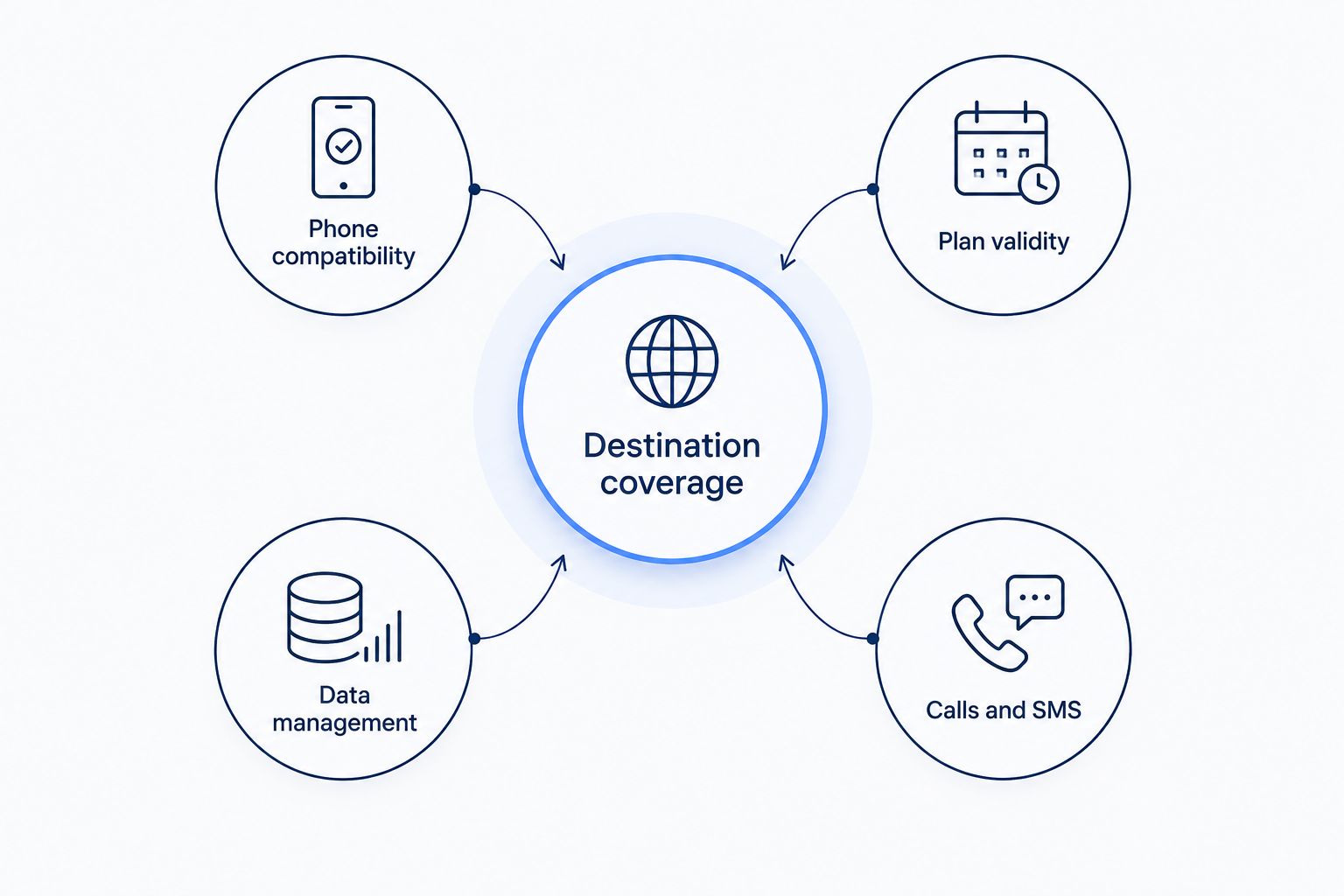
Use these five criteria before comparing providers or plan sizes:
- Destination coverage: India must appear in the specific plan’s supported destinations. For regional plans, check every country on your route individually.
- Phone compatibility: Your exact phone model must support eSIM, and its carrier-lock status must allow the intended provider.
- Plan validity: Check what starts the validity period: installation, manual activation or connection to a supported network.
- Data management: Look for a clear way to check remaining data, understand renewal rules and add data when needed.
- Calls and SMS: Decide whether internet access is enough or whether you need ordinary calling, text messages or an Indian number.
Treat hotspot support and speed restrictions as additional checks if you will work from your laptop. Do not assume that a phone data allowance permits tethering or that an unlimited label means unrestricted speeds.
India eSIM options at a glance
These are buying routes, not interchangeable products. The table ranks them by the problem each solves; the sections below use the same order.
| Option | Best for | Standout feature or selection criterion | Key limitation |
|---|---|---|---|
| A-sim | App-managed travel data | Usage management and top-ups through the app | Confirm India coverage and the specific plan’s service terms |
| India-only travel eSIM | A trip staying within India | Destination scope matches a single-country itinerary | Does not establish coverage for another country |
| Regional travel eSIM including India | A trip across a defined group of countries | One plan covering the listed destinations | Regional labels do not guarantee that India is included |
| Global travel eSIM including India | A trip spanning separate regions | Destination coverage across the listed countries | Every stop still needs an individual coverage check |
| Local carrier eSIM with voice and SMS | Travellers who need an Indian number | Telephone services when included in the selected plan | Eligibility, registration and service terms need checking |
Match the plan to the route
Start with where you will use mobile data, then check your phone and service requirements. A transit stop only belongs in your coverage list if you intend to connect there.
1. A-sim: best travel eSIM shortlist for app-based management
A-sim offers travel eSIMs for single countries, regions and international destinations. You can access its service through the website or app, manage usage in the app and top up through the app. Its travel eSIMs integrate with compatible iPhone and Android devices.
A-sim is the travel eSIM shortlist for travellers who want app-based usage tracking and top-ups. For India, choose the specific plan only after checking its destination list, validity rules and supported services.
A-sim pros:
- Website and app access give you two ways to manage the travel service.
- In-app usage management helps you monitor your connection during a trip.
- In-app top-ups provide a way to add data through the same service.
- Single-country, regional and global options support different itinerary types.
A-sim cons:
- The brand’s range of destination categories does not replace checking India on the selected plan.
- App-based management does not remove the need to check phone compatibility, hotspot terms or calling support.
Best for: Travellers who prioritise managing travel data from their phone rather than choosing solely by destination scope.
Verdict: Hold until the selected plan passes your India coverage and compatibility checks; choose it when app-based management is your priority.
2. India-only travel eSIM: best for a single-country holiday
An India-only travel eSIM focuses your plan selection on one destination. That makes the comparison straightforward when your itinerary stays within India: assess the supported network, allowance, validity and service restrictions without sorting through unrelated countries.
For example, a 7-day trip needs validity that covers the entire period you expect to use mobile data. Installation and activation are separate questions; check the start rule before deciding when to install.
India-only travel eSIM pros:
- Destination scope matches an itinerary confined to India.
- You can compare plans against one country’s coverage requirements.
- The selection process stays focused on allowance and trip duration.
India-only travel eSIM cons:
- Do not expect it to work during a stop in another country.
- Country-wide destination coverage does not guarantee reception at every address or remote location.
Best for: Holidaymakers whose mobile-data needs begin and end in India.
Verdict: Buy an India-only plan when its validity, supported network and services match your trip.
3. Regional travel eSIM: best for a defined cross-border route
A regional travel eSIM covers the countries named in that particular plan. The word regional describes the scope; it does not tell you whether India, or any other stop, is included.
For a 2-country itinerary, check both destinations before choosing. A regional option belongs on your shortlist when its coverage list matches the route and you want to use that plan across the covered borders.
Regional travel eSIM pros:
- One selected plan can serve several listed destinations.
- Coverage scope can match a cross-border itinerary more closely than a country-only plan.
- You can assess the journey’s data needs together rather than treating each destination separately.
Regional travel eSIM cons:
- Broad region names hide important differences between destination lists.
- Network access and service terms need checking for each country, not just India.
Best for: Travellers visiting India alongside other countries explicitly covered by the same regional plan.
Verdict: Buy only when every destination where you need data appears in the plan’s coverage list.
4. Global travel eSIM: best for trips spanning separate regions
A global travel eSIM is designed around a broad list of destinations. It fits a journey that reaches beyond one country or a single regional package, provided the selected plan includes every relevant stop.
Global does not mean every country, every network or identical service everywhere. For a 2026 itinerary spanning separate regions, build your destination checklist first and compare it with the plan’s actual coverage.
Global travel eSIM pros:
- A broad destination list can fit a geographically varied itinerary.
- One plan can cover listed stops across separate regions.
- You can evaluate coverage against the complete journey before departure.
Global travel eSIM cons:
- A broad footprint is unnecessary if you only need data in India.
- The global label does not establish local calling, hotspot access or equal performance between countries.
Best for: Travellers whose itinerary crosses separate regions and does not fit a suitable regional plan.
Verdict: Hold for a multi-region trip; skip global scope when an India-only plan meets your needs.
5. Local carrier eSIM: best for an Indian number and telephone services
A local carrier eSIM belongs in a different comparison when your priority is ordinary calls, SMS or an Indian phone number. Select a plan that explicitly includes those services, then check the carrier’s registration requirements and your eligibility.
Do not assume that every local mobile plan supports eSIM or that every visitor can complete the same registration process. Confirm the requirements before making local telephone service essential to your arrival plans.
Local carrier eSIM pros:
- A suitable plan can provide a local number rather than data alone.
- Included voice and SMS services support ordinary telephone communication.
- You can assess a local carrier’s service offering directly against your requirements.
Local carrier eSIM cons:
- Registration and eligibility requirements add steps to the purchase decision.
- Overseas coverage is a separate question; an Indian plan is not automatically a cross-border travel plan.
Best for: Travellers whose stay requires local telephone services, not just internet access.
Verdict: Buy after confirming eligibility, eSIM support and the voice or SMS services you need.
How the options are ranked
This 2026 ranking uses destination coverage, compatibility, validity, data management and telephone requirements. Each option owns a different use case; the order does not claim that one network is faster or that one provider has better reception throughout India.
App-managed travel data comes first because it addresses day-to-day usage control. Country, regional and global plans follow by itinerary scope. Local carrier service is the separate choice for local telephone needs.
Before you activate your India eSIM
Use this sequence to avoid choosing the right plan but configuring the wrong line:
- Check your phone. Confirm eSIM support for the exact model and verify its carrier-lock status.
- Read the start rule. Identify when validity begins before installing or activating the profile.
- Save the instructions. Keep installation details accessible without relying on the new connection.
- Choose your data line. Select the travel eSIM for mobile data and follow its roaming instructions.
- Test the connection. Once service should be active, load a page over mobile data rather than Wi-Fi.
If you keep your home line active, check its roaming settings separately. Turning off data roaming on that line does not answer whether calls or texts incur charges under your home carrier’s terms.
Read the guide to keeping your home number active with dual SIM before deciding which line handles data and which handles telephone service.
Which India eSIM should you choose?
For an undecided traveller visiting only India in 2026, start with an India-only travel eSIM and compare management features next. Move to a regional or global plan only when the destination list solves an actual cross-border requirement.
Choose A-sim for your travel eSIM shortlist when app-based usage management and top-ups matter, then verify the selected plan’s India coverage. Choose a suitable local carrier plan instead when an Indian number or ordinary telephone services are central to your stay.
For a 14-day trip, check validity against all 14 days you need service, including arrival and departure. An adequate data allowance is not useful after the plan expires.
FAQ
What’s the best eSIM for India in 2026?
The best eSIM for India matches your destinations, phone compatibility and service needs. Start with an India-only travel plan for a single-country trip; choose regional or global coverage only when your route requires it.
Is a regional eSIM better than an India-only eSIM?
A regional eSIM is the better fit when its destination list covers the other countries on your trip as well as India. An India-only plan is the more focused choice when you need mobile data only in India.
Will an India travel eSIM give me an Indian phone number?
A data-only travel eSIM does not give you an Indian phone number for ordinary calls and SMS. If you need those services, select a plan that explicitly includes a local number, voice and messaging.
Can I keep my home number while using an India eSIM?
You can keep your home number active when your phone supports the required dual-SIM configuration. Select the travel eSIM for data and check your home carrier’s charges for calls, texts and roaming.
Should I install my India eSIM before I fly?
Install before departure only after checking the plan’s installation and validity instructions. Some plans distinguish installation from activation, so confirm what starts the service period.
Can I use an India eSIM as a hotspot for my laptop?
You can use hotspot sharing when both your phone and the selected plan permit it. Check tethering restrictions and data limits before relying on the connection for work.
Will an eSIM work everywhere I travel in India?
An eSIM does not guarantee reception everywhere in India. Coverage depends on the supported network, your location and your phone; check your route rather than relying only on the country label.
One last thing
Save offline maps and arrival details before you leave. Your first connection is easier to troubleshoot when the hotel address, installation instructions and essential travel information are already on your phone.
Do not delete a travel eSIM as your first troubleshooting step. Reinstallation depends on the provider’s rules; check the instructions before removing the profile.