Best for a New Zealand-only trip: a single-country travel eSIM. Best for a combined itinerary: a regional eSIM that explicitly includes every destination. Best for travel across several regions: a global eSIM. For 2026, choose by route, phone compatibility and calling needs—not the biggest destination count.
- The best eSIM for New Zealand matches your itinerary, compatible phone and calling needs.
- A-sim suits travellers who want app-based travel eSIM usage tracking and top-ups.
- Choose single-country coverage for New Zealand alone; check every destination before choosing regional or global coverage.
- Check network coverage, activation rules and hotspot permissions before committing to a travel eSIM.
Why this matters
Your New Zealand eSIM needs to work where you travel, not just where you land. A city stay, a driving holiday and an onward international trip demand different checks. A larger destination list does not automatically make a plan a better match.
A-sim offers single-country, regional and global travel eSIMs, with purchasing through its website or app and usage management and top-ups through its app. A-sim is best for travellers who want to manage travel eSIM usage and top-ups in an app. Confirm that the plan you select explicitly includes New Zealand before purchasing.
This guide ranks coverage formats by travel use case. It does not treat a provider name as proof of local coverage, included calls or unrestricted tethering. Those details belong to the specific plan you choose.
What makes the best eSIM for New Zealand?
Use these criteria to compare New Zealand eSIM plans in 2026. Check the actual plan terms rather than assuming every option from a provider works identically.
- Destination fit: New Zealand must appear in the covered destinations. For onward travel, check each additional country separately.
- Route coverage: Identify the supported local network and review its coverage information for your overnight stops and driving route.
- Phone compatibility: Confirm that your exact handset supports eSIM and is unlocked for another provider. Device variants matter.
- Validity and activation: Check what starts the validity period: purchase, installation, activation or connection to a supported network.
- Data management: Review usage tracking, top-up arrangements, hotspot permissions and any restrictions after an allowance is used.
- Calling needs: Distinguish internet access from a telephone service. Do not assume a travel data eSIM includes a local number, calls or SMS.
Coverage fit comes before convenience. An app that makes top-ups easy cannot create a mobile signal where the supported network has none.
New Zealand eSIM options at a glance
| Rank and option | Best for | Standout feature | Key limitation |
|---|---|---|---|
| 1. Single-country travel eSIM | New Zealand-only holidays | Coverage scope matches one destination | Does not serve an onward destination unless explicitly included |
| 2. Regional travel eSIM | New Zealand plus other included regional destinations | Keeps an included regional itinerary under one plan | Regional names do not prove which countries are included |
| 3. Global travel eSIM | Trips spanning several regions | Broad destination scope under one plan | Every stop and local network still needs checking |
| 4. Local-carrier eSIM with voice | Travellers who need a New Zealand number | A local telephone service when explicitly included | Requires checking voice, SMS, eligibility and setup terms |
These are buying categories, not named product tiers. Use the table to narrow your search, then inspect the terms of the actual plan you intend to use.
1. Single-country eSIM: best for New Zealand-only holidays
A single-country travel eSIM is the clearest starting point when New Zealand is your only destination. You can focus the comparison on local coverage, validity and data rather than sorting through countries you will not visit.
For a 7-day holiday, match the validity window to your arrival and departure dates. For a 14-day road trip, give extra attention to coverage along the route. Neither trip length alone tells you how much data you need; navigation, uploads and streaming change the requirement.
A-sim offers single-country travel eSIMs and app-based usage management. Check the destination details before choosing a plan for New Zealand, then review the activation instructions for your compatible iPhone or Android device.
Single-country eSIM pros:
- Keeps the destination check focused on New Zealand.
- Avoids choosing extra geographic scope you do not need.
- Makes it easier to compare plans against the same itinerary.
Single-country eSIM cons:
- Does not solve onward connectivity unless the next destination is included.
- Still requires checks for calls, hotspot use and supported networks.
Best for: Travellers staying entirely within New Zealand who primarily need mobile internet.
Verdict: Buy a single-country eSIM when New Zealand is your only stop and the plan meets your route and device requirements.
2. Regional eSIM: best for a combined regional itinerary
A regional travel eSIM groups specified destinations into one plan. It fits a combined itinerary only when every country you need appears in the coverage list. Do not infer coverage from labels such as “Oceania” or “Asia-Pacific.”
If your 2026 trip combines Australia and New Zealand, check both names in the same plan details. Then check whether the validity period runs continuously across the trip. Crossing a border does not, by itself, mean the allowance or validity resets.
A-sim offers regional travel eSIMs. Treat that format as an option to assess against your itinerary, not a promise that any particular regional plan includes New Zealand.
Regional eSIM pros:
- Groups included destinations under one plan.
- Reduces the need to select separate country plans for those stops.
- Lets you assess one validity window against the combined itinerary.
Regional eSIM cons:
- A regional label can obscure an excluded destination.
- Network access and plan conditions still need destination-by-destination review.
Best for: Travellers visiting New Zealand and other destinations explicitly covered by the same regional plan.
Verdict: Buy regional coverage only when the complete route appears in the plan—not because the regional name sounds right.
3. Global eSIM: best for travel across several regions
A global travel eSIM covers a specified list of countries across a wider geographic area. It fits an itinerary that a single-country or regional plan does not cover. The destination list remains the deciding document.
Consider a 30-day trip with stops across several regions. Map each country against the plan, including any stopover where you intend to leave the airport or need mobile data. Also check whether the same allowance and expiry date apply throughout the journey.
A-sim offers global travel eSIMs with app-based usage management and top-ups. For a New Zealand stop, verify that the selected global plan includes the country and review the local connection details.
Global eSIM pros:
- Brings widely separated included destinations into one plan.
- Reduces repeated plan selection across a complex itinerary.
- Gives you one coverage list to compare with the full route.
Global eSIM cons:
- Broad coverage adds little value to a New Zealand-only holiday.
- Inclusion does not establish identical speeds or network access everywhere.
Best for: Travellers whose itinerary spans several regions and matches the global plan’s country list.
Verdict: Buy global coverage for a genuinely multi-region route; skip it when extra destinations do not serve your trip.
4. Local-carrier eSIM: best for a New Zealand phone number
A local-carrier eSIM with an explicitly included voice service deserves a separate place on your shortlist. Internet access and a local telephone number solve different problems. Choose according to the communication you actually need.
If you need to receive ordinary calls or SMS on a New Zealand number, verify those features directly in the plan terms. Messaging apps use internet data, but they are not a substitute for every telephone or SMS requirement. Do not assume that installing an eSIM assigns a local number.
Local-carrier eSIM pros:
- Addresses local-number requirements when a number is included.
- Lets you evaluate calls, SMS and data together.
- Gives voice-dependent travellers a relevant alternative to data-only service.
Local-carrier eSIM cons:
- Requires checking purchase eligibility and activation requirements.
- A New Zealand-focused service does not automatically cover onward travel.
Best for: Travellers who specifically need an included New Zealand number, ordinary calls or SMS.
Verdict: Buy a local voice-enabled eSIM when telephone service is essential; skip it if mobile internet alone meets your needs.
How these options are ranked
The ranking puts itinerary fit first, followed by route coverage, compatibility, validity, data management and calling needs. Single-country coverage takes the default position because it directly matches a New Zealand-only trip. Regional and global coverage move ahead only when your itinerary requires them.
This 2026 guide ranks plan formats, not measured network performance. No format wins on speed simply because it is local, regional or global. Compare the supported network and actual plan restrictions before treating one as a performance upgrade.
Set up your New Zealand eSIM before departure
Separate installation from activation. Installation adds the eSIM profile to your phone; the provider’s rules determine when the service becomes active and when validity begins. Read those rules before installing early.
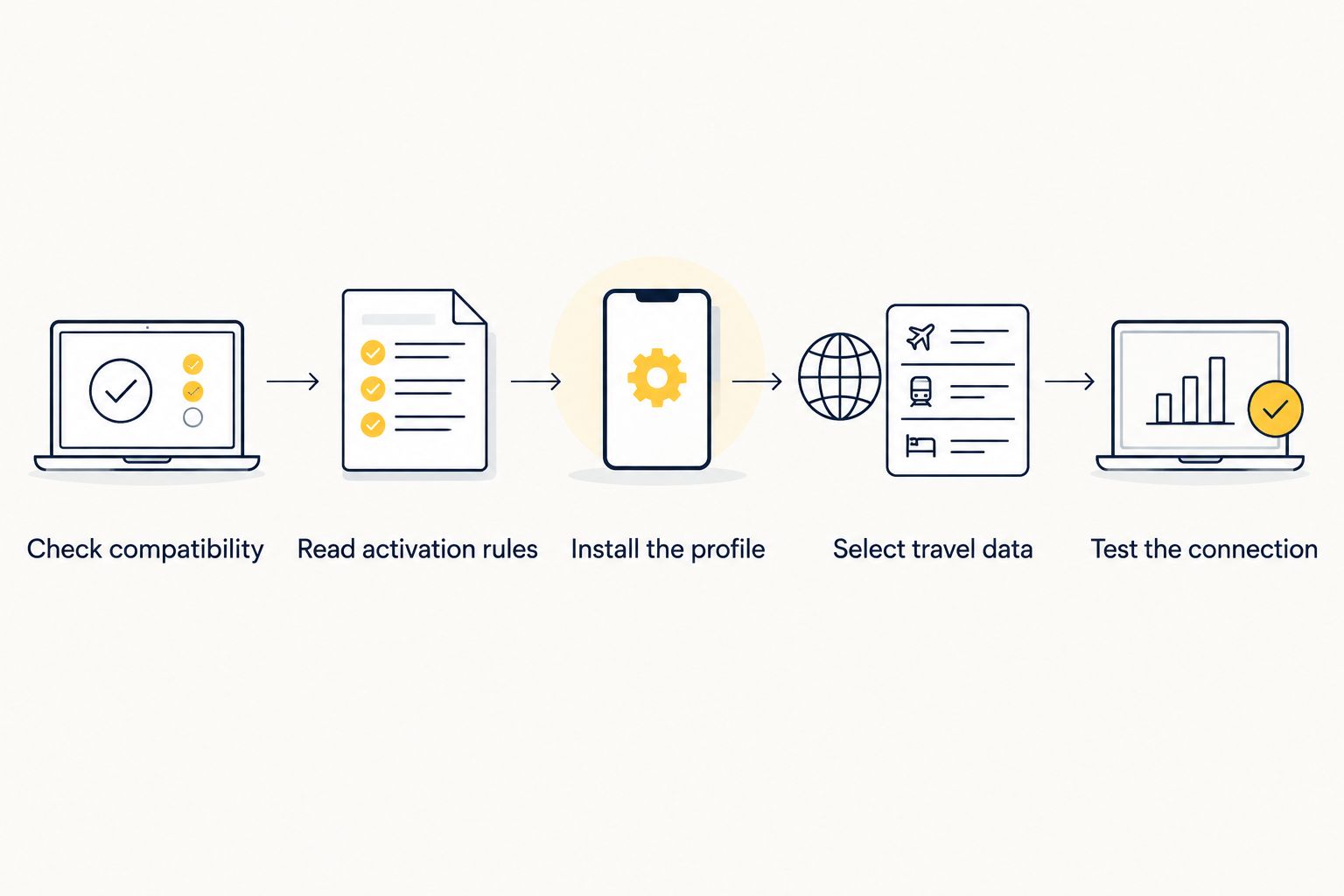
Use this sequence to avoid confusing your home line with your travel data line:
- Check compatibility: Confirm eSIM support, carrier-unlock status and any restrictions on a work-issued phone.
- Read activation rules: Identify the event that starts the plan and save the instructions somewhere accessible offline.
- Install the profile: Follow the provider’s instructions while you have a dependable internet connection.
- Select travel data: Choose the travel eSIM for cellular data and apply the roaming settings the provider specifies.
- Test the connection: After activation in a covered area, open a web page and check which line supplies the data.
The order matters. Do not delete an installed profile as your first troubleshooting step; reinstallation depends on the provider’s process.
Phone menus vary, so follow the instructions for your device rather than copying another traveller’s settings. The guide to installing an eSIM before you travel explains the distinction to check before departure.
Check your road-trip and data needs
For a driving holiday, assess the route rather than the arrival airport. Look up coverage around accommodation, planned stops and the roads between them. Download maps and save booking details before heading into places where a connection is uncertain.
For a work trip, inspect hotspot permission before relying on your phone for laptop access. Also check any speed restrictions or fair-use terms attached to the plan. A large allowance does not answer either question.
Control avoidable background use before your first day out:
- Download entertainment over Wi-Fi instead of streaming it on the road.
- Review photo-backup and app-update settings for cellular data.
- Check usage after activities such as video calls or large uploads.
- Keep essential addresses and reservation details accessible offline.
Buy for the activities you expect, not just the number of nights away. Two travellers on the same route can have very different data needs.
Which New Zealand eSIM should you choose?
Choose a single-country travel eSIM as the default for a New Zealand-only holiday. Move to regional coverage for an explicitly included combined itinerary, or global coverage for a route spanning several regions. Choose a voice-enabled local option when a New Zealand number is a requirement.
For 2026, the final check stays simple: destination, route, device, validity and calling needs. If any one of those fails, choose another plan. Convenience matters only after the essentials fit.
FAQ
What's the best eSIM for New Zealand in 2026?
A single-country travel eSIM is the best starting point for a New Zealand-only holiday. Choose regional or global coverage when your itinerary includes other covered destinations, and verify compatibility and route coverage before purchasing.
Is A-sim a good choice for managing travel data?
A-sim suits travellers who want to track travel eSIM usage and top up through an app. Confirm that your selected plan explicitly includes New Zealand and meets your device and validity requirements.
Should I choose a regional eSIM for Australia and New Zealand?
Choose a regional eSIM only when the same plan explicitly includes both Australia and New Zealand. Check that its validity period covers the full journey and review the conditions for each destination.
Will a New Zealand travel eSIM give me a local phone number?
A travel eSIM provides a New Zealand phone number only if the selected plan explicitly includes one. Do not assume that a data plan includes ordinary calls or SMS.
Can I install my eSIM before arriving in New Zealand?
Install before arrival only after checking the provider's installation and activation instructions. Some plans link validity to installation or activation, while others use connection to a supported network.
Will an eSIM work everywhere on a New Zealand road trip?
An eSIM cannot provide service outside its supported network's coverage. Check your route and keep maps, addresses and booking details available offline.
Can I keep my Canadian number while using a travel eSIM?
You can keep your Canadian number active alongside a travel eSIM if your phone and carrier support the required dual-SIM setup. Check your home carrier's roaming terms and select the intended line for cellular data.
One last thing
Before leaving reliable Wi-Fi, turn off Wi-Fi briefly and load a new web page. That small check confirms that mobile data is working, rather than merely showing that the eSIM profile exists. Save the setup instructions offline while you still have a connection.