
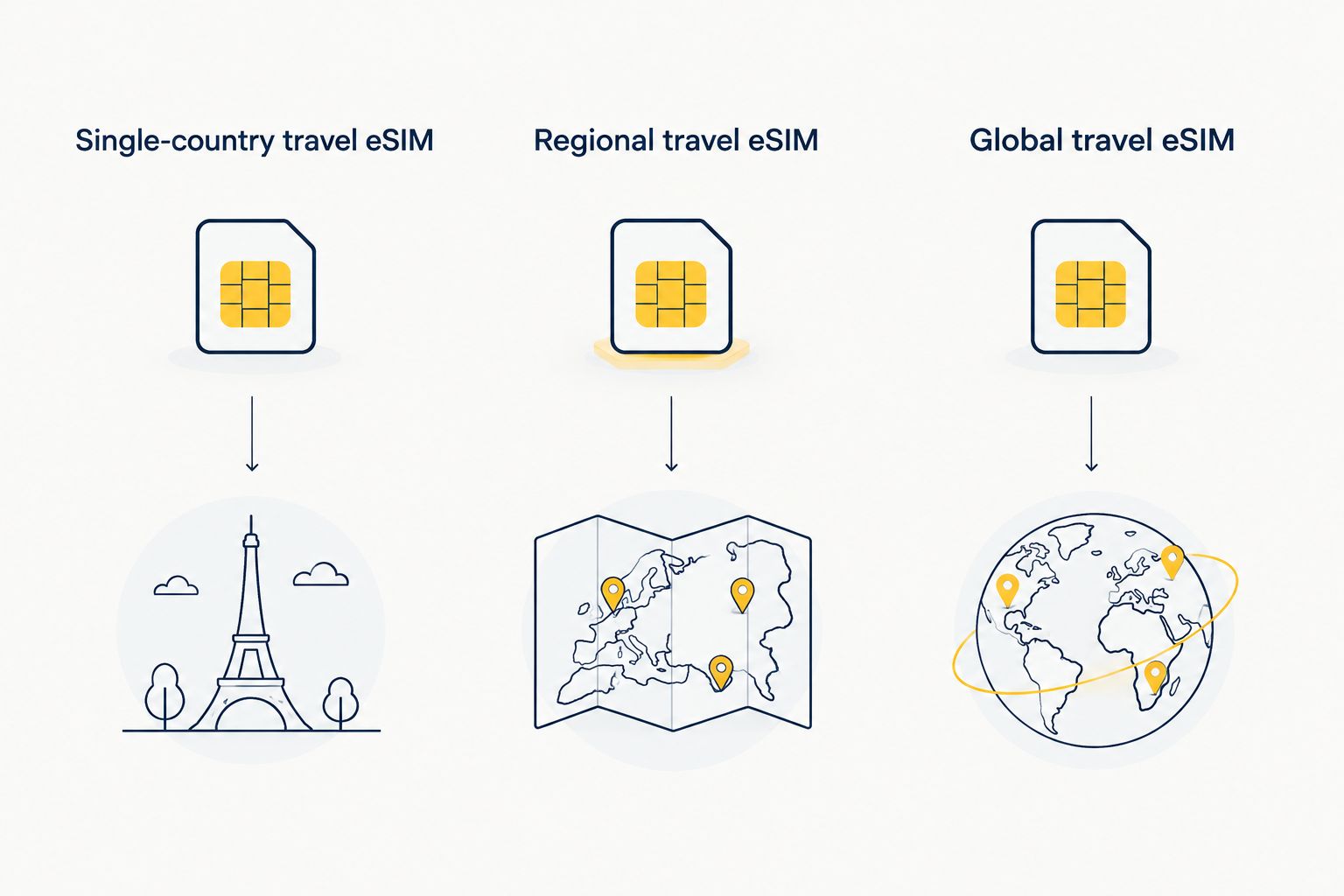
Best for one destination: a single-country travel eSIM. Best for a regional route: a regional travel eSIM. Best for a cross-region itinerary: a global travel eSIM. A-sim offers these coverage types with app-based usage management and top-ups; this 2026 guide explains which fits your solo trip.
- The best esim for solo travelers matches the itinerary: single-country, regional, or global coverage.
- A-sim travel eSIMs suit solo travelers who want to manage usage and top up through an app.
- Choose single-country coverage for one destination; regional coverage for a route within one covered region.
- Choose global coverage for cross-region travel, but check every destination before buying.
- Confirm phone compatibility, activation rules, and calling requirements before departure.
Why this matters
When you travel alone, your phone often holds the route to your accommodation, your booking details, and your way to contact someone back home. Choosing an eSIM means matching those tasks to the countries you will visit—not choosing the widest coverage label by default.
A-sim travel eSIMs suit solo travelers who want to manage usage and top up through an app. That is a practical benefit, not a guarantee of signal everywhere. Your route, phone, and chosen plan still determine whether the option fits.
For a 2026 trip, treat mobile data and offline preparation as separate jobs. An eSIM supplies a connection where the plan and network support it. Downloaded directions and saved booking details remain useful when the connection disappears.
What makes the best eSIM for solo travelers?
Use these six criteria before comparing coverage types:
- Destination fit: Check each country on your itinerary, including places where you leave the airport during a connection. A regional or global label is not a complete country list.
- Phone compatibility: Confirm that your exact device supports eSIM and can use another provider. Model variants and carrier restrictions matter.
- Validity and activation: Read what starts the validity period and whether it covers your arrival through departure. Installing an eSIM and starting its plan are not always the same event.
- Usage control: Choose an allowance around your activities. Maps, messaging, uploads, and video calls create different demands.
- Top-up access: Understand how to add data and whether that process needs an internet connection. Resolve the process before your allowance runs out.
- Calls and support: Check whether the plan includes a phone number, voice calls, or SMS. Also check how you would seek help if mobile data stopped working.
The strongest choice passes all six checks. Broader geographical coverage does not compensate for an incompatible phone or a plan that expires before you fly home.
Solo-travel eSIM options at a glance
These are coverage categories, not invented product names. The order reflects increasing itinerary breadth, rather than measured network performance.
| Rank and option | Best for | Standout feature | Key limitation |
|---|---|---|---|
| 1. Single-country travel eSIM | One destination | Coverage scope matches a fixed-country itinerary | Does not cover another country unless the plan explicitly includes it |
| 2. Regional travel eSIM | A multi-country route within one covered region | One coverage selection can include several itinerary stops | Regional boundaries and included countries vary by plan |
| 3. Global travel eSIM | A route spanning different regions | Broad geographical scope | Global does not mean every country or every location |
For your 2026 shortlist, write down the destinations first. Then check the country list for the coverage category that matches. Leave options out when they do not solve a problem on your route.
1. Single-country travel eSIM: best for a fixed destination
A single-country travel eSIM provides coverage for the country specified by the plan. It is the default choice when your entire trip stays within that destination and you do not need mobile data elsewhere.
Imagine a 7-day trip spent entirely in one country. That itinerary gives you a straightforward selection task: confirm the destination, check the validity, and choose an allowance for your activities. Extra geographical coverage does not add another destination to your trip.
Single-country travel eSIM pros:
- Keeps the coverage decision focused on the destination you will visit.
- Makes it easier to compare options with the same geographical scope.
- Avoids treating unused international coverage as a reason to choose a plan.
Single-country travel eSIM cons:
- Does not meet an added border-crossing requirement unless that destination is included.
- Requires another coverage decision if your itinerary expands.
- Still depends on local network coverage; a country listing does not promise signal everywhere.
Best for: Solo travelers with one confirmed destination, including city breaks and longer stays in the same country.
Check airport transfers and day trips before committing. A trip described as one destination can still include a stop across a border. If you intend to use data there, that stop belongs on your coverage checklist.
Verdict: Buy single-country coverage when your mobile-data needs stay within one listed country.
2. Regional travel eSIM: best for a multi-country regional route
A regional travel eSIM includes a defined group of countries within a region. It fits an itinerary with several covered stops without requiring you to select separate geographical coverage for each stop.
Consider a 14-day trip across 2 countries in the same region. A regional option fits only if both countries appear in its coverage list. The name of the region alone is not enough to make that decision.
Regional travel eSIM pros:
- Matches a route with several included countries.
- Reduces the need to organize separate country-specific coverage selections.
- Gives you a useful comparison category when your itinerary remains within one region.
Regional travel eSIM cons:
- Can exclude a country you associate with that region.
- Does not automatically cover a later stop outside the listed area.
- Does not guarantee identical network conditions across borders.
Best for: Solo travelers taking a multi-country holiday within one covered region.
Before selecting regional coverage for 2026, check the complete route, not just the first and last stops. Include overland transit destinations where you need navigation or messaging. Exclude connections where you do not intend to use cellular data, rather than assuming every airport stop requires a separate plan.
Keep the coverage list accessible offline. If plans change during the trip, you can check whether the next destination is included before relying on the connection there.
Verdict: Buy regional coverage when every country requiring mobile data appears in the plan's list.
3. Global travel eSIM: best for a cross-region itinerary
A global travel eSIM has a broader country list designed for travel across different regions. It is the relevant category when your route cannot fit within one country or one regional grouping.
Choose it for the destinations it includes, not for the word global. A broad plan still has defined coverage, validity, and usage rules. Those details decide whether it works for your itinerary.
Global travel eSIM pros:
- Provides a coverage category for trips spanning different regions.
- Lets you assess several distant destinations against one country list.
- Reduces separate geographical selections when all required stops are included.
Global travel eSIM cons:
- Does not mean worldwide coverage without exceptions.
- Adds geographical scope you do not need on a fixed-country trip.
- Cannot remove local coverage gaps or extend plan validity by itself.
Best for: Solo travelers with confirmed stops in different regions, including round-the-world itineraries.
For a cross-region trip in 2026, check the longest gap between your first and final use. A plan that covers the destinations but not the travel dates is the wrong choice. Review the allowance as well: more included countries do not tell you how much data you receive.
If your route remains unsettled, maintain a destination checklist and update it before each booking. Do not assume an unplanned stop is included simply because the plan has a broad label.
Verdict: Buy global coverage for a verified cross-region route; skip it when narrower coverage meets your needs.
How the options are ranked
The ranking prioritizes destination fit, followed by compatibility, validity, usage control, top-ups, and calling requirements. Single-country coverage comes first because it is the simplest geographical match for a fixed destination—not because it has proven better speeds or lower costs.
Regional and global coverage earn their places when your itinerary requires them. The best coverage category is the narrowest one that includes every destination where you need mobile data.
A-sim offers single-country, regional, and global travel eSIMs, with access through its website or app. You can manage usage and top up through the app. Assess the selected plan's conditions separately from those service features.
Set up your solo-travel connection before departure
A good coverage choice still needs the right phone settings. Follow the selected provider's installation instructions, then check how your home line and travel line will work together.
Confirm the device
Check the exact phone model and carrier-lock status. A phone supporting eSIM does not automatically mean it can accept every travel provider. Resolve compatibility before buying or trying to install a plan.
Check the activation trigger
Read whether validity begins at installation, activation, or first connection to a supported network. Follow the plan's instructions rather than applying a rule from another eSIM. This keeps preparation from unintentionally using part of your travel period.
Select the data line
When you are ready to use the travel eSIM, select the intended line for cellular data. Review roaming settings separately for your home line and travel line; provider instructions can require roaming on the travel eSIM.
If you keep your home number active, understand your home carrier's charges before using calls or texts. A second line does not cancel the first line's billing rules.
Test essential tasks
Once connected at the destination, check a map, send a message, and open your accommodation details. These checks confirm the tasks you actually need. A signal icon alone does not prove that an app can reach the internet.
Save the accommodation address and arrival instructions offline beforehand. Keep an alternative way to access booking details if your phone becomes unavailable.
Which eSIM should you choose?
Choose single-country coverage for a fixed destination, regional coverage for an included regional route, and global coverage for verified cross-region stops. That decision remains the useful starting point in 2026.
Choose A-sim when app-based usage management and top-ups match how you want to manage travel data. Before selecting a plan, verify destinations, validity, compatibility, and any voice or SMS requirements. Those checks matter more than the breadth of the coverage label.
Choose coverage for your solo trip
Compare your route with single-country, regional, or global travel eSIM options.
FAQ
What's the best eSIM for solo travelers in 2026?
The best eSIM for solo travelers matches every destination where you need mobile data. Choose single-country coverage for one destination, regional coverage for an included regional route, or global coverage for cross-region travel. A-sim offers these coverage types with app-based usage management and top-ups.
Is a regional eSIM better than a single-country eSIM?
A regional eSIM is the better geographical fit when your trip includes several countries listed in that plan. Single-country coverage is the simpler match when all your mobile-data use stays within one country. Check the actual country list before deciding.
Can I install a travel eSIM before I leave home?
You can install many travel eSIMs before departure, but you must follow the selected plan's instructions. Check what starts its validity period before installing or activating it. Installation timing is not universal across plans.
Can I keep my home phone number while using a travel eSIM?
You can keep your home number active if your phone supports the required dual-SIM setup. Select the travel line for mobile data and review your home carrier's calling, texting, and roaming charges. A travel data plan does not automatically include home-number services.
Does a travel eSIM include calls and text messages?
Calls and text messages are included only when the selected plan explicitly provides them. Do not assume a travel eSIM includes a phone number or SMS. Internet messaging and calling apps use data but are separate from carrier voice and text services.
Will a global eSIM work in every country?
A global eSIM works only in the countries included in its plan, subject to network coverage. Global is a coverage category, not a promise of service everywhere. Verify every itinerary stop where you need cellular data.
Can I top up my A-sim eSIM during a solo trip?
A-sim supports top-ups through its app. Check the selected plan's top-up process before departure and arrange internet access before your data runs out. App access still requires a working connection.
One last thing
An eSIM and your offline documents solve different problems. A working connection helps you request directions; a saved address lets you show a driver where you need to go when the connection fails.
Before departure, download your arrival route and save your accommodation details outside your inbox. Make that preparation part of choosing the plan, not a task for the airport arrivals hall.