Best overall for a Switzerland-only trip: a single-country eSIM that explicitly covers Switzerland. Best for European border crossings: a regional eSIM covering every stop; best for multi-continent travel: a global eSIM matching your itinerary—choose by route, not by the longest country list.
- The best esim for switzerland covers your exact route, travel dates, device and data needs.
- Choose a Switzerland-only eSIM for a single-country trip; check regional coverage before crossing borders.
- A-sim offers travel eSIMs with app-based usage tracking and top-ups; confirm Switzerland in the selected plan.
- Check activation rules, hotspot permissions and voice services before choosing a travel data plan.
Why this matters
Switzerland is not an EU member, so an EU roaming label alone does not establish Swiss coverage. A European itinerary and a European data package are not automatically the same thing. Read the included-country list rather than relying on a regional name.
For your 2026 trip, separate the provider from the package. A-sim offers single-country, regional and global travel eSIMs, with purchasing through its website or app and usage management and top-ups through the app. Confirm that the particular package you select includes Switzerland.
A-sim is a fit for travel eSIM users who want app-based usage tracking and top-ups. That is a management benefit, not evidence that every package covers the same destinations or includes the same services.
What makes the best eSIM for Switzerland?
Judge your 2026 shortlist against these criteria before comparing package names:
- Explicit Swiss coverage: Switzerland must appear in the package’s included destinations. Check every additional country on your route too.
- Validity that fits: The service period must cover your arrival through departure. Identify what starts the validity clock.
- Usable data allowance: Match the allowance to maps, messaging, calls and uploads. Check any speed restrictions attached to an unlimited label.
- Device compatibility: Confirm eSIM support for your exact phone model and regional variant, plus any carrier-lock restrictions.
- Required features: Verify hotspot use, voice calls and SMS individually. Mobile data does not establish that these are included.
- Clear management: Know where to see your balance, obtain setup instructions and check top-up terms before departure.
Reject a package that fails a required condition. A larger allowance does not solve an unsupported phone, and broader geographic scope does not fix a validity period that ends before your flight home.
Switzerland eSIM options at a glance
These are ranked package types, not a speed-tested provider league table. Each recommendation serves a different itinerary; the ranking changes when your route changes.
| Rank and option | Best for | Standout feature | Key limitation |
|---|---|---|---|
| 1. Switzerland-only eSIM | A trip entirely within Switzerland | Destination scope matches the trip | Does not establish coverage across neighbouring borders |
| 2. Europe regional eSIM | Switzerland plus European stops | One package can cover listed countries | Switzerland and every stop need explicit inclusion |
| 3. Global travel eSIM | A trip across multiple regions | Broader destination scope | The global label does not guarantee every destination |
None of these categories establishes a particular network, speed, calling allowance or hotspot policy. Those belong to the individual package terms. Compare packages within the right category only after choosing your geographic scope.
1. Switzerland-only eSIM: best for a Swiss-only itinerary
A Switzerland-only eSIM is the default category for a trip that stays within Switzerland. It keeps the selection focused on the destination you need rather than on countries you will not visit.
For a 3-day city break, start with your arrival and departure times, then check the package’s activation trigger. A short visit still needs service for airport transfers and the journey home, not just the middle of the holiday.
Switzerland-only eSIM pros:
- Gives you a clear destination-specific starting point.
- Keeps unrelated destinations out of your selection criteria.
- Lets you compare allowances and validity for the same geographic need.
Switzerland-only eSIM cons:
- Does not solve connectivity for an additional country unless explicitly included.
- Requires a separate decision if your itinerary expands beyond Switzerland.
Best for: Travellers staying entirely within Switzerland, including a city break or a domestic rail itinerary.
Before choosing, inspect the listed network information, data allowance, validity trigger and top-up conditions. Do not treat a Switzerland label as proof of uninterrupted reception in every tunnel, building or mountain location.
Verdict: Buy a Switzerland-only eSIM for a Swiss-only route once the package meets your device and usage requirements.
2. Europe regional eSIM: best for crossing European borders
A Europe regional eSIM is the better category when Switzerland shares your itinerary with other European countries. One package can serve the route if its country list includes every destination.
For a 7-day trip combining Switzerland and France, verify both countries before choosing the allowance. Repeat that check for any additional stop where you need mobile data, including an overnight connection.
Europe regional eSIM pros:
- Can keep a multi-country route within one package.
- Makes destination coverage a single itinerary-wide check.
- Avoids choosing a separate country package for each included stop.
Europe regional eSIM cons:
- The Europe label alone does not confirm Switzerland.
- A package that covers most of your route still leaves a gap at an excluded stop.
Best for: Travellers crossing between Switzerland and other explicitly included European destinations.
For 2026 planning, check the actual package rather than relying on a previous purchase or a remembered country list. Keep a copy of the selected terms alongside your booking details so you know what you chose.
Verdict: Buy a Europe regional eSIM when every European stop, including Switzerland, appears in its coverage list.
3. Global travel eSIM: best for multi-region journeys
A global travel eSIM belongs on your shortlist when Switzerland is part of a journey spanning multiple regions. Its purpose is broader geographic scope, not an automatic improvement in Swiss reception.
For a 14-day journey spanning Europe and Asia, write down each destination before opening the package selector. Compare the full route against the included-country list, then check whether the validity covers the whole journey.
Global travel eSIM pros:
- Can cover destinations across different regions under one package.
- Gives you one geographic checklist for a complex itinerary.
- Suits trips whose data needs extend beyond Europe.
Global travel eSIM cons:
- Global does not mean every country is included.
- Broad coverage does not establish identical service conditions at every destination.
Best for: Multi-region travellers who confirm that one package covers all required stops.
Check how top-ups relate to the original package. Adding data and extending validity are separate questions; verify both rather than assuming a top-up does everything you need.
Verdict: Buy a global travel eSIM for a verified multi-region route; skip it as the default for a Switzerland-only holiday.
How these options are ranked
The ranking prioritizes itinerary fit, then validity, device support, data needs and required features. Switzerland-only comes first because it answers the simplest version of the query: a visitor travelling only in Switzerland.
This is not a claim that one package type has faster service or better reception. Move the regional option to first place for a qualifying European route, and move the global option first for a qualifying multi-region route.
The best package is the one that satisfies your required conditions without relying on assumptions. Country count is not a substitute for coverage where you actually need it.
Set up your Switzerland eSIM before departure
Complete the checks while you still have a dependable internet connection. Installing an eSIM and starting its service period are different events under some package rules, so read the activation instructions before proceeding.
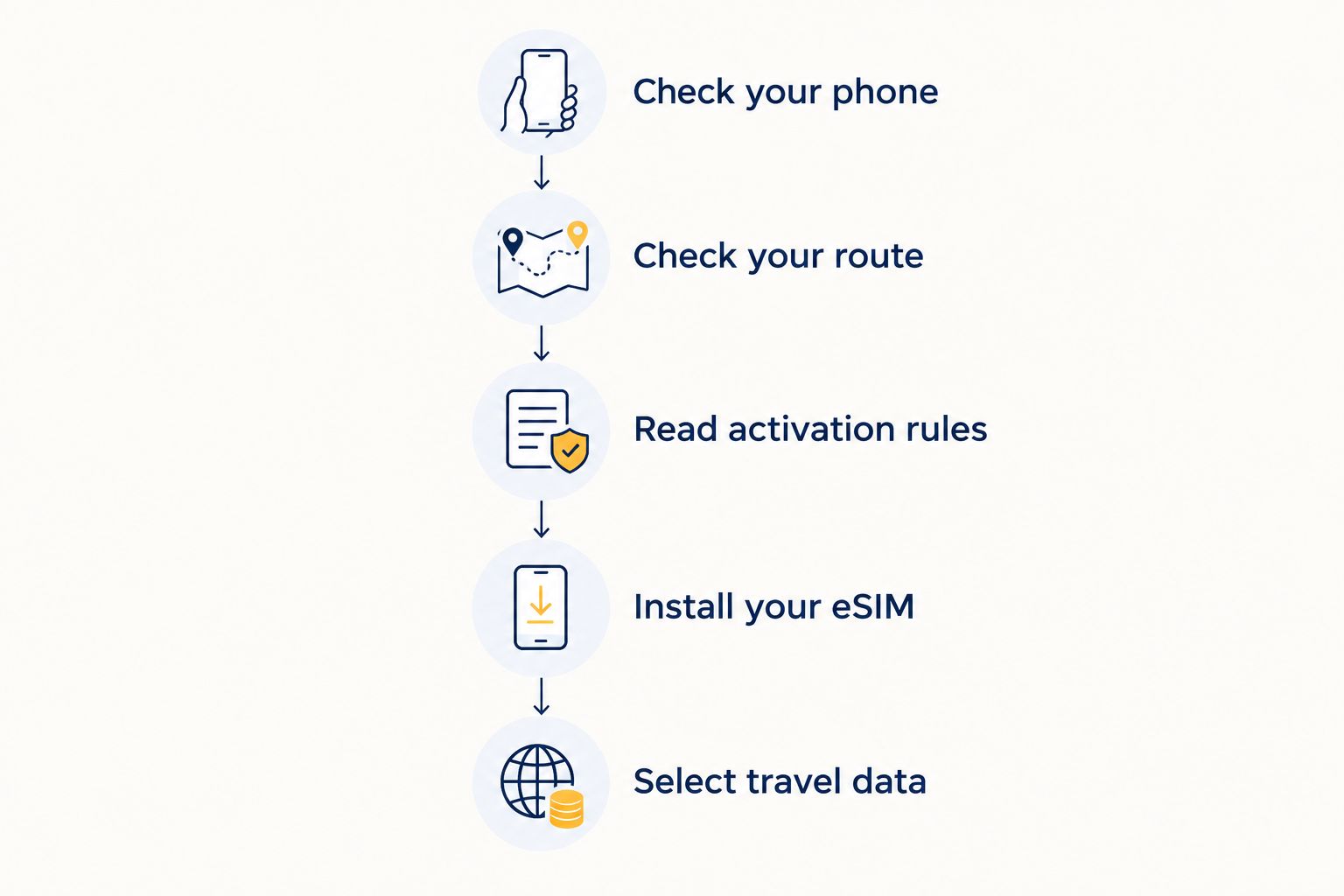
- Check your phone. Confirm eSIM support for your exact model and verify that carrier restrictions do not prevent another provider’s service.
- Check your route. Match Switzerland and every required stop against the package’s destination list.
- Read activation rules. Identify whether installation, first connection or another stated event starts validity.
- Install your eSIM. Follow the provider’s instructions and give the line a recognizable label.
- Select travel data. Choose the intended line for mobile data and apply the provider’s roaming instructions to that line.
Keep the instructions accessible offline. If you want to prepare early, read the guide to installing an eSIM before you travel and apply the selected package’s activation conditions.
Do not delete an installed eSIM as your first troubleshooting step. Reinstallation rules differ; first check the selected data line, roaming instructions, remaining allowance and provider guidance.
Match your data plan to your actual habits
For a 2026 Switzerland trip, separate essential mobile tasks from activities you can move to Wi-Fi. Messaging, navigation and checking reservations belong on your essential list. Video uploads, streaming and device backups deserve a deliberate decision.
Use your phone’s existing data history as the starting point. Review which apps consume data, then account for travel-specific changes such as more navigation or less access to your usual Wi-Fi.
- Download offline maps before leaving a reliable connection.
- Save tickets, booking references and accommodation details offline.
- Restrict background updates and cloud backups on mobile data.
- Check hotspot permissions before planning laptop work.
- Check the remaining balance before a long transfer or remote excursion.
A-sim supports usage tracking and top-ups through its app. Check the selected package’s terms before treating a top-up as your backup, and review the balance while you still have connectivity.
Keep your home number separate from travel data
An eSIM is a way to provision mobile service digitally; it does not, by itself, establish whether a package supplies data, a telephone number, voice calls or SMS. Read the service description before relying on it for calls or verification codes.
On a compatible dual-SIM phone, you can configure separate lines for home-number services and travel data. Review automatic data-switching settings so your phone does not move data use to an unintended line.
Your home carrier’s conditions still govern its line. Keeping a number enabled does not mean every call, message or roaming action is included in your existing service.
For mountain travel, save your route and essential information offline. A working eSIM does not remove the need for a backup when mobile reception is unavailable.
Which Switzerland eSIM should you choose?
Choose a Switzerland-only eSIM if your entire itinerary stays in Switzerland. Choose a Europe regional package for verified European border crossings, or a global package for a verified multi-region journey.
For your 2026 purchase, make the final decision in this order: destinations, phone compatibility, validity, data allowance, then required features. Reject any package that fails one of your essential checks.
A-sim is a practical starting point when app-based usage management and top-ups match how you travel. Confirm Swiss coverage and the selected package’s terms before making the decision.
FAQ
What's the best eSIM for Switzerland in 2026?
A Switzerland-only eSIM is the default choice for a trip entirely within Switzerland. Choose a regional or global package instead when its included destinations match a wider itinerary, and verify device compatibility and validity before purchasing.
Does a Europe eSIM include Switzerland?
A Europe eSIM includes Switzerland only when Switzerland appears in that package’s destination list. Do not rely on the regional name or on Switzerland’s geographic location.
Is A-sim a good fit for a Switzerland trip?
A-sim is a fit for travellers who want app-based travel eSIM usage tracking and top-ups. Confirm that the selected package explicitly includes Switzerland and meets your validity and feature requirements.
Can I install my Switzerland eSIM before I leave?
Follow the selected package’s installation and activation instructions before installing early. Establish what starts its validity period so preparation does not consume service time you need during the trip.
Will my travel eSIM include a Swiss phone number?
Do not assume a travel eSIM includes a Swiss telephone number. Check whether the package provides data only or explicitly includes voice calls and SMS.
Can I keep my Canadian number while using a travel eSIM?
You can keep your Canadian number enabled alongside a travel eSIM when your phone supports the required dual-SIM setup. Your Canadian carrier’s terms still apply to activity on that line.
Will a Switzerland eSIM work in the mountains?
A Switzerland eSIM requires usable mobile coverage at your location. Check the listed network information and keep maps, tickets and essential details accessible offline.
Can I use my Switzerland eSIM as a laptop hotspot?
Use a travel eSIM for a laptop hotspot only when the package and phone permit tethering. Check the hotspot terms and remember that laptop activity draws from the applicable data allowance.
One last thing
An active eSIM does not prove your phone is using it for mobile data. After arrival, check the selected data line, turn off Wi-Fi briefly and load a page. Then confirm the connection uses your intended travel line before starting a large download.