
Best for a Thailand-only trip: a Thailand-only eSIM. Best for app-managed usage and top-ups: A-sim. Best for a multi-country Southeast Asia itinerary: a regional eSIM that explicitly includes every stop. This 2026 guide ranks the options by travel need, not by unsupported speed claims or promotional promises.
- The best esim for thailand matches your itinerary, compatible phone and actual data needs.
- A-sim suits travellers who want app-managed travel eSIM usage and top-ups; confirm Thailand coverage before choosing.
- Choose Thailand-only coverage for a single-country trip; regional coverage needs every destination listed.
- Choose a local operator eSIM when a Thai number matters, after checking voice and SMS inclusion.
Why this matters
Your Thailand connection has several jobs: loading maps, messaging accommodation, finding transport and keeping travel documents accessible. An eSIM handles mobile connectivity, but its coverage, validity and included services determine whether it fits those jobs.
Choose the plan around the trip, not the biggest data label. A Thailand holiday, a regional backpacking route and a working trip need different checks. A plan that covers your destinations still needs to support your phone and the features you intend to use.
For a 2026 departure, read the current plan terms before purchasing. Installation, activation and the start of validity are separate questions; do not assume they happen together.
What makes the best eSIM for Thailand
Use these six criteria before comparing options:
- Destination coverage: Thailand must appear in the plan's covered destinations. For regional travel, check every additional country separately.
- Phone compatibility: Your exact device variant must support eSIM, and its carrier-lock status must permit the service you want to install.
- Validity: The usable period must cover your travel dates, including arrival and departure. Check what starts the validity clock.
- Data management: Look for a clear way to check remaining data and understand what happens when the allowance ends.
- Required features: Check hotspot permission, voice calls and SMS separately. A mobile-data connection does not establish that all three are included.
- Network information: Read the named network and coverage details where supplied. An eSIM format alone does not establish signal quality or speed.
A practical example: for a 7-day trip, compare the full arrival-to-departure period against the plan's validity. For a 14-day trip, include travel days rather than counting only hotel nights. For a 21-day trip, check the renewal or top-up process before committing.
Those are itinerary examples, not data-usage estimates. Your phone's recent usage is a better starting point for choosing an allowance than a generic daily recommendation.
Thailand eSIM options at a glance
These entries compare a named provider with coverage and service types. They are not five independently tested brands, and the ranking does not establish a fastest network winner.
| Rank | Option | Best for | Standout feature | Key limitation |
|---|---|---|---|---|
| 1 | A-sim | Managing usage and top-ups through an app | Website or app access, with in-app usage management and top-ups | Check the selected plan's Thailand coverage and service terms |
| 2 | Thailand-only eSIM | An itinerary entirely within Thailand | Coverage scope matches a single-country trip | Does not establish coverage for another country |
| 3 | Regional eSIM | A Southeast Asia itinerary with several stops | One coverage scope spanning listed destinations | Regional labels do not guarantee every destination is included |
| 4 | Global eSIM | A trip crossing several world regions | Broad geographic scope across listed countries | Broad scope does not prove suitability for your particular route |
| 5 | Local operator eSIM | Travellers who need a Thai number | Direct operator option to assess for local voice and SMS | An eSIM offer does not automatically include a number or calling service |
1. A-sim: best travel eSIM option for app-based management
A-sim is best for travellers who want to manage travel eSIM usage and top-ups through an app. The service offers global, regional and single-country travel eSIM options through its website or app, with integration for compatible iPhone and Android devices.
That makes app-based management the reason to shortlist it. Before choosing for Thailand, check the actual plan's destination list, validity, data allowance and supported features. The provider's general coverage categories are not a substitute for the selected plan's terms.
A-sim pros:
- Get travel eSIMs through the website or app.
- Manage usage through the app.
- Top up through the app.
- Compare global, regional and single-country coverage options.
A-sim cons:
- Your device still needs to meet eSIM compatibility requirements.
- App management does not remove the need to check plan-specific coverage and validity.
- Confirm voice, SMS and hotspot support separately rather than assuming inclusion.
Best for: Travellers who want usage management and top-ups in an app rather than treating connectivity as a one-time purchase.
Verdict: Buy only after the selected plan confirms Thailand coverage and fits your device and dates.
2. Thailand-only eSIM: best for a single-country holiday
A Thailand-only eSIM is the default coverage type when your whole itinerary stays in Thailand. It keeps the destination decision simple: assess one country's coverage rather than a regional or worldwide list.
For your 2026 holiday, compare the plan against the places you will visit, not just the country name. Bangkok, an island stay and a remote excursion belong in your coverage check; do not infer identical service everywhere from national inclusion.
Thailand-only eSIM pros:
- Matches a single-country itinerary directly.
- Keeps destination checks focused on Thailand.
- Gives you a clear comparison point for validity, allowance and required features.
Thailand-only eSIM cons:
- Does not cover another destination unless the terms explicitly say so.
- A country label alone does not establish network reach at every stop.
- A data-only offer does not provide ordinary voice calls or SMS.
Best for: Travellers staying entirely in Thailand who primarily need mobile data for maps, messaging and browsing.
Verdict: Buy for a Thailand-only itinerary once coverage, validity and features match your needs.
3. Regional eSIM: best for a multi-country Southeast Asia trip
A regional eSIM is the coverage type to assess when Thailand is one stop among several neighbouring destinations. Its value is the match between one plan's country list and your complete route.
Do not treat the phrase Southeast Asia as a coverage guarantee. Write down each destination and compare it with the current list. A connection during a stopover also needs coverage if you intend to use mobile data there.
Regional eSIM pros:
- Covers multiple destinations when those countries are explicitly included.
- Lets you assess the itinerary against one plan's validity period.
- Reduces separate country-plan decisions when the route matches the coverage list.
Regional eSIM cons:
- Country inclusion varies between plans.
- A shared allowance needs to last across the covered journey.
- Coverage in one country does not prove the same service conditions in another.
Best for: Travellers combining Thailand with other listed destinations on the same trip.
Verdict: Buy when every intended mobile-data stop is included; skip when a required country is missing.
4. Global eSIM: best for travel across several world regions
A global eSIM belongs on the shortlist when your journey goes beyond Southeast Asia. Think of an itinerary that includes Thailand and destinations in other regions, rather than a holiday confined to one country.
For a 2026 multi-region trip, broad coverage is only the starting point. Check the exact country list, the validity window and any destination-specific conditions. The word global does not mean every country or every network is included.
Global eSIM pros:
- Provides one coverage category to assess for a multi-region itinerary.
- Fits journeys that extend beyond a regional plan's listed destinations.
- Helps organise connectivity planning around the full route.
Global eSIM cons:
- The destination list still needs a country-by-country check.
- Broad geographic scope does not establish better performance in Thailand.
- One validity period must fit the portions of the trip you need covered.
Best for: Travellers visiting Thailand as part of a journey across several world regions.
Verdict: Buy for a matching multi-region route; skip as the default for a Thailand-only holiday.
5. Local operator eSIM: best when a Thai number matters
A local operator eSIM is the category to examine when ordinary local calls or SMS matter more than app-based messaging. Assess the operator's current offer for a Thai number, included services and visitor registration requirements.
The distinction is service inclusion, not the digital SIM itself. A travel data plan supports internet-based communication, while receiving an ordinary SMS requires service on the number receiving it. Check the exact offer before relying on it for reservations or verification.
Local operator eSIM pros:
- Gives you a direct operator option to assess for local calling.
- Lets you check local-number and SMS inclusion together.
- Provides an alternative when internet-only communication does not meet your needs.
Local operator eSIM cons:
- A local number and voice service must be confirmed in the offer.
- Registration and activation requirements need checking before travel.
- Local service does not establish coverage for onward international destinations.
Best for: Travellers who specifically need a Thai number or ordinary local calling and SMS.
Verdict: Buy only when the offer explicitly includes the local services you require.
How these options rank
This ranking uses the six criteria above: destination fit, device compatibility, validity, data management, required features and network information. Each option owns a different travel need; the order is not a measured network-performance ranking.
App management wins for ongoing control. Country coverage wins for a Thailand-only route. Regional or global coverage wins only when the destination list matches the journey. Local operator service belongs first when a Thai number is a requirement rather than a preference.
No coverage type automatically wins on speed. Compare the actual network information and plan conditions for your intended locations.
Set up your Thailand eSIM without avoidable mistakes
Use this sequence before your 2026 departure. Follow the provider's instructions whenever installation or activation timing differs from the general checklist.
- Check compatibility. Confirm eSIM support for your exact phone variant and check carrier-lock status.
- Check coverage. Match the destination list and validity rules to your route and travel dates.
- Install the profile. Use the supplied instructions with an internet connection. Check whether installation starts validity before proceeding.
- Select mobile data. Choose the travel line for data and apply its required roaming settings. Review the home line separately.
- Test the connection. When the plan is active in its covered destination, load a webpage and confirm which line supplies data.
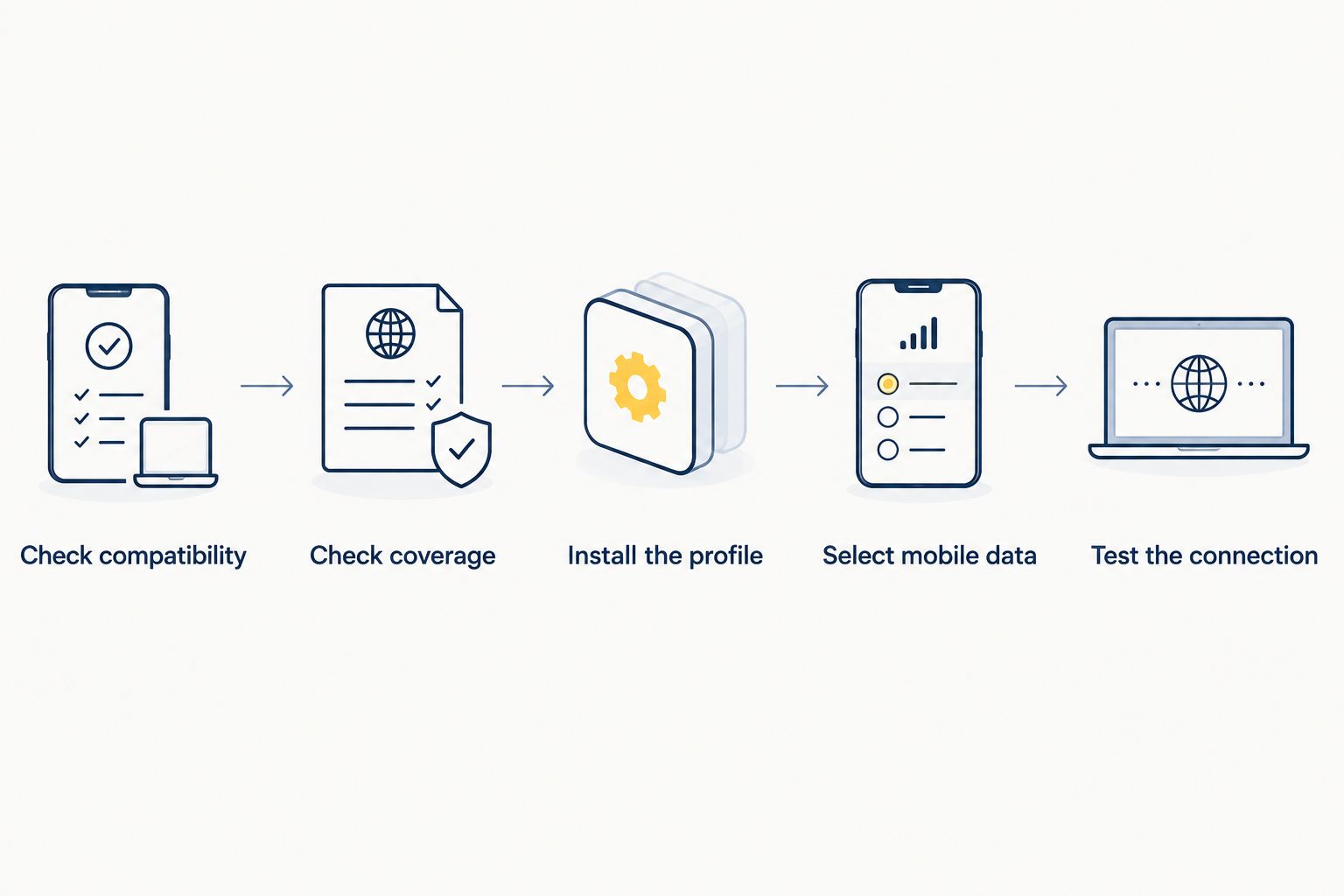
Do not confuse successful installation with a working mobile-data connection. A profile can be present while the wrong line is selected for data or the plan has not yet activated.
Read the guide to how long eSIM activation takes before deciding when to install. Timing matters because your connection and your validity period need to fit the same itinerary.
Which Thailand eSIM should you choose?
Choose a Thailand-only eSIM if Thailand is your only destination and mobile data is your main requirement. Start there, then compare compatible plans against your dates, allowance and required features.
Choose A-sim when app-based usage management and top-ups are your priority, after confirming the selected plan covers Thailand. Choose regional coverage for a matching Southeast Asia route, global coverage for a matching multi-region route, or a local operator offer when you need a Thai number.
For 2026 travel, keep the decision tied to current terms. A familiar provider name does not replace checking the plan you are actually buying.
Choose coverage for your trip
Compare travel eSIM options, then check Thailand inclusion, validity and device compatibility.
FAQ
What's the best eSIM for Thailand in 2026?
A Thailand-only eSIM is the default choice for a trip entirely within Thailand. Choose by confirmed coverage, device compatibility, validity and required features rather than an unsupported overall ranking.
Is A-sim a good option for a Thailand trip?
A-sim is a suitable option to assess if you want app-managed travel eSIM usage and top-ups. Confirm that your selected plan explicitly includes Thailand and meets your device, date and service requirements.
Should I choose a Thailand eSIM or a regional eSIM?
Choose Thailand-only coverage for a single-country itinerary and regional coverage when every additional destination is listed. A regional name alone does not guarantee coverage for each stop.
Can I keep my home number while using a Thailand eSIM?
You can keep your home line alongside a travel eSIM when your phone supports the required dual-SIM setup. Select the travel line for mobile data and check your home carrier's rules for calls, SMS and roaming.
Will a Thailand travel eSIM give me a Thai phone number?
Only a plan that explicitly includes a Thai number provides one. Do not assume a mobile-data eSIM includes ordinary voice calls or SMS.
Can I use my Thailand eSIM as a hotspot?
You can use hotspot only when your phone and the selected plan permit tethering. Check the terms before relying on the connection for a laptop or another traveller.
Should I install my eSIM before flying to Thailand?
Install before departure only after checking the provider's installation and validity rules. Installation and activation are not necessarily the same event, so confirm what starts the usable period.
One last thing
Your travel data line and your home phone number have different jobs. Keeping the home line enabled for messages does not require selecting it for mobile data, but receiving messages and making calls remain subject to your home carrier's terms.
Before leaving, label each line clearly and check the mobile-data selection. That simple settings check is more useful than choosing a larger allowance while leaving the wrong line in charge of your connection.