Best for app-managed travel data: A-sim. Best for a Philippines-only itinerary: a country-specific eSIM. Best for an Asian multi-country trip: a regional eSIM. This 2026 guide ranks buying options by trip fit, not by an unsupported claim that one provider has the fastest Philippine network.
- For the best esim for philippines, match coverage, validity and phone compatibility before choosing a provider.
- A-sim travel eSIMs suit travellers who want app-based usage management and top-ups.
- Choose a country-specific eSIM for a Philippines-only trip; check that regional plans explicitly include the Philippines.
- A global eSIM suits travel across regions, but a broader country list does not prove better local coverage.
Why this matters
The best Philippines eSIM is the one that covers your stops, works on your exact phone and lasts through your departure. A long destination list does not answer those questions. Neither does an unlimited label without the accompanying usage terms.
Separate the seller from the plan. An app-managed service can offer different geographic plan types, so the options below are not mutually exclusive. Choose the geographic scope first, then assess the provider and the specific plan.
For a 2026 trip, read the current plan details before purchasing. Network access, validity, hotspot rules and activation conditions belong in that decision—not assumptions based on a provider's name.
What makes the best eSIM for the Philippines?
Use these six criteria before comparing options:
- Destination coverage: The plan must explicitly include the Philippines and every other country where you need data.
- Local network: Identify the Philippine network named in the plan and check its coverage against your actual stops.
- Phone compatibility: Confirm your exact device variant supports eSIM and accepts another carrier's service.
- Validity and activation: Establish what starts the validity period and whether it covers your whole trip.
- Data and hotspot terms: Match the allowance, any speed restrictions and tethering permissions to your use.
- Account management: Check how you monitor remaining data, add more data and retrieve installation instructions.
Coverage at your destination matters more than the size of the provider's worldwide country list. A plan that includes the Philippines still needs a closer look if your route includes remote accommodation, inland excursions or boat transfers.
Philippines eSIM options at a glance
| Option | Best for | Standout feature | Key limitation |
|---|---|---|---|
| A-sim travel eSIMs | Managing usage and top-ups through an app | Website or app access, with in-app usage management | Philippine network access and individual plan terms need checking |
| Country-specific eSIM | Staying within the Philippines | Geographic scope matches a single-country itinerary | Does not cover onward countries unless expressly included |
| Regional eSIM | Combining the Philippines with other Asian destinations | One plan covering its listed regional destinations | Regional labels do not establish which countries are included |
| Global eSIM | Travelling across multiple world regions | One plan covering its listed worldwide destinations | Broad geographic scope does not establish local network quality |
These are purchase routes, not four separate network technologies. The same provider can sell country-specific, regional and global plans. Use the table to identify the scope you need before choosing the seller.
1. A-sim: best travel eSIM for app-based management
A-sim provides travel eSIMs through its website and app, with global, regional and single-country options. You can manage usage and top up through the app. Its service supports eSIM setup on compatible iPhone and Android devices.
A-sim travel eSIMs are best for travellers who want app-based usage management and top-ups. That is a management recommendation, not a claim about Philippine network speed or nationwide coverage.
A-sim pros
- Purchase through the website or app.
- Manage data usage through the app.
- Top up through the app.
- Choose among geographic plan types to match your route.
A-sim limitations
- General service features do not establish which Philippine network a particular plan uses.
- App-based top-ups do not establish whether adding data also extends validity.
- Phone compatibility still needs checking for your exact model and regional variant.
Best for: Travellers who want to handle their travel data in an app rather than manage only an installation email.
For your 2026 booking, inspect the chosen plan's destination list, activation trigger and data terms before installing it. Keep a copy of the instructions somewhere accessible without mobile data.
Verdict: Buy only after confirming that the selected plan includes the Philippines and matches your device and dates.
2. Country-specific eSIM: best for a Philippines-only holiday
A country-specific eSIM keeps the geographic decision simple: you are buying connectivity for the Philippines rather than for a wider itinerary. It is the first plan type to compare when you arrive in the Philippines, stay there and then return home.
Do not mistake country-specific scope for a local phone number. Check whether the actual plan includes ordinary calls or SMS, or only mobile data.
Country-specific eSIM pros
- The destination scope matches a Philippines-only trip.
- You can focus your coverage checks on Philippine locations.
- There is no need to evaluate unrelated onward destinations.
Country-specific eSIM limitations
- Onward travel requires another plan unless additional destinations are expressly included.
- Single-country scope does not guarantee coverage at every Philippine stop.
- A data-only plan does not supply ordinary local calling or SMS service.
Best for: Travellers whose entire mobile-data itinerary stays inside the Philippines.
Compare the plan's named network against your accommodation and excursion locations. A city hotel and a remote island stay are different coverage questions, even when both sit within the same destination list.
Verdict: Buy for a Philippines-only itinerary after checking network coverage and validity.
3. Regional eSIM: best for a multi-country Asian itinerary
A regional eSIM covers the countries specified in its destination list. It fits a trip that combines the Philippines with other included Asian destinations, without requiring you to choose a separate country plan for each stop.
The word Asia is not a coverage guarantee. Read the complete destination list and verify every country on your route, including any stopover where you intend to use mobile data.
Regional eSIM pros
- One plan can cover multiple listed destinations.
- A shared validity period can fit a continuous multi-country journey.
- You can assess the itinerary as a whole rather than country by country.
Regional eSIM limitations
- The regional label alone does not confirm Philippine coverage.
- The available network can differ between countries.
- A single validity period needs to last through the final included stop.
Best for: Travellers combining the Philippines with other destinations explicitly included in the same regional plan.
For a 2026 regional trip, check the start and end of the entire journey—not just your Philippine arrival and departure. A plan activated at an earlier stop needs enough remaining validity for the Philippines.
Verdict: Buy when every intended destination is listed and the validity covers the full route.
4. Global eSIM: best for trips across world regions
A global eSIM covers the destinations named in its worldwide plan list. It belongs on your shortlist when the Philippines is one stop on a journey spanning different regions, rather than a reason to buy the broadest plan by default.
Global describes geographic scope. It does not establish unlimited use, identical network access everywhere or permission to use the service at sea.
Global eSIM pros
- One plan can cover listed destinations across different regions.
- A single destination list gives you a starting point for checking a complex route.
- It avoids choosing separate geographic plans where one suitable plan already covers the itinerary.
Global eSIM limitations
- A worldwide label does not mean every country is included.
- Network access and service conditions require checking by destination.
- Extra geographic scope does not prove better coverage within the Philippines.
Best for: Travellers whose route includes the Philippines and destinations outside the same regional plan.
Write down your complete route before comparing global options. Include transit countries only when you actually need mobile data there; an airport connection and a stay are different requirements.
Verdict: Buy for a cross-region itinerary only when the listed destinations and terms fit the whole journey.
How these options are ranked
The ranking prioritizes practical fit: account management, geographic scope, local coverage, compatibility, validity and data conditions. It is not a measured speed ranking or a network test.
The default decision is narrow: choose the geographic scope your trip needs, then compare the specific plans within it. App management is useful, but it cannot compensate for a missing destination or an incompatible phone.
Check your phone and plan before departure
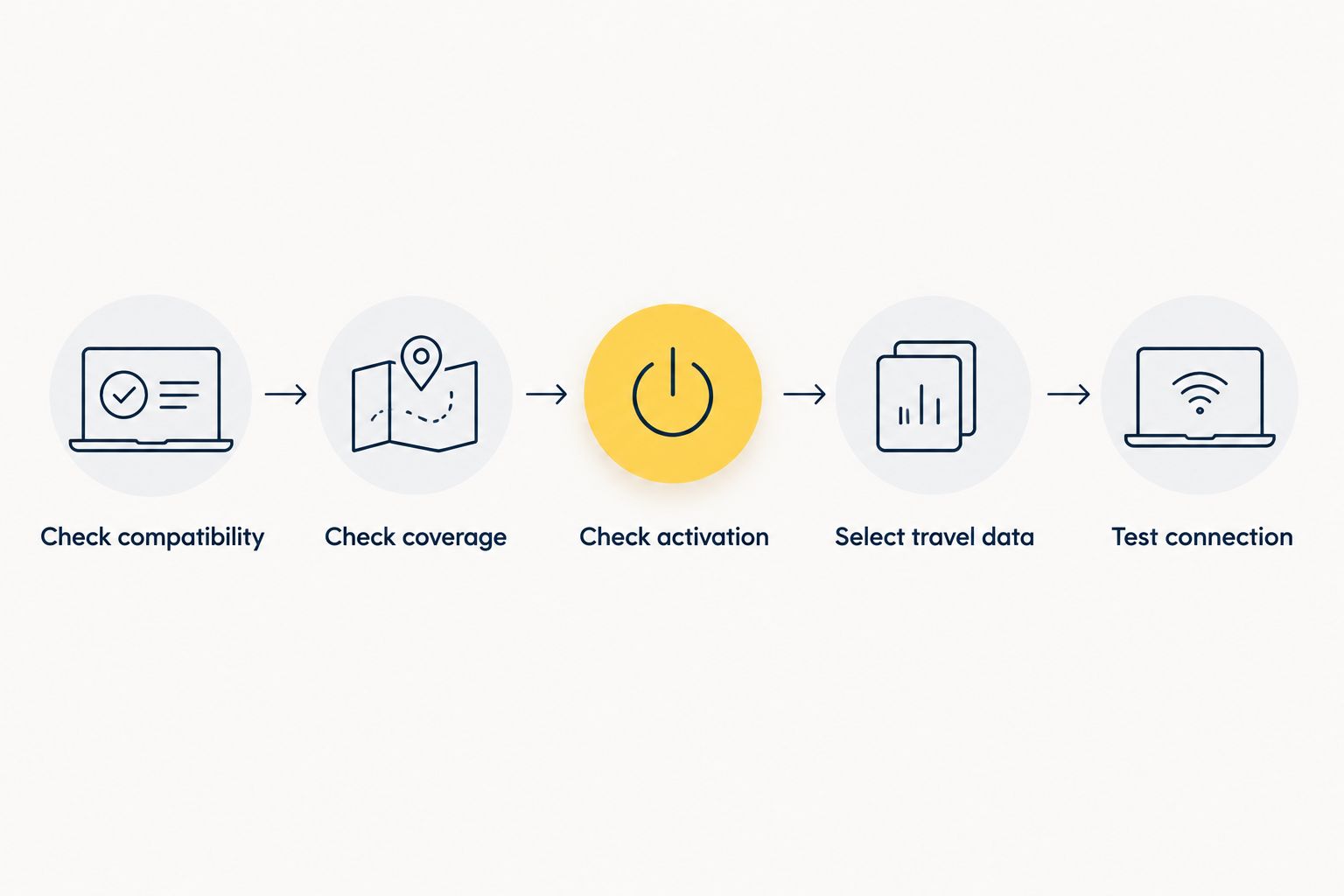
Use this sequence for your 2026 departure. Installation and activation are separate questions: installing a profile does not, by itself, tell you when a plan's validity begins.
- Check compatibility. Confirm eSIM support for your exact phone variant and check whether a carrier lock prevents another provider's service.
- Check coverage. Match the destination list and named network to your route, not just your arrival airport.
- Check activation. Read what starts validity and follow the plan's installation instructions while you have reliable internet.
- Select travel data. After installation, choose the intended line for mobile data and apply its required roaming settings.
- Test connection. At the destination, confirm that a webpage loads over mobile data rather than Wi-Fi.
Do not automatically copy roaming settings from your home line to the travel line. Follow each provider's instructions, and disable automatic mobile-data switching if you do not want the phone falling back to your home plan.
If you are unsure when to install, read the guide to installing an eSIM before travel. Keep the installation instructions available before changing settings.
Which Philippines eSIM should you choose?
Start with a country-specific plan for a Philippines-only trip. Move to a regional plan when your route includes other listed Asian destinations, and consider a global plan when the journey crosses regions.
Choose an app-managed provider when checking usage and adding data from the same app matters to you. Then verify the actual plan: Philippine inclusion, network, phone compatibility, validity, hotspot permissions and any calling features you need.
For 2026, do not choose on an unlimited label alone. Read what happens after any high-speed allowance, whether tethering has separate rules and exactly when the plan expires.
FAQ
What's the best eSIM for the Philippines in 2026?
The best fit for a Philippines-only trip is a country-specific eSIM with suitable local network coverage and validity. A-sim is an option for travellers who want app-based usage management and top-ups; confirm Philippine inclusion and the selected plan's terms before purchase.
Should I choose a Philippines eSIM or an Asia regional eSIM?
Choose a Philippines-specific eSIM for a single-country trip and a regional eSIM when it explicitly covers your other destinations. Check the full destination list rather than relying on the regional name.
Will a travel eSIM work on my iPhone or Android?
A travel eSIM requires a compatible device that accepts the provider's service. Check the exact model, regional variant and carrier-lock status before purchasing.
Does a Philippines travel eSIM include a local phone number?
A Philippines travel eSIM includes a local number only if the plan expressly provides one. Do not treat mobile data as proof that ordinary calls or SMS are included.
Can I keep my Canadian number while using a travel eSIM?
You can keep your Canadian line installed alongside a travel eSIM on a compatible dual-SIM phone. Select the travel line for mobile data and check your Canadian carrier's terms before using calls, texts or roaming services.
Can I use a Philippines eSIM as a hotspot?
You can use a Philippines eSIM as a hotspot when the plan permits tethering and your phone supports it. Check for separate hotspot allowances or restrictions before relying on it for a laptop.
Will an eSIM work everywhere in the Philippines?
An eSIM does not guarantee service everywhere in the Philippines. Coverage depends on the network the plan can access and conditions at your location; prepare offline maps and booking details for connection gaps.
One last thing
Download the route to your accommodation before you fly. Save the address, booking confirmation and arrival instructions offline as well. These remain useful while you configure mobile data—or wherever cellular coverage is absent.
A successful connection at the airport confirms that the setup works there. It does not establish coverage at your next island, hotel or excursion stop.