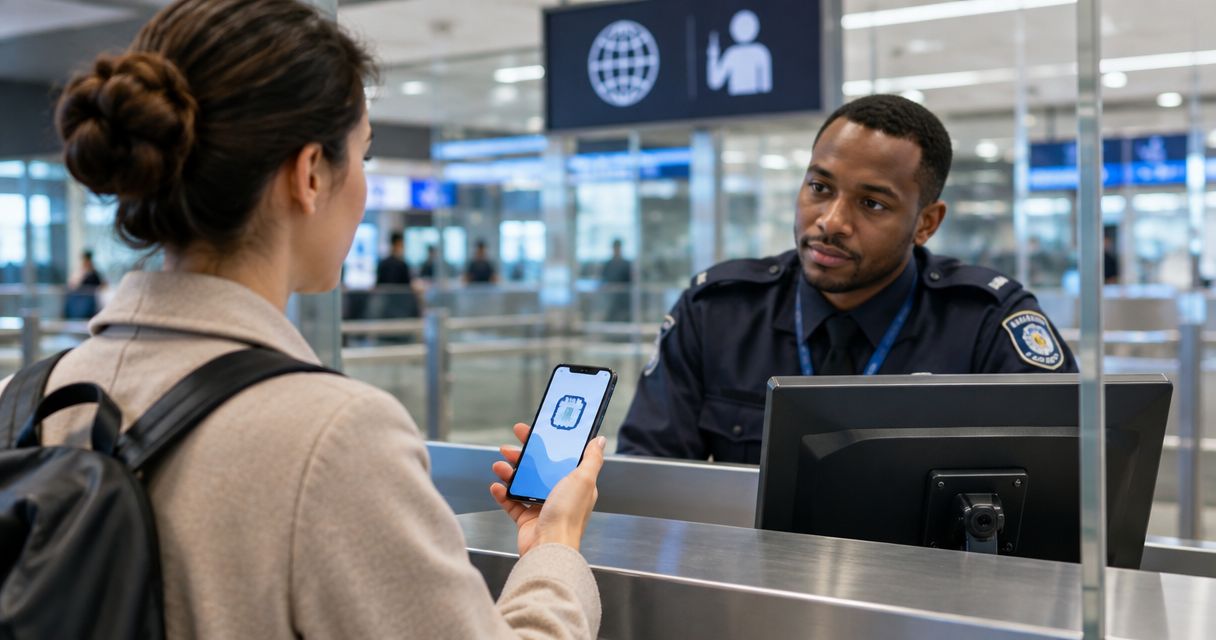
Border control does not normally ask to see your eSIM as an entry document; your passport, visa or travel authorisation, and the purpose of your visit are separate from your mobile connection. An officer can still ask about your phone or examine it where local law permits, so an eSIM is not exempt from a lawful device inspection. For travel in 2026, distinguish entry requirements, mobile-service registration and phone searches before you pack.
- Does border control ask to see your eSIM? Not normally as an entry document; phone inspections are a separate issue.
- Passport checks and SIM registration serve different purposes. A mobile provider's identity request is not immigration clearance.
- A-sim travel eSIMs suit travellers who want website purchasing, app-based usage management and top-ups.
- Keep travel documents accessible offline. An installed eSIM does not guarantee a working connection at the border.
Why this matters
Your mobile connection is not your permission to enter a country. Confusing the two can leave you preparing an eSIM receipt while overlooking the actual documents your destination requires.
There are also separate questions about whether a particular mobile service is permitted and whether your phone can be inspected. Read the guide to whether eSIMs are legal in every country, then check the destination's official rules rather than treating coverage as proof of legal permission.
For your 2026 trip, organise preparation around 3 separate checks: entry documents, mobile-service requirements and device-search rules. Each has a different authority and a different purpose.
Does border control ask to see your eSIM?
An eSIM is not normally something you present at passport control. It does not establish nationality, replace a visa or prove that your visit meets immigration conditions.
An officer's questions about your trip can still involve information stored on your phone. Showing a hotel confirmation is different from showing an eSIM subscription, and both are different from a formal examination of the device.
| Check | What it concerns | Where your eSIM fits | What to prepare |
|---|---|---|---|
| Immigration clearance | Identity and permission to enter | A mobile subscription does not replace required travel documents | Passport and destination-required documents |
| Mobile-service registration | Eligibility to activate or use a telecom service | A provider can require identity information under applicable rules | Documents specifically requested by the provider |
| Device inspection | Examination of a phone under border authority | Installed settings or stored records can be relevant to an examination | Understand the destination's device-search rules |
The Canada Border Services Agency's guidance on examining digital devices at the Canadian border describes device examinations as distinct from routine document checks. U.S. Customs and Border Protection also publishes guidance on border searches of electronic devices. These are examples of why a blanket promise that border officers will never look at your phone is wrong.
Neither example turns an eSIM into a standard entry document. Prepare for the destination's immigration requirements, not an assumed requirement to display your mobile plan.
When an officer asks about your phone
Listen to the actual request. An officer asking for your accommodation address has not necessarily asked to search your device, and an officer asking about your phone has not necessarily asked for proof of your eSIM purchase.
If the request is unclear, ask whether the officer needs a particular document, your contact details or access to the device. That distinction helps you respond accurately without guessing what information is relevant.
Answer truthfully. Do not describe a data plan as a local telephone number unless it actually includes one, and do not claim that a mobile subscription proves residence or permission to work.
For a formal device examination, follow the applicable law and official instructions. Advice about unlocking, passwords and refusal cannot be reduced to a universal rule because border powers and travellers' legal status differ between jurisdictions.
When a provider asks for identification
A request for your passport during mobile-service registration is not the same as a request at passport control. Telecommunications providers can have identity-verification obligations, and the requirements depend on the country and service.
Read the provider's instructions before submitting personal information. Confirm that the request comes through an authentic channel and concerns the service you are buying, rather than an unrelated message claiming to be from an airport or border authority.
Mobile registration does not grant immigration permission. Even after a provider accepts your identity documents, you still need to satisfy the destination's entry requirements separately.
The reverse is also true: admission to a country does not guarantee that every eSIM service is supported or permitted there. Check both questions before departure instead of using one answer as a substitute for the other.
When your travel documents are on your phone
Your eSIM can help you retrieve a booking, but it should not be the only way you can access that booking. A discharged battery, unavailable signal or account sign-in problem can interrupt access even when the document itself is valid.
Save the relevant files locally and confirm that they open without an internet connection. A link in an email is not an offline copy, and a screenshot is not a substitute for an original document where the issuing authority requires the original.
Keep your accommodation address and any required supporting details easy to find. Avoid handing over your entire inbox merely because the confirmation is buried inside it; organise the specific document before you reach the desk.
For a 2026 arrival, use the format accepted by the destination authority. Some documents can be presented electronically, while others require a physical original or a prescribed application process.
Why border questions vary
The relevant differences concern your journey and the destination's rules, not whether your phone uses a removable SIM card. These 5 factors help explain why one traveller's experience is not a reliable promise for another:
- Destination: Immigration requirements and legal powers to inspect devices differ by jurisdiction.
- Travel status: Citizens, residents and visitors do not necessarily face identical admission requirements or consequences.
- Purpose of travel: Tourism, study, employment and business visits require different supporting information.
- The officer's request: Retrieving a booking and undergoing a device examination are different situations.
- Mobile-service rules: Provider registration requirements are separate from immigration requirements and depend on the applicable telecom rules.
Check official government guidance for the destination and any transit country where you will pass through immigration. An eSIM provider's coverage list answers a connectivity question, not an entry-law question.
How should you prepare your phone before arrival?
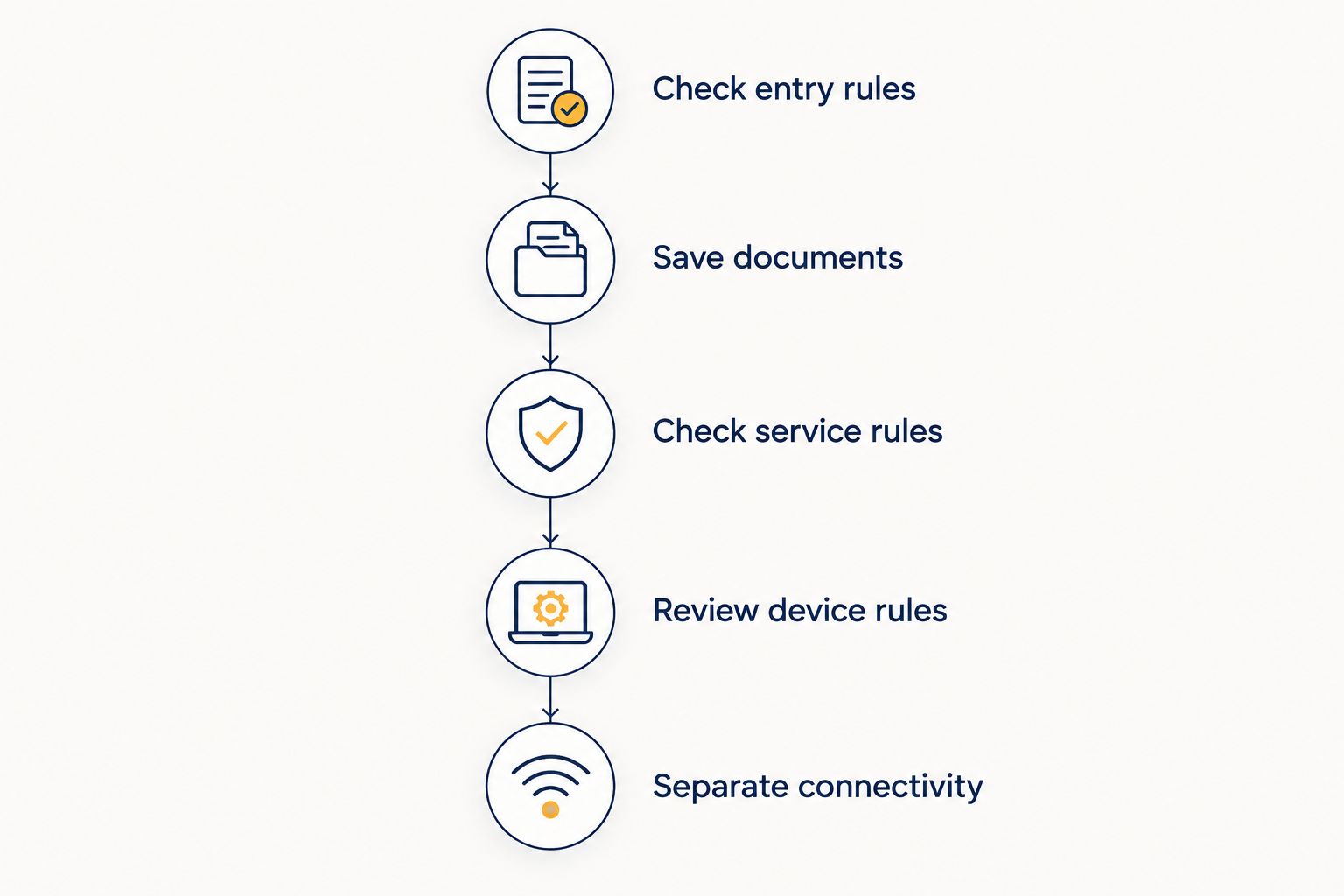
Use this 5-step checklist for your 2026 trip. The aim is to make required information accessible while keeping connectivity decisions separate from border formalities.
- Check entry rules. Confirm passport, visa, travel-authorisation and supporting-document requirements through the destination's official authority. Include transit requirements where they apply.
- Save documents. Download the documents you need and test that they open offline. Carry physical originals when the rules require them.
- Check service rules. Confirm device compatibility, destination coverage and any identity-registration requirement with your mobile provider. Read when the plan's validity begins before installing or activating it.
- Review device rules. Read the destination's official guidance on border examinations of electronic devices. Do not assume that ordinary domestic search rules apply unchanged at the border.
- Separate connectivity. Treat installation and network connection as phone setup, not immigration clearance. Keep your required documents accessible even if the connection fails.
The order matters: establish what you must present before deciding how your phone will help you present it. Installing a mobile plan first does not resolve missing entry paperwork.
Once you have saved your documents, test them with the phone disconnected from the internet. Open the actual files rather than checking that their names appear in a downloads list.
Where a travel eSIM helps—and where it does not
A travel eSIM is useful for connectivity tasks such as accessing online bookings, maps and messaging services when the plan and network support your destination. It is not a passport, visa, proof of residence or guarantee of admission.
A-sim travel eSIMs are best for travellers who want website purchasing, app-based usage management and app-based top-ups. A-sim offers global, regional and single-country travel eSIMs for compatible iPhone and Android devices.
You can explore A-sim after checking which destinations and devices you need to cover. Choose around the actual itinerary rather than assuming that the broadest geographical option answers every travel requirement.
The benefit is managing travel connectivity through the website or app. The limitation is equally clear: a travel eSIM does not resolve entry requirements, device-search obligations or a phone's compatibility restrictions.
Before choosing any plan, check its coverage, supported device requirements, validity conditions and whether it includes the communication features you need. Do not infer voice calls, SMS or a local number from the word eSIM alone.
Do I need to show an eSIM receipt at immigration?
An eSIM receipt is not normally an immigration document. Keep it for account support or purchase records, but do not substitute it for accommodation details, onward-travel evidence or other documents your destination requires.
If an officer specifically requests information about a purchase or phone service, respond to that request truthfully. A specific question is not evidence that every traveller must carry an eSIM receipt.
Can border control see my eSIM just by scanning my passport?
A passport scan does not itself display the eSIM profiles installed on your phone. Passport processing and the settings stored on your device are separate systems; that distinction does not establish what other information authorities can access under their laws.
A phone examination is a different process. Do not confuse the absence of an eSIM display during passport scanning with immunity from a lawful device search.
Should I delete my eSIM before crossing a border?
Deleting an eSIM is not a substitute for meeting entry requirements or understanding device-search rules. It can also interrupt your connection, and reinstalling depends on your provider's policy.
Do not assume that deleting a profile erases related emails, receipts or app records. Handle your connectivity settings according to the provider's instructions, not as a way to avoid a border examination.
FAQ
Does border control ask to see your eSIM when you enter a country?
Border control does not normally request an eSIM as an entry document. Officers can still ask about your phone or examine it where applicable law permits, which is separate from checking your passport or visa.
Do I need an active eSIM to get through immigration?
An active eSIM is not normally an entry requirement. Keep required documents accessible without mobile data and follow the destination authority's rules about document formats.
Can a border officer ask me to unlock my phone?
A border officer's authority to request access to your phone depends on the jurisdiction and circumstances. Check official device-search guidance before travel; no universal rule covers every border or traveller.
Is giving my passport to an eSIM provider the same as an immigration check?
No. A provider's identity check concerns mobile-service registration, while immigration authorities determine whether you meet entry requirements. Verify that any document request comes from the authentic provider.
Does a travel eSIM automatically give me a local phone number?
No. An eSIM does not automatically include a local number, voice calls or SMS. Check the specific plan's features before giving a contact number on travel paperwork.
Can I use A-sim to keep track of my travel data?
A-sim supports usage management and top-ups through its app. Those connectivity features do not replace travel documents or change the destination's border rules.
What should I check before travelling with an eSIM in 2026?
For travel in 2026, check entry requirements, mobile-service rules, device compatibility and official guidance on border device examinations. Save required documents offline so access does not depend on a working connection.
One last thing
Test your travel documents offline before testing your travel data. Turn off internet connectivity, open each required file and confirm that the relevant details are readable.
That simple check exposes a common preparation mistake: saving access to a document rather than saving the document itself. Your eSIM handles connectivity; your entry paperwork needs its own backup.