No. In 2026, an eSIM is not automatically legal to use with every plan in every country. The relevant question is whether local rules permit the service, the provider can supply it there, and your plan can connect at your destination. Installing an eSIM on your phone does not settle any of those questions.
- Is eSIM legal to use in every country? No; check the destination’s rules and the specific plan.
- A travel eSIM that installs successfully is not proof that its service is permitted or available abroad.
- A-sim travel eSIMs suit travelers who want to choose destination coverage and manage data through an app or website.
- Check local rules, provider authorization, plan coverage and device support before departure.
Is eSIM legal to use in every country?
No universal permission covers every destination, provider and eSIM plan. An eSIM is a way to store a mobile subscription on a device; the rules that matter concern the mobile service supplied through it. A destination can regulate which operators serve customers, what identity checks apply and how mobile connections operate. Those questions need destination-specific answers in 2026.
Do not treat a successful installation as a legal clearance. Your phone can accept a profile before you travel, while the plan’s usable destinations and local requirements remain separate questions. If you are also checking the security side of travel connectivity, the guide to eSIM safety for international travel addresses a different issue: whether the connection is safe, not whether a particular service meets local rules.
Why this matters
You can face three different problems that look alike from your phone: a plan is not offered for your destination, a plan does not connect there, or a provider cannot lawfully supply that service under local rules. A settings change cannot resolve all three. Check the destination and the provider before troubleshooting the device.
This distinction also prevents a common mistake: assuming that a regional or global label guarantees service in every country within a trip. A plan’s stated coverage is the starting point, not a substitute for checking its destination list. If your route changes in 2026, repeat the check for the new stop rather than relying on the name of the plan you already installed.
Which kind of eSIM service are you using?
A home-carrier plan, a locally issued plan and a travel plan can reach the same destination through different providers and arrangements. Compare the actual service you intend to use; the eSIM format alone does not tell you which rules apply.
| Option | Best for | What to verify | Limitation |
|---|---|---|---|
| Home-carrier roaming | Keeping your existing line active while traveling | Whether your carrier permits service at the destination and how that service operates there | Your home plan’s terms do not establish local legal permission on their own |
| Locally issued eSIM | Using a plan supplied for the destination | Local registration requirements and whether you can complete them | Setup can depend on local eligibility or identity checks |
| Travel eSIM | Arranging data for an international trip | The provider’s destination list, service terms and applicable local requirements | Regional or global wording does not guarantee every stop on your route |
A-sim travel eSIMs are best for travelers who want to arrange destination data through an app or website and manage usage there. The trade-off is the same one that applies to any travel eSIM: you still need to verify your destination and the plan’s coverage. A-sim’s app and website cannot replace a regulator’s rules or make an unsupported destination available.
How do you check whether your eSIM is permitted?
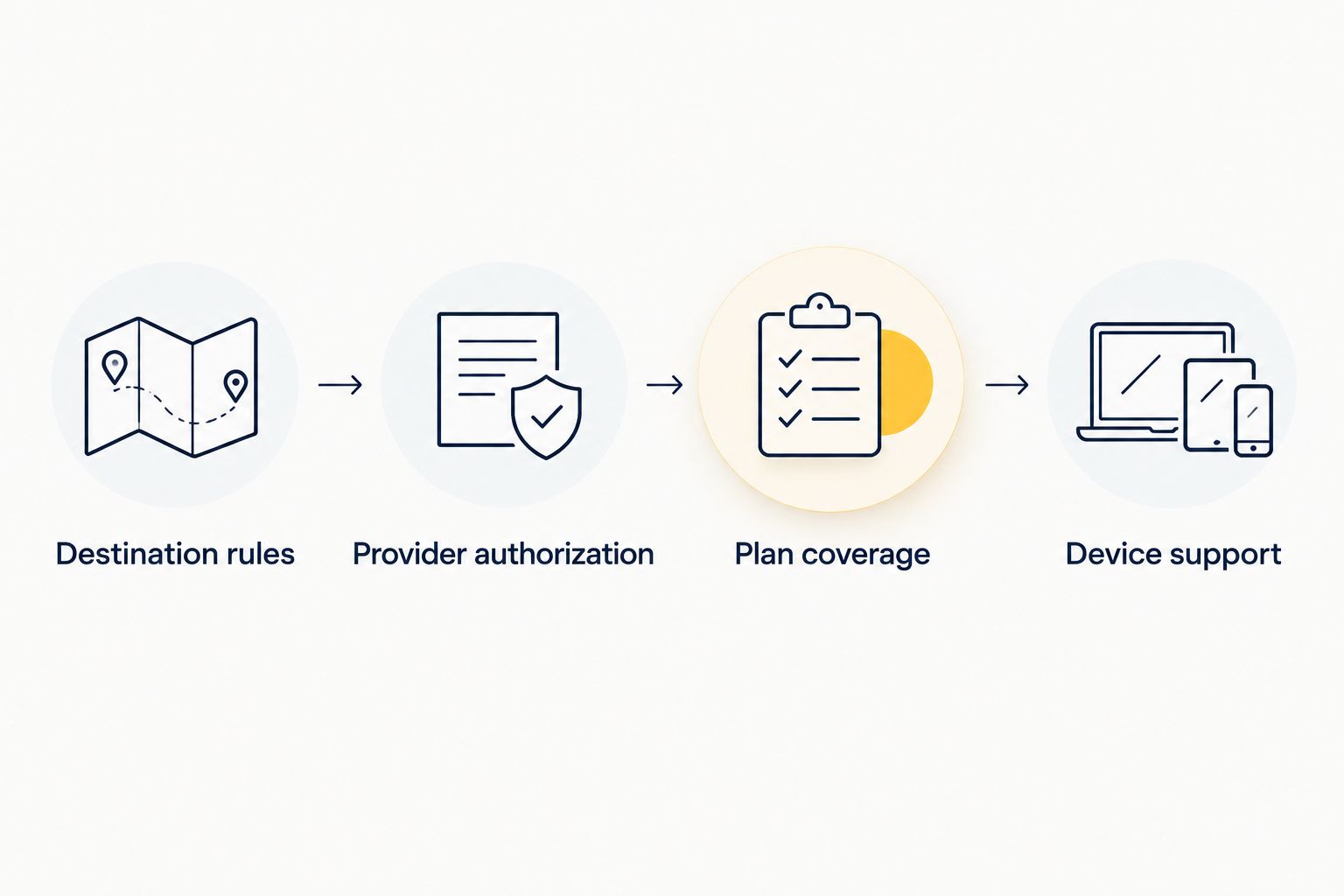
Use this sequence before you leave, especially if your trip crosses borders. It separates legal permission from the practical reasons a phone might fail to connect.
- Check destination rules. Look for current guidance from the destination’s telecommunications regulator or another official government source. Focus on visitor use, mobile-service registration and any rules that affect the type of plan you intend to buy.
- Check provider authorization. Ask the provider who supplies the mobile service at your destination and whether that service can be offered to visitors there. A sales page alone does not answer every local compliance question.
- Check plan coverage. Read the plan’s named destinations and service conditions. Confirm each place where you expect to connect rather than assuming a regional title covers your full itinerary.
- Check device support. Confirm your phone supports eSIM, accepts the intended provider and is not blocked by a carrier lock. This is a connection check, not a legal test.
Keep the answers distinct. If official guidance calls for registration, find out how the provider handles it. If the provider cannot confirm the destination, choose a service whose coverage and local requirements you can verify. If the rules and coverage check out but your phone will not connect, investigate device settings and carrier restrictions instead of assuming the service is prohibited.
For a trip in 2026, record the source and date of the local guidance you rely on. A page about general eSIM compatibility does not answer a destination-specific legal question. Likewise, a plan description that lists a country establishes a coverage claim; it does not, by itself, explain the local rules behind that service.
Why the answer varies by destination and plan
There is no useful worldwide yes-or-no list for every eSIM. The answer depends on the service being supplied and the rules at the place where you use it:
- Destination rules: Local authorities set the conditions for mobile services within their jurisdiction. Check the current official guidance for your stop, not only advice written for another country.
- Provider authorization: A service must be supplied through an arrangement that meets the applicable local requirements. Ask the provider about the service you will actually use.
- Registration requirements: Some destinations require identity or subscriber checks. Whether you can complete them as a visitor is a separate question from whether your phone supports eSIM.
- Plan coverage: A provider can offer an eSIM without including your destination in a particular plan. Check the plan itself, not just the provider’s list of destinations.
- Device and carrier restrictions: An unsupported or locked phone can prevent activation or connection. That failure does not, on its own, say anything about local law.
- Changes to your route: A connection that works at one stop does not establish that the same plan is permitted and covered at the next. Recheck when you add a destination.
The practical rule for 2026 is simple: verify the destination, the service and the device separately. Treat each answer as evidence for that question only. A compatible phone does not validate a plan; an advertised destination does not explain registration rules.
Does an installed eSIM mean I can legally use it abroad?
No. Installation shows that your phone accepted an eSIM profile; it does not establish that the plan is permitted for use at your destination. Check current local guidance, the provider’s terms and the plan’s coverage before relying on it abroad.
This matters when you install a plan at home for a later trip. The profile can sit on your phone while the relevant questions remain unanswered: where the service is supplied, whether your destination is included and what a visitor must do to use it. Resolve those questions before you need data, not after you arrive.
Is a travel eSIM legal if a physical SIM works there?
A working physical SIM does not prove that every travel eSIM can be used on the same terms. The services can have different providers, registration processes and coverage arrangements. Compare the specific plans against the destination’s current requirements rather than treating the SIM format as the deciding factor.
The reverse inference fails too. If one eSIM plan does not connect, that does not prove eSIM technology is banned. The plan might lack coverage, the device might be restricted, or activation might be incomplete. Identify which condition failed before drawing a legal conclusion.
What if my eSIM stops working after I cross a border?
First check whether the new destination appears in your plan’s coverage and whether the plan remains active. Then check your phone’s selected mobile-data line and the provider’s setup instructions. Do not use a connection failure as evidence of either a ban or legal permission.
If you are using an A-sim travel eSIM, the app can help you manage usage and top up. Those controls address your plan, not the destination’s rules. Before adding data, confirm the place you have entered is included in the service you intend to use.
What should you ask before choosing a travel eSIM?
Ask questions that produce an answer you can act on. A general assurance that eSIM works internationally is less useful than a clear answer about your route and the service you are buying.
- Is every destination on my itinerary named in this plan’s coverage?
- Which provider supplies the mobile service at each destination?
- Are there visitor identity or registration steps, and who completes them?
- Does the plan include the type of connection I need, rather than merely allowing installation?
- Will my phone accept this eSIM if it is locked to my home carrier?
- Where can I find current support instructions if the plan does not connect?
Use the answers to separate a legal question from a buying decision. Official local guidance is the place to verify requirements; the provider should explain its own service and coverage; your phone or home carrier can clarify device restrictions. No single compatibility badge answers all three.
For travelers weighing a home-carrier line against a travel eSIM in 2026, the best option is the one whose destination coverage and requirements you can confirm before departure. A-sim travel eSIMs offer app or website setup and usage management, but you still need to check the exact plan and destination before relying on one.
Check your travel eSIM options
Review destination coverage before choosing a plan.
FAQ
Is eSIM legal to use in every country in 2026?
No universal rule makes every eSIM plan legal to use in every country in 2026. Check the destination’s current rules and the specific provider’s service before traveling.
Can a country restrict a travel eSIM without banning eSIM technology?
Yes. Rules governing who supplies mobile service or how subscribers register are different from the phone’s ability to hold an eSIM profile. Check the requirements for the service you intend to use.
Does successful eSIM activation prove it is legal at my destination?
No. Activation confirms a device or account step, not compliance with local requirements. Verify the destination and plan separately.
Where should I check eSIM rules before an international trip?
Start with current guidance from the destination’s telecommunications regulator or another official government source. Then ask your provider how its specific plan meets any relevant requirements.
Can I use the same travel eSIM in every country on a regional trip?
Only rely on a travel eSIM at destinations included in that plan’s coverage and subject to applicable local rules. Check each stop before departure.
Is an eSIM illegal if it will not connect abroad?
No. A failed connection does not establish a legal ban. Check plan coverage, activation, device support and carrier restrictions before identifying the cause.
Does a carrier-locked phone change whether eSIM is legal?
A carrier lock affects whether your phone can use another provider’s service, not the destination’s mobile-service rules. Check both issues separately.
One last thing
The easiest mistake in 2026 is answering the wrong question. An eSIM is a format, not a passport for mobile service. Before departure, match each destination to current local requirements and to a named plan that covers it. Only then does phone setup become the next step.