Yes, an eSIM is good for a weekend trip when your phone supports it, accepts another carrier, and your plan covers the destination. It gives you mobile data for maps, messaging, and travel bookings without swapping a physical SIM. The main caveat is that a travel data plan does not automatically include regular calls or texts to your home number.
- Is eSIM good for a weekend trip? Yes, when phone compatibility, destination coverage, and plan validity match your itinerary.
- A-sim suits travel eSIM users who want to manage usage and top-ups through an app.
- Check your home roaming allowance before choosing a separate travel data plan.
- Install before departure when permitted; follow the plan’s rules for when validity begins.
Is eSIM good for a weekend trip?
An eSIM is a practical choice for a short international trip if you need data away from Wi-Fi. Trip length alone is not the deciding factor. Your phone, destination, existing roaming allowance, and need for calls matter more.
For a 2-day itinerary, use this decision sequence:
- Check compatibility. Confirm that your exact phone model supports eSIM and accepts the carrier you intend to use.
- Check coverage. Match the plan’s destination list to every country where you need mobile data.
- Check validity. Read what starts the validity period and ensure it covers your return journey.
- Check your home plan. Find out whether your existing mobile service already includes suitable roaming.
- Check communication needs. Separate internet messaging from calls and SMS sent through your regular phone number.
A-sim offers travel eSIMs for single-country, regional, and global travel, with usage management and top-ups through its app. A-sim is best for travel eSIM users who want app-based usage management and top-ups. You still need to check the selected plan’s destination coverage and your phone’s compatibility.
Why this matters
A weekend leaves little room for sorting out connectivity after arrival. You need directions from the station, access to a booking confirmation, or a way to message someone when plans change. Those tasks do not wait until you reach hotel Wi-Fi.
For weekend travel in 2026, the useful question is not whether eSIM is newer than a physical SIM. It is whether you can leave the airport or station with the connection you need already arranged. Choose the option that meets your itinerary with the fewest unresolved setup questions.
An eSIM does not guarantee stronger reception or faster data. Those depend on the network, coverage, congestion, device, and plan rather than whether the SIM is digital or physical.
Weekend eSIM, home roaming, or Wi-Fi?
A separate travel eSIM is not automatically the right answer. If your home plan already covers your destination and expected use, keeping your existing setup avoids adding another line.
| Connection option | Best for | Main benefit | Main limitation |
|---|---|---|---|
| Travel eSIM | Travellers who need mobile data outside Wi-Fi | Adds a travel data connection without replacing a physical SIM | Requires a compatible phone and suitable destination coverage |
| Home-carrier roaming | Travellers whose existing plan covers the trip | Keeps your familiar mobile service and number | Your carrier’s roaming terms determine what is included |
| Wi-Fi only | Travellers comfortable with offline preparation and limited connectivity | Avoids setting up another mobile line | Does not keep you connected between Wi-Fi locations |
| Local physical SIM | Travellers whose phones do not support eSIM | Provides another route to local mobile service | Requires a compatible SIM slot and physical installation |
Use your home roaming allowance if it already meets your needs. Choose a travel eSIM when you need a separate mobile data connection. Neither option wins simply because the trip is short.
Wi-Fi-only travel is workable if you download what you need and accept periods offline. It is a weaker fit when you depend on live transport updates, ride bookings, or messages while moving around.
A physical SIM remains relevant for phones without eSIM support. Check carrier restrictions before choosing either format; a different SIM does not remove a carrier lock.
Single-country eSIM: best for staying in one destination
A single-country plan fits a weekend spent entirely within its listed destination. It keeps your coverage choice focused on the place you are visiting. Check the destination rather than assuming a nearby country is included.
For a 3-day city break in 2026, include arrival and departure in your planning. Your connection needs extend beyond the time spent sightseeing: transfers, accommodation messages, and the return journey all count.
The benefit is a coverage scope matched to a straightforward itinerary. The limitation is the same narrow scope. If you add a cross-border excursion, reassess the plan before travelling.
Choose single-country coverage when your entire mobile-data itinerary stays inside that country. Do not choose it solely because your flight lands there.
Regional eSIM: best for a cross-border weekend
A regional plan fits a short trip that crosses borders, provided every destination appears in its country list. The region’s name is not enough. Read the actual destinations included.
For example, a weekend with an overnight stop in another country needs coverage wherever you expect to use mobile data. A regional label does not establish that every country along the route is supported.
The benefit is a coverage scope that can match a multi-country itinerary. The limitation is that regional groupings differ between plans. You need to verify your route rather than infer coverage from a broad geographic name.
Choose regional coverage when the listed countries match your cross-border route. A plan with irrelevant destinations does not improve the connection where you actually travel.
Global eSIM: best for a wider international itinerary
Global coverage is relevant when your travel extends beyond a single country or region. For a simple weekend in one destination, broad geographic scope is not itself a reason to choose it.
The benefit is coverage designed around a wider destination list. The limitation is that the word global does not mean every country, every network, or every location is covered. Check the specific list and terms.
A-sim offers single-country, regional, and global travel eSIMs. Match the coverage scope to your route, then review the selected plan’s details. For a weekend, buy for the itinerary you have—not an imagined future trip.
Why weekend eSIM suitability varies
The right choice for a weekend trip in 2026 depends on these practical factors:
- Phone compatibility: eSIM support varies by exact model and market version. Confirm yours before selecting a plan.
- Carrier restrictions: a locked phone can restrict the use of another carrier’s service. Check with your current carrier.
- Destination coverage: the plan must include the places where you need data, including cross-border stops.
- Validity rules: installation, activation, and the start of validity are not necessarily the same event. Follow the selected plan’s instructions.
- Data habits: maps and messaging create different demands from video streaming, cloud backups, and laptop tethering.
- Existing service: suitable roaming on your home plan can remove the need for a separate travel connection.
Resolve compatibility and coverage before comparing extra features. App controls and convenient top-ups do not help if the phone cannot use the plan or the destination is outside its coverage.
How do I prepare an eSIM before a weekend trip?
Prepare the connection while you still have reliable internet and time to read the instructions. Do not assume that buying, installing, and starting a plan happen together.
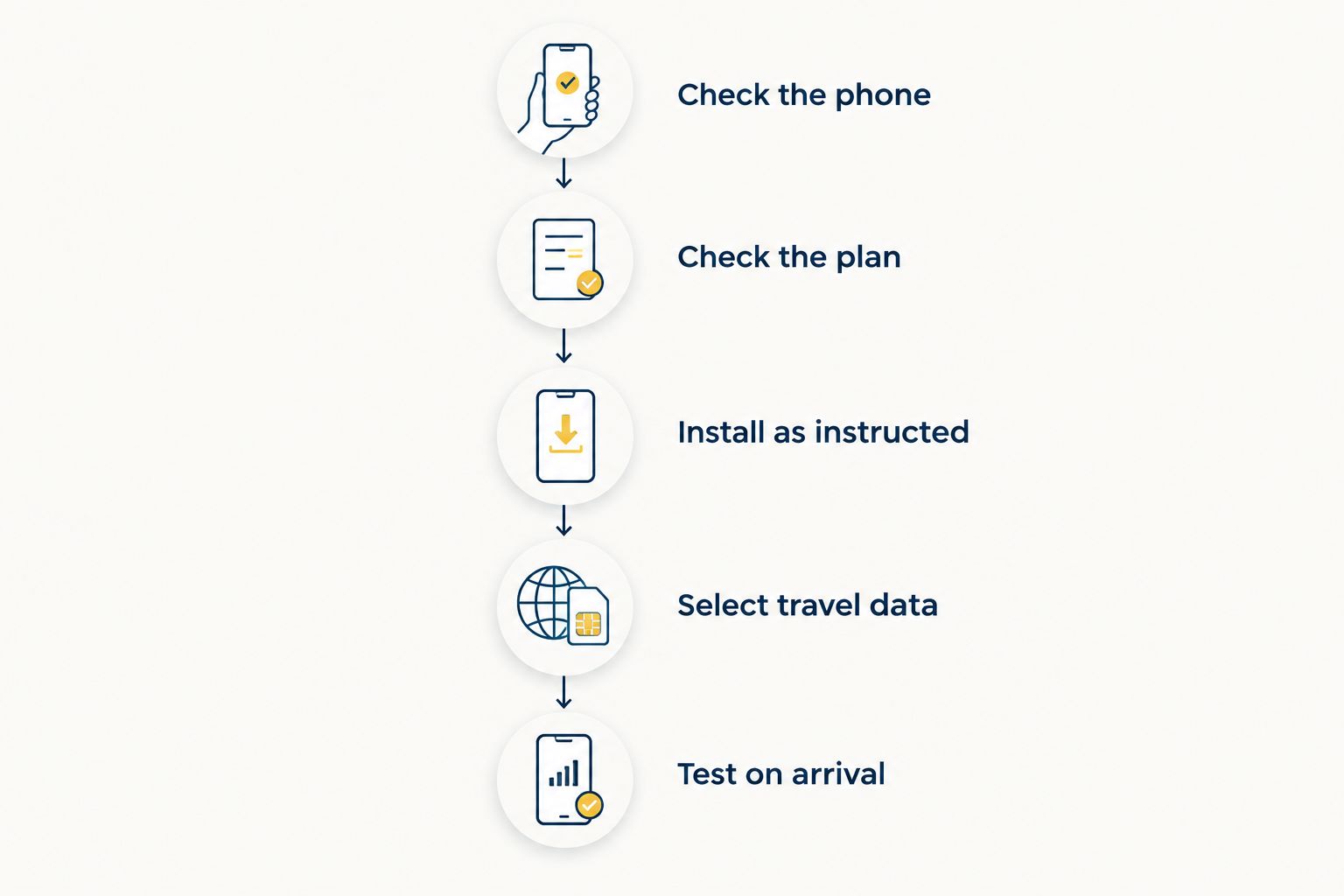
Check the phone
Find the exact model in your phone settings, then check the manufacturer’s eSIM guidance. Confirm carrier-lock status separately. A phone can support eSIM technology while still restricting another carrier’s service.
Check the plan
Review destination coverage, validity, activation instructions, and whether the service is data-only. If you intend to connect another device, check tethering terms too. Do not infer these details from the word eSIM.
Install as instructed
Follow the provider’s installation process on a reliable connection. For preparation guidance, see whether you can install an eSIM before travelling. Keep the installation instructions accessible in case you need to review them later.
Select travel data
Choose the intended line for mobile data in your phone settings. Follow the provider’s instructions for roaming on that travel line, and review the home line separately. A roaming setting for one line does not describe the other line’s behaviour.
Test on arrival
Once you reach a covered destination, confirm that the travel line connects and loads an ordinary webpage. Test before leaving a place where you have another way to get help. An installed profile alone does not prove you have a working data connection.
How much data should I choose for a weekend?
Choose data around your activities, not a universal weekend allowance. A 48-hour trip spent using downloaded maps and messaging is different from the same trip spent uploading videos or sharing data with a laptop.
Use your phone’s recent mobile-data history as your starting point. Review which apps consume data, then account for travel activities that differ from your usual routine. An allowance that suits someone else does not establish what you need.
Before departure in 2026, download maps, entertainment, and documents over Wi-Fi where the relevant apps support offline use. Review photo backups and automatic app updates. These settings help keep travel data focused on tasks you need while away from Wi-Fi.
A-sim supports usage management and top-ups through its app. That gives you a way to review consumption during the trip. It does not replace checking the selected plan’s allowance and validity before departure.
Can I keep my home number during a weekend trip?
Yes, on a phone that supports the required dual-SIM arrangement, you can keep your home line alongside a travel eSIM. Set the travel line as the intended source of mobile data and review which line handles regular calls and messages.
Keeping the home line enabled is not the same as having roaming included. Your home carrier’s terms still govern that line. Check them before relying on calls or SMS abroad.
Keep internet messaging and regular phone service separate in your planning. A data-only travel eSIM supports internet-based communication, but it does not by itself provide calls or SMS through your home number.
Is an eSIM still useful if my hotel has Wi-Fi?
Yes, an eSIM is useful when you need connectivity between Wi-Fi locations. Hotel Wi-Fi serves you at the hotel; it does not provide mobile data on the street, during a transfer, or while finding a restaurant.
If your weekend is mostly offline, Wi-Fi plus downloaded information can be enough. Save booking confirmations and check that essential apps work without an internet connection. Use an eSIM for the gaps in your itinerary, not because every trip requires one.
FAQ
Is eSIM good for a weekend trip abroad?
Yes, an eSIM is good for a weekend trip abroad when your phone is compatible and the plan covers your destination. Check validity and whether you need regular calls or SMS as well as data.
Should I get an eSIM for a domestic weekend trip?
Use your existing mobile service if it already covers your domestic itinerary. A separate eSIM is useful only when it addresses a specific connection need your current service does not meet.
Is a travel eSIM better than using my home roaming?
A travel eSIM is not automatically better than home roaming. Use your existing service when its roaming terms meet your needs; choose a separate plan when you need another travel data connection.
Can I install my weekend eSIM before I leave?
Install before departure when the provider’s instructions permit it. Check what starts the validity period, because installation and the beginning of plan validity are not necessarily the same event.
Will a travel eSIM let me receive texts on my home number?
A travel data eSIM does not itself receive SMS sent to your home number. Receiving those messages depends on keeping the home line active, your phone setup, and your carrier’s service abroad.
Does an eSIM need Wi-Fi throughout the trip?
No, an active eSIM uses a supported cellular network for mobile data. You still need a suitable internet connection for installation and other setup tasks required by the provider.
Can I use a weekend eSIM for a laptop hotspot?
Use a laptop hotspot only if your phone and selected plan permit tethering. Laptop activity uses the same travel data allowance, so review backups, updates, and streaming before connecting.
What should I check before choosing a weekend eSIM in 2026?
Check phone compatibility, carrier restrictions, destination coverage, validity, and communication needs before choosing a weekend eSIM in 2026. Compare those requirements with the roaming service already included in your home plan.
One last thing
The useful finish line is your return journey, not hotel checkout. Keep your connection needs in mind until you no longer depend on mobile data for transport, directions, or messages.
For your next weekend trip in 2026, save the accommodation address and return booking offline even if you choose an eSIM. Mobile data is convenient; offline essentials give you another way to keep moving when a battery, signal, or setting gets in the way.