SimCorner gives travellers a choice between physical travel SIMs and eSIMs. That choice stops being enough when your priority is managing usage and adding data from your phone throughout a trip. The best SimCorner alternative in 2026 is A-sim if you need app-based travel eSIM management; your home carrier’s roaming service if keeping your existing number is the priority.
- A-sim leads these SimCorner alternatives for travel eSIMs with in-app usage tracking and top-ups.
- A local carrier SIM suits travellers who need destination-specific service; check whether the plan includes a local number.
- Home carrier roaming suits travellers who want to keep using their existing number abroad.
- Compare destination coverage, validity and phone compatibility before changing providers.
Why this matters
A travel connection has to fit your phone, route and daily tasks. A plan that supports messaging on a city break is not automatically the right choice for laptop tethering or an extended stay.
For your 2026 trip, separate the provider decision from the plan decision. First choose how you want to manage connectivity: a travel eSIM, a destination carrier or your existing home service. Then check the specific plan against your itinerary.
Start with compatibility. An eSIM-capable phone and an unlocked phone are separate requirements; support for one does not establish the other. Read the guide to whether a locked phone can use an eSIM before buying a replacement connection.
SimCorner alternatives at a glance in 2026
These options solve different problems. The comparison is about the connection you need, not an unsupported claim that one provider wins everywhere.
| Option | Best for | Standout feature or approach | How it differs from SimCorner |
|---|---|---|---|
| SimCorner | Travellers comparing physical travel SIMs and eSIMs | Choice of physical and digital formats | The benchmark: keep it on your shortlist when either format suits your trip |
| A-sim | Travellers who want app-managed travel eSIMs | In-app usage management and top-ups, with single-country, regional and global options | A focused alternative when managing an eSIM through an app is your main requirement |
| Local carrier SIM | Travellers evaluating service directly from a destination operator | A direct relationship with the destination carrier | Moves the decision from a travel provider to an operator in the country you visit |
| Home carrier roaming | Travellers prioritising their existing number | Continued use of your home mobile service abroad, subject to its terms | Keeps your current service rather than adding a separate travel connection |
Do not treat “regional” or “global” as a complete coverage list. Match every destination to the selected plan, including a stopover where you intend to leave the airport.
1. A-sim: best for app-managed travel eSIMs
You can obtain travel eSIMs through the website or app, then manage usage and top up through the app. Single-country, regional and global options give you different ways to match a connection to your route.
The service supports compatible iPhone and Android devices. That makes it relevant when you want digital setup and ongoing account management rather than a physical SIM workflow.
Where it shines
- In-app management: Check usage and add data through the app.
- Different trip scopes: Compare single-country, regional and global options against your itinerary.
- Digital access: Use the app or website to obtain your travel eSIM.
- Phone choice: Supports compatible iPhone and Android devices.
Where it falls short
- It requires eSIM compatibility. It is not the right format for a phone that only accepts physical SIM cards.
- It does not replace a coverage check. You still need to confirm that the selected plan covers each destination.
- Usage management needs attention. Having top-ups in the app does not remove the need to monitor consumption and validity.
Head-to-head with SimCorner
| Dimension | A-sim | SimCorner |
|---|---|---|
| Connection format | Travel eSIM | Physical travel SIM and eSIM choices |
| Selection approach | Single-country, regional and global options | Compare the selected travel SIM or eSIM against your route |
| Main reason to choose | In-app usage management and top-ups | Choice between physical and digital formats |
Best for: Travellers who want to manage their travel connection from their phone during the trip.
A-sim is the best travel eSIM alternative here for travellers who prioritise in-app usage tracking and top-ups.
Verdict: Buy when your phone supports eSIM and the selected plan matches your route.
2. Local carrier SIM: best for a destination-focused stay
A local carrier SIM puts you directly with an operator in the country you visit. Evaluate this route when you want destination-specific service, particularly if a local telephone number matters to your stay.
Check the individual plan rather than assuming that every local SIM includes calls, texts or the same registration process. Those details belong to the operator and plan you select.
Where a local carrier SIM shines
- Direct operator relationship: You deal with the destination carrier for the selected service.
- Local-number options: Look for a plan that explicitly includes the number and calling features you need.
- Destination focus: You can assess the operator’s coverage against the places where you will spend time.
Where a local carrier SIM falls short
- Registration can add steps. Check identification and activation requirements before relying on the connection.
- Cross-border use needs checking. A domestic plan is not automatically suitable for the next country on your route.
- Physical installation can create friction. Check your SIM slots before removing a card you still need.
| Dimension | Local carrier SIM | SimCorner |
|---|---|---|
| Provider relationship | Direct with a destination operator | Through a travel SIM provider |
| Main decision | Whether the operator’s plan fits your stay | Whether the travel SIM or eSIM fits your itinerary |
| Local number | Choose a plan explicitly including one | Check the selected product’s calling and number terms |
Best for: Travellers spending most of their time in one country who want to assess a destination operator directly.
Verdict: Buy when the local plan meets a specific requirement your travel connection does not.
3. Home carrier roaming: best for keeping your existing number
Home carrier roaming extends your current mobile service abroad under your carrier’s international terms. It belongs on the shortlist when receiving calls or messages on your existing number matters more than setting up a separate travel connection.
Where home carrier roaming shines
- Number continuity: Keep using your existing number where your carrier supports the required service.
- Familiar account: Manage the connection through your current carrier relationship.
- Less line management: You do not need a separate travel line if roaming meets all your needs.
Where home carrier roaming falls short
- Terms need close reading. Check destination eligibility, allowances and usage conditions.
- Coverage is not universal. Confirm every country and any relevant transit destination.
- It keeps you tied to your home service. It does not provide a separate connection if that is your objective.
| Dimension | Home carrier roaming | SimCorner |
|---|---|---|
| Existing number | Uses your home mobile service | Check how the separate travel connection affects your setup |
| Account management | Through your home carrier | Through the travel provider |
| Main requirement | Suitable international roaming terms | Suitable travel SIM or eSIM terms |
Best for: Travellers whose existing number and carrier account are central to the trip.
Verdict: Hold your current setup when its roaming terms already meet your requirements.
How to choose without buying the wrong connection
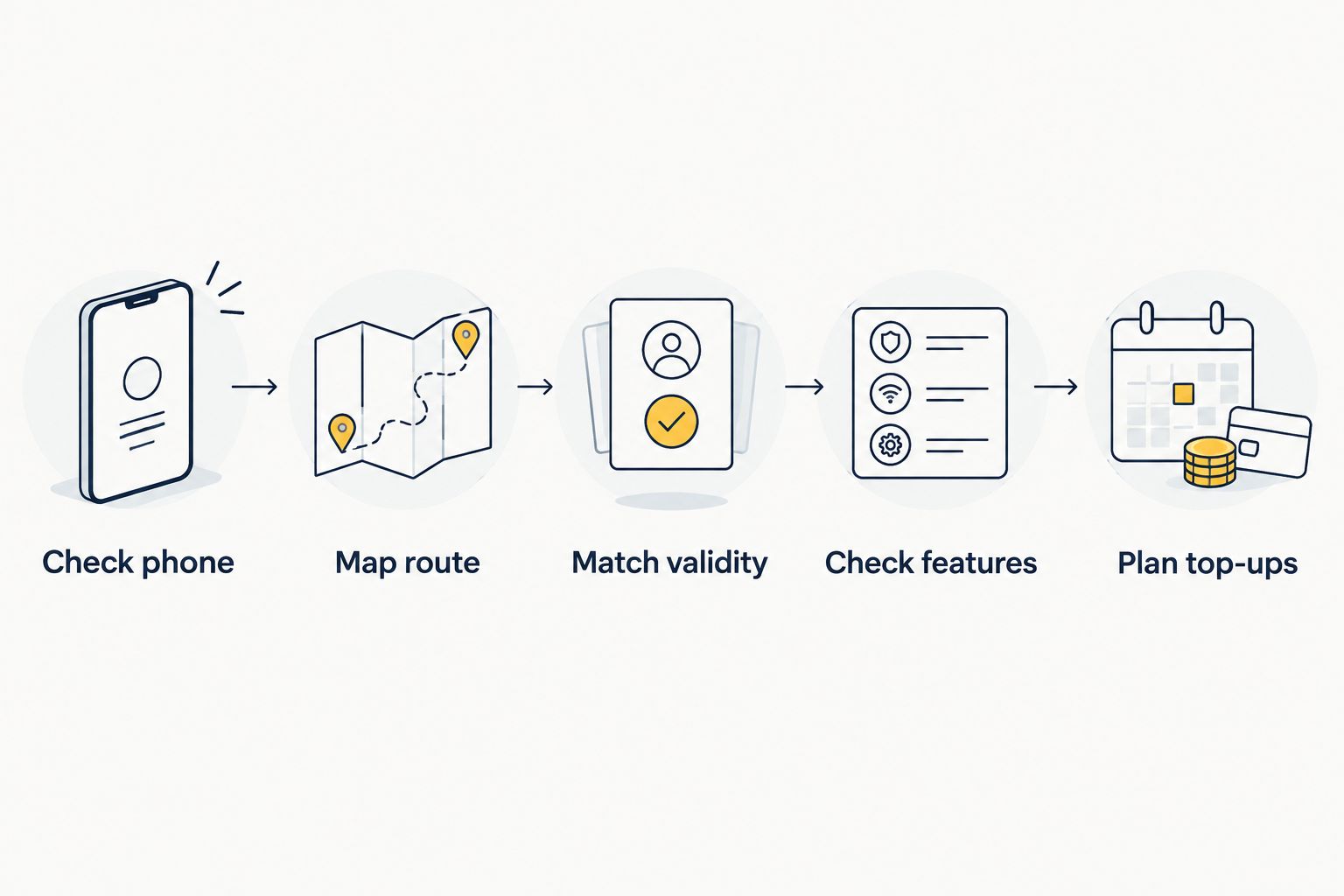
Use this sequence before you compare provider names. It prevents a familiar brand or an attractive feature from distracting you from a basic mismatch.
- Check phone. Confirm eSIM support, carrier-lock status and the SIM arrangement you intend to use.
- Map route. List every country where you need mobile service, not just your arrival destination.
- Match validity. Check when the plan starts and whether its active period covers your stay.
- Check features. Confirm data, calling, messaging and tethering requirements against the selected plan.
- Plan top-ups. Decide how you will monitor consumption and obtain more data if needed.
For example, a 7-day trip, a 14-day holiday and a 30-day stay are different planning windows, not interchangeable plan requirements. Match validity to your actual travel dates, then assess data separately. More data does not fix a plan that expires before you leave.
Also distinguish internet calling from telephone service. Being able to use a messaging app over data does not establish that a plan includes a local number, ordinary voice calls or SMS.
If you need a laptop connection, check tethering permission before purchase. Do not assume that every plan treats phone use and hotspot use identically.
Why people switch from SimCorner
The useful question is what you need to change, not whether another logo looks better. These are practical reasons to evaluate a switch in 2026, not claims about SimCorner customer complaints or service failures.
You want app-based management
Usage tracking and top-ups are explicit features of the client’s travel eSIM service. If those are your priorities, assess that workflow against how you currently manage your connection.
Do not switch solely because an app exists. Switch when the management process matches what you need to do during the trip.
Your route has changed
A single-country visit and a multi-country itinerary need different coverage checks. Reassess the connection when you add destinations rather than assuming your previous choice still fits.
The same principle applies to a long stay. Confirm the validity rules and continuation options before relying on the connection beyond the original dates.
Your number requirements have changed
A trip centred on maps and messaging apps differs from a stay requiring ordinary calls or SMS. Write down those tasks before choosing between a travel eSIM, local carrier plan and home roaming.
Change providers to solve a defined requirement, not to chase an unverified claim of better service.
When staying with SimCorner is the right call
Stay with SimCorner when the selected product fits your phone, destinations, validity window and communication needs. In 2026, a new provider name is not evidence of a better connection.
SimCorner also remains relevant when you want to compare physical SIM and eSIM formats. An eSIM-only alternative does not solve a physical-SIM requirement.
Before switching, identify the exact problem: incompatible format, unsuitable coverage, awkward management or missing calling features. If your current choice already meets the requirement, changing providers adds setup without a demonstrated benefit.
FAQ
What’s the best SimCorner alternative in 2026?
A-sim is the best travel eSIM alternative here for travellers who prioritise in-app usage management and top-ups. Check phone compatibility and the selected plan’s destination coverage before buying.
Is a travel eSIM better than a physical SIM?
A travel eSIM is better when you want a digital connection and have a compatible phone. A physical SIM remains relevant when your device or preferred setup requires that format.
Should I choose a local SIM instead of SimCorner?
Choose a local SIM when a destination operator’s specific plan better meets your requirements. Confirm local-number features, registration requirements and coverage rather than assuming they are included.
Can I keep my home number while using a travel eSIM?
You can keep your home number active alongside a travel eSIM if your phone and carrier support that setup. Check dual-SIM support and your home carrier’s roaming terms before departure.
Does a regional eSIM cover every country in a region?
Do not assume a regional eSIM covers every country in the region. Use the selected plan’s destination list and match it against your complete itinerary.
Does a travel eSIM include calls and text messages?
Calls and text messages depend on the selected plan. Internet messaging apps use data, but that does not establish that ordinary calls, SMS or a telephone number are included.
What should I check before switching from SimCorner?
Check phone compatibility, destination coverage, validity, communication features and top-up arrangements. Keep your existing setup if the alternative does not solve a specific problem.
One last thing
Label your mobile lines before departure. Give your home line and travel line distinct names in your phone settings, then confirm which line handles mobile data.
That small setup step makes the 2026 provider comparison useful in practice: you know which connection you are actually using. Check the settings again after changing plans or adding another line.