Sim Local combines travel eSIMs with airport retail assistance, making it useful when you want help before departure. That model stops being the deciding factor when you want to buy digitally, track usage yourself and add data during a trip. The best Simlocal alternative in 2026 is A-sim if you need app-managed travel data; home-carrier roaming is the better starting point if keeping your existing service is the priority.
- Among Simlocal alternatives, A-sim suits travellers who want travel eSIMs with app-based usage tracking and top-ups.
- Home-carrier roaming suits travellers who prefer using their existing service, subject to their carrier’s destination terms.
- A local carrier suits travellers who need a destination-specific mobile service, particularly a local number.
- Stay with Sim Local when its chosen plan fits your trip and airport assistance matters to you.
Why this matters
A travel connection has to match your route, phone and everyday tasks. An easy purchase does not settle whether you can receive a verification text, connect a laptop or use the service in your next country.
For a 2026 trip, compare the service you will actually use—not just the provider name. Separate mobile data from ordinary calls and SMS, then check each requirement against the exact plan. That prevents a convenient purchase from becoming the wrong connection.
Simlocal alternatives at a glance
The options below solve different problems. A travel eSIM focuses on connectivity abroad; home roaming extends your existing carrier service; a local carrier provides service for the destination where it operates.
| Option | Best for | Standout feature | How it differs from Sim Local |
|---|---|---|---|
| A-sim | Self-managed travel data | Website or app purchase, usage management and in-app top-ups | A digital purchase-and-management option rather than a choice based on airport retail help |
| Home-carrier roaming | Keeping your existing mobile service | Uses your current carrier account and number | Starts with the service already on your phone |
| A local mobile carrier | Destination-specific service | Direct relationship with a carrier in the country you visit | Requires choosing a local service rather than a travel-focused provider |
| Sim Local | Travellers who value airport retail assistance | Travel connectivity with a physical retail presence | The benchmark: stay if its plan and purchase experience meet your needs |
There is no universal winner across these options. Compare the destination list, validity rules and included services before treating any provider as a replacement.
1. A-sim: best for app-managed travel data
A-sim offers travel eSIMs for single countries, regions and international itineraries. You can purchase through its website or app, manage usage in the app and top up there. It is the strongest fit here when you want to manage travel data yourself rather than make retail assistance the reason for choosing a provider.
Best for: Travellers who want digital purchasing, usage tracking and top-ups in an app.
Where it shines
- Purchase flexibility: Start through the website or app, depending on how you prefer to arrange your trip.
- Different trip shapes: Choose between country, regional and global options, then check the destinations included in the specific plan.
- Usage visibility: Manage consumption through the app instead of relying only on your phone’s general data counter.
- In-trip management: Add data through the app when you need a top-up.
Where it falls short
- Your phone must support travel eSIM use. An incompatible or carrier-restricted device is a purchase blocker, not a setup inconvenience.
- Data management is not a substitute for checking call requirements. If you need ordinary calls, SMS or a local number, confirm those separately before choosing a plan.
- A regional or global label is not an itinerary guarantee. Check every destination against the selected plan, including stopovers where you need connectivity.
Head-to-head with Sim Local
| Dimension | A-sim | Sim Local |
|---|---|---|
| Buying route | Website or app | Digital purchase and airport retail channels |
| Main reason to choose | App-based usage management and top-ups | A suitable travel plan, with airport retail assistance where offered |
| Destination decision | Country, regional or global options | Check the chosen plan against your route |
| Phone requirement | Compatible device that permits the service | Compatible device that permits the chosen eSIM service |
Before buying, check your exact phone model and carrier restrictions. The guide to using an eSIM on a locked phone addresses a compatibility question that matters more than the provider ranking.
Verdict: Buy when self-managed travel data is your priority and the selected plan matches your phone and route.
2. Home-carrier roaming: best for keeping your existing service
Home-carrier roaming is the first alternative to check when your current number matters more than changing providers. You keep the carrier relationship you already have and use its international service under the applicable roaming terms. The decision depends on your destination and account—not on whether roaming is inherently better or worse than a travel eSIM.
Best for: Travellers who want to keep using their existing mobile service abroad.
Where home-carrier roaming shines
- Account continuity: You manage the service through your current carrier.
- Number continuity: Your existing number remains the line associated with that service.
- Less provider switching: You do not need to choose a separate travel-data provider if your carrier’s international service meets your needs.
Where home-carrier roaming falls short
- Terms need close attention. Check destination eligibility, data allowances and how usage is billed before departure.
- Your itinerary can cross different roaming rules. Do not assume every stop falls under the same arrangement.
- Keeping the line active does not settle every feature. Confirm calls, incoming texts and data separately with your carrier.
Head-to-head with Sim Local
| Dimension | Home-carrier roaming | Sim Local travel eSIM |
|---|---|---|
| Account | Existing home-carrier account | Separate travel service |
| Number | Existing home number | Check whether the selected plan includes a number |
| Setup decision | Confirm roaming eligibility and settings | Confirm compatibility, installation and activation rules |
| Main check | Your account’s international terms | The selected travel plan’s terms |
For a hypothetical 7-day trip in 2026, start by checking what your existing account already permits. Do not buy a separate connection merely because it appears on an alternatives list.
Verdict: Hold your current service if its international terms meet your trip requirements.
3. A local mobile carrier: best for destination-specific service
A local carrier deserves a place on your shortlist when you need service centred on a particular country, especially a local number. Choose the plan for the functions you need, not simply because it is local. Registration, eligibility and service terms differ by destination and carrier.
Best for: Travellers who need a destination-specific mobile service and are prepared to check local requirements.
Where a local carrier shines
- Local-service focus: You can assess plans designed for the country where you will spend your time.
- Number requirements: A plan that explicitly includes a local number can address needs that data alone does not.
- Longer stays: It is a relevant option to assess when your trip starts resembling a temporary move.
Where a local carrier falls short
- More destination-specific research: Check registration requirements, phone compatibility and account management before committing.
- Cross-border use needs a separate check: A domestic plan is not automatically a multi-country travel plan.
- A local number does not replace your home number: Keep access to any home-line services you still require.
| Dimension | Local mobile carrier | Sim Local travel eSIM |
|---|---|---|
| Main focus | Service in the destination country | Connectivity arranged for travel |
| Local number | Select a plan that explicitly includes one | Check the selected plan’s inclusions |
| Multi-country route | Confirm international-use terms | Confirm covered destinations |
For a hypothetical 30-day stay, put local-number needs and account administration on your checklist alongside data. Neither the length of the stay nor the word local decides the result by itself.
Verdict: Buy only when the local service answers a requirement your travel-data option does not.
Why people switch from Sim Local
A useful reason to switch is a specific requirement another option meets. The criteria below are decision triggers, not claims about Sim Local customer behaviour or shortcomings.
- You want app-based data management. Choose around the ability to check usage and handle top-ups during the trip.
- You need your existing mobile service. Review home roaming before adding another provider.
- You need a local number. Compare plans that explicitly include the calling and messaging functions you require.
- Your route has changed. Recheck every destination rather than assuming the original plan still fits.
For 2026 travel, write down the reason before switching. If the reason is simply that another provider appears higher in a list, you have not identified a benefit yet.
Choose by route, then by phone, then by features
Start with the itinerary. A hypothetical 14-day trip across several countries needs a destination-by-destination check, while a single-country stay needs a closer look at service for that country.
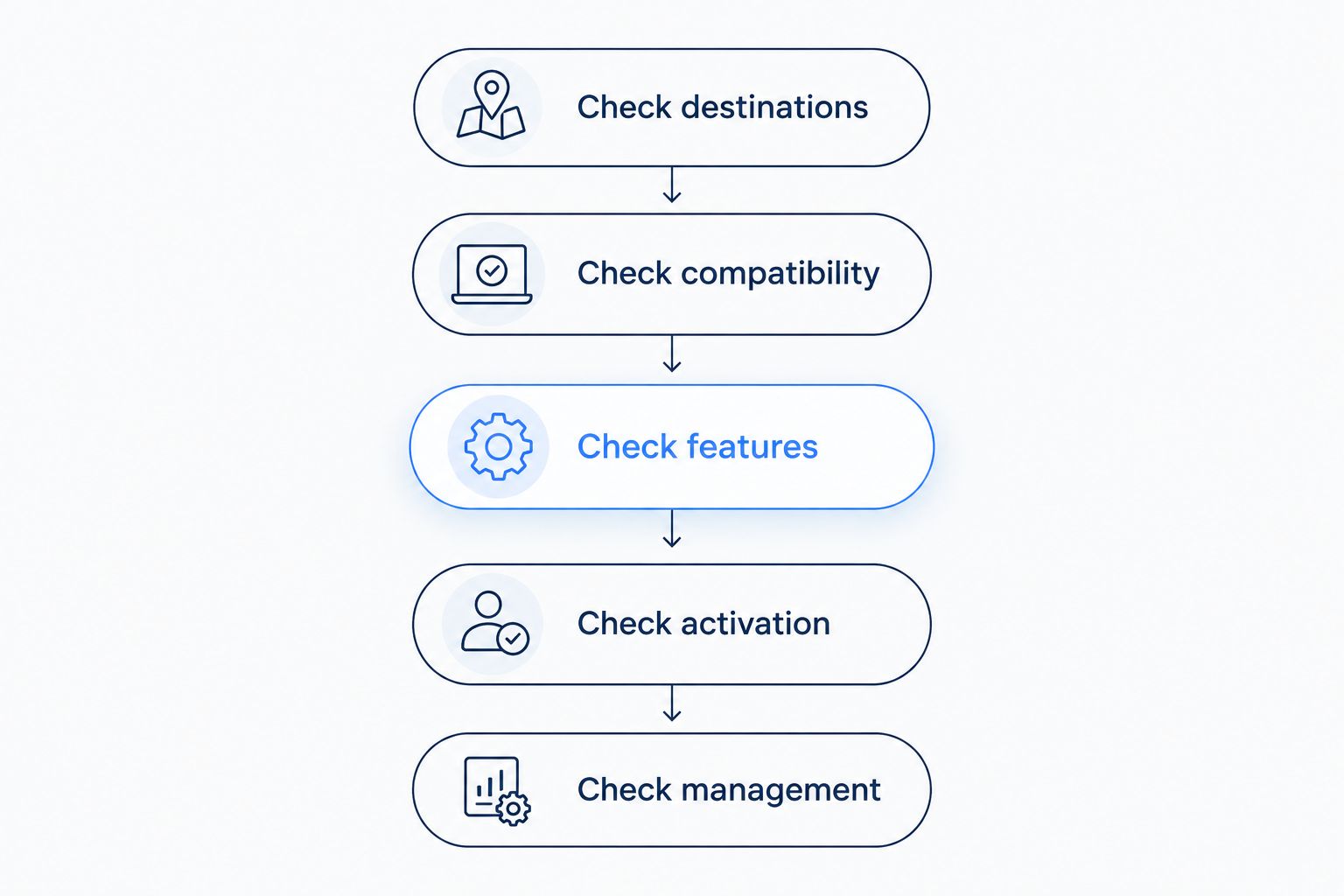
Use this sequence before buying:
- Check destinations: List every place where you need mobile data, including meaningful stopovers.
- Check compatibility: Confirm the exact device supports eSIM and permits another provider’s service.
- Check features: Identify whether you need data, ordinary calls, SMS, a local number or hotspot use.
- Check activation: Read when validity starts and what installation requires.
- Check management: Decide how you will monitor usage and obtain more data.
Installation and activation are separate questions. Read the plan’s instructions before installing, and confirm what event starts its validity period; do not assume purchase, installation and first use mean the same thing.
Also check the phone settings you will use after arrival. Selecting a travel line for mobile data does not, by itself, establish how your home carrier handles calls, texts or roaming.
When staying with Sim Local is the right call
Stay with Sim Local when its selected plan fits your route, your phone supports it and its purchase experience suits you. Airport assistance is a legitimate reason to prefer a provider, particularly when you want help choosing or setting up connectivity.
A 2026 alternatives guide should not turn a working service into a problem. Change providers to solve a defined need; keep the current choice when it already meets that need without adding unnecessary administration.
FAQ
What is the best Simlocal alternative in 2026?
A-sim is the best fit here for travellers who want travel eSIMs with app-based usage management and top-ups. Home-carrier roaming is the better starting point when keeping your existing mobile service matters most.
Should I use a travel eSIM or my home carrier abroad?
Use a travel eSIM for a separate travel connection, or home-carrier roaming when your existing service meets your international needs. Check destinations, included services and account terms before choosing.
Can I keep my home number while using a travel eSIM?
You can keep your home number active alongside a travel eSIM on a phone that supports the required dual-SIM setup. Confirm device support and your home carrier’s charges for any calls, texts or roaming use.
Will a travel eSIM work on a locked phone?
A carrier lock can prevent a phone from using another provider’s eSIM. Confirm the device’s lock status and your carrier’s restrictions before buying.
Does a travel eSIM include a local phone number?
A travel eSIM does not automatically include a local phone number. Read the selected plan’s inclusions and choose a service that explicitly supports the calls or SMS you need.
Is a regional eSIM enough for a multi-country trip?
A regional eSIM fits only when its destination list covers the places where you need service. Check every country and the plan’s validity rules rather than relying on the regional label.
When should I stay with Sim Local instead of switching?
Stay with Sim Local when its plan meets your destination, device and service requirements. Its airport retail assistance is also a valid reason to keep it on your shortlist.
One last thing
Do not delete an installed eSIM as your first troubleshooting step. Reinstallation rules differ by provider and plan, so check the instructions before removing the profile. First confirm the selected data line, the plan’s activation state and the required roaming settings.
That small precaution matters after landing. Keep the installation instructions accessible before departure, along with a way to reach the provider if the connection does not work.